 English
 中文简体
中文简体
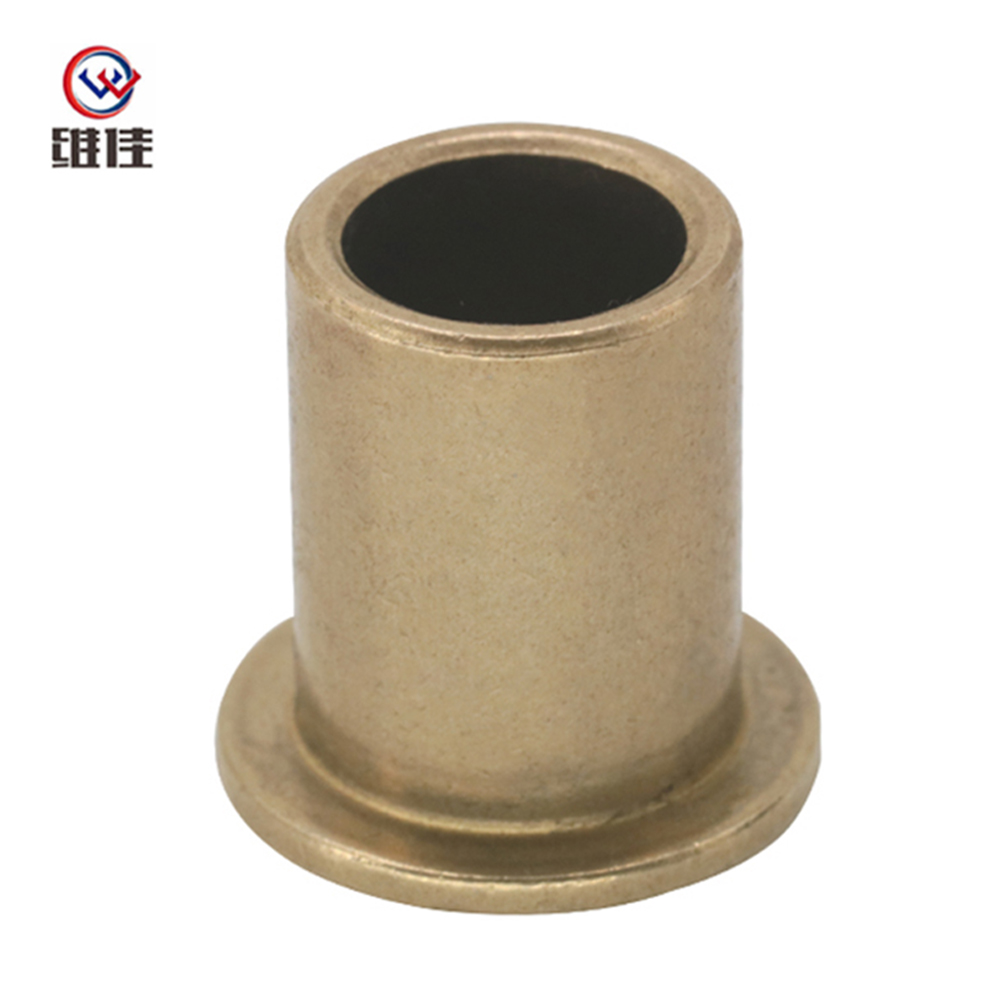
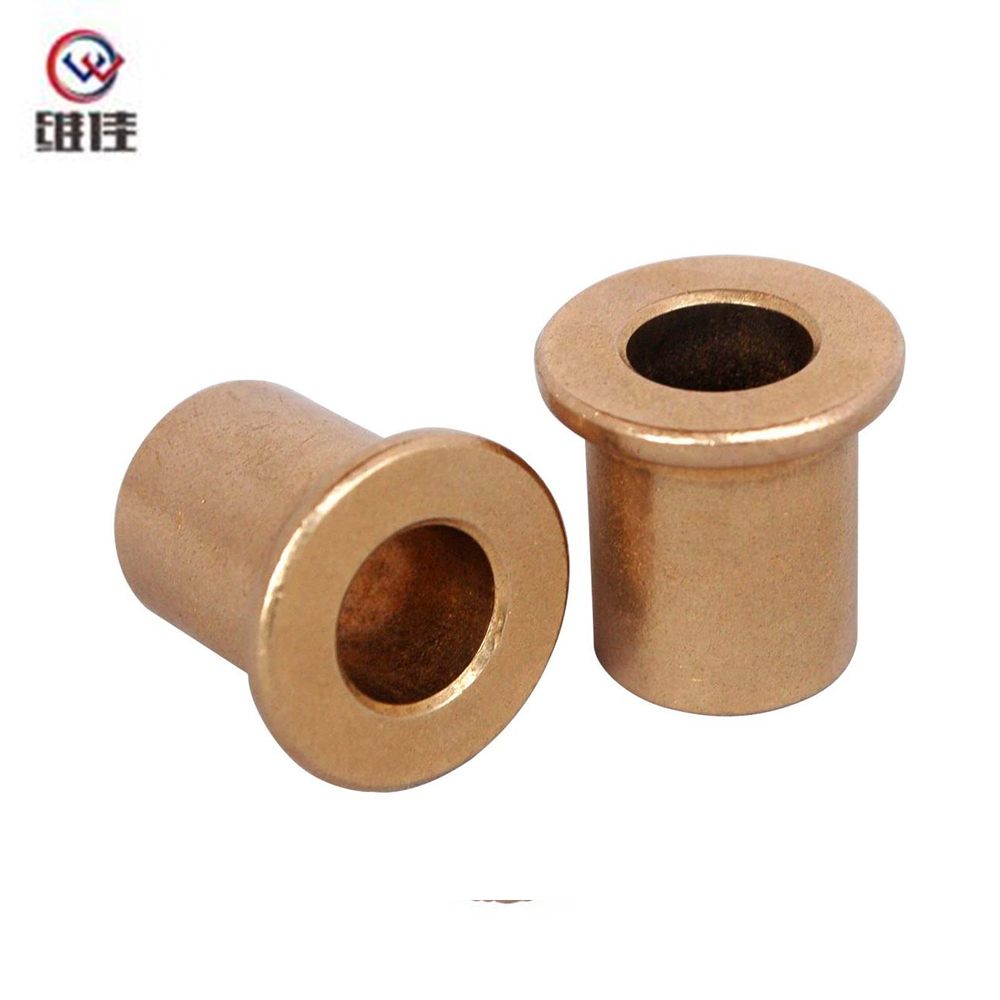
Premium Material: Our flange bushing is crafted from Sint B50 oil-impregnated bronze, featuring an 18% oil content. The high-quality tin bronze material ensures exceptional hardness, wear resistance, ...
See DetailsE-mail us: [email protected]
Tel: +86-15239857375


 Home / Author / Tan Xinyue — After-Sales Technical Coordinator / Sint B50 Oil-Impregnated Bronze Flange Bushings: A Reliable Self-Lubricating Solution for Modern Machinery
 Sint B50 Oil-Impregnated Bronze Flange Bushings: A Reliable Self-Lubricating Solution for Modern Machinery
 2026.08.09
 Tan Xinyue — After-Sales Technical Coordinator
Content
- 1 What Is a Sint B50 Oil-Impregnated Bronze Flange Bushing?
- 2 How the Self-Lubricating Principle Works
- 3 Why the Flange Configuration Is Valuable
- 4 Material Advantages of Sint B50 Sintered Bronze
- 5 Performance Advantages Compared with Conventional Bushing Solutions
- 6 Manufacturing Process and Quality Control
- 7 Application Areas
- 8 How to Select the Correct Bushing
- 9 Advantages of Customized Manufacturing
- 10 Manufacturing Strengths of Jiande Welfine Technology Co., Ltd.
- 11 Installation and Service Considerations
- 12 Common Causes of Premature Wear
- 13 Role in Sustainable and Efficient Manufacturing
- 14 Future Development of Sintered Bronze Bushings
- 15 Frequently Asked Questions
- 15.1 Does the Sint B50 oil-impregnated bronze flange bushing require regular lubrication?
- 15.2 What does the 18% oil content mean?
- 15.3 Can this bushing support axial loads?
- 15.4 Is it suitable for high-speed applications?
- 15.5 Can the bushing be used for oscillating movement?
- 15.6 What shaft material is normally recommended?
- 15.7 Can custom flange dimensions be manufactured?
- 15.8 Can different materials or lubricants be requested?
- 15.9 How should the bushing be stored before installation?
- 15.10 How can product quality be evaluated?
- 15.11 What certifications does the manufacturer hold?
- 15.12 Does the company provide OEM and ODM services?
- 16 Conclusion
- 17 References
- 18 Product: Sint B50 Powdered Metallurgy Oil-Impregnated Bronze Flange Bushing
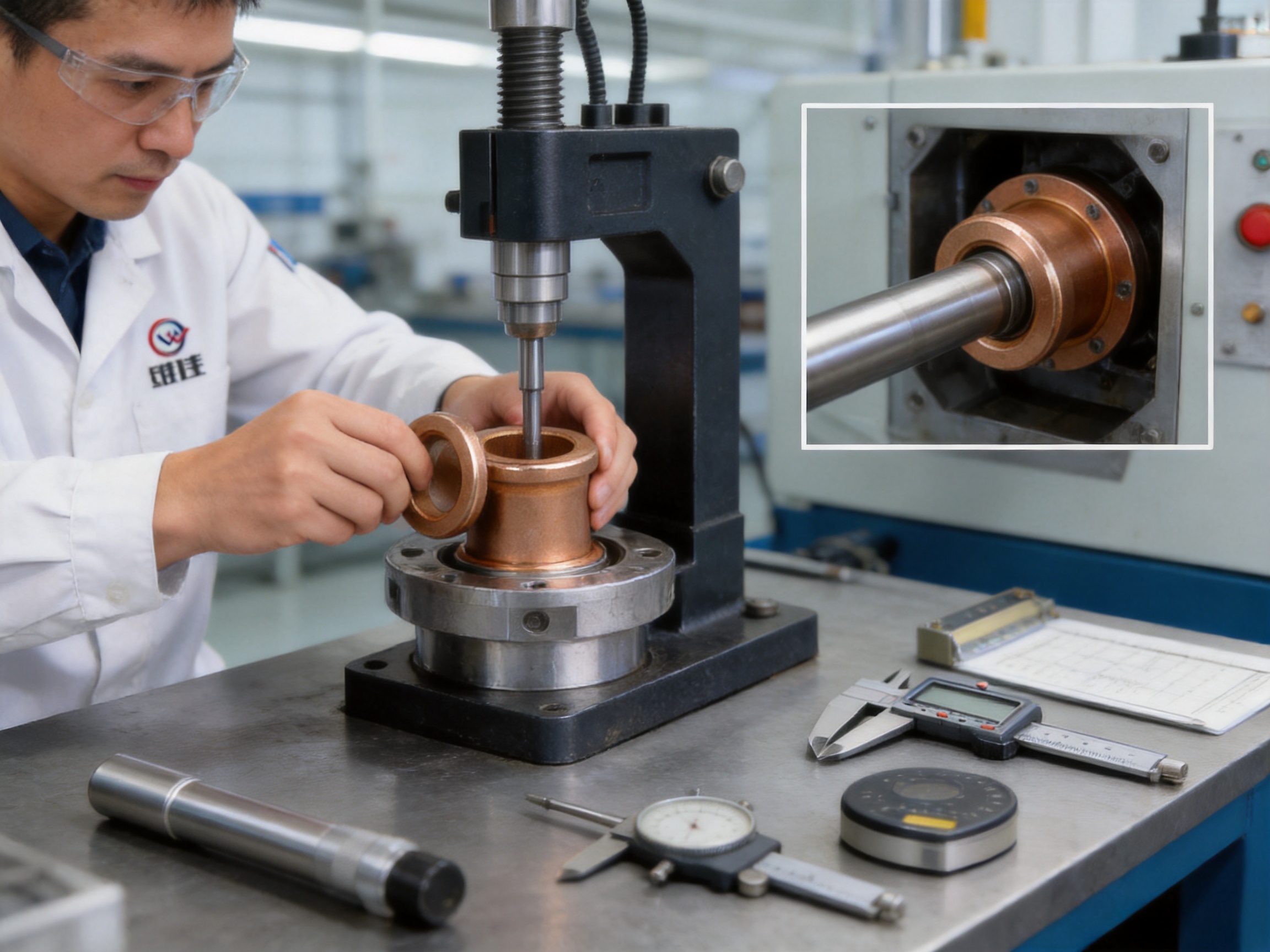
Modern machinery increasingly depends on compact, reliable, and low-maintenance components. While motors, gears, shafts, and control systems often receive the most attention during equipment design, the performance of smaller support components can determine whether an assembly operates smoothly over many years or experiences premature wear and downtime. Bushings are one of these essential components. They guide shafts, support radial loads, reduce friction, control movement, and help maintain accurate alignment between mating parts.
The Sint B50 oil-impregnated bronze flange bushing is designed to meet these requirements through a combination of porous sintered bronze, integrated lubricant storage, precision manufacturing, and a practical flange configuration. Unlike ordinary solid-metal bushings that may require frequent relubrication, this type of powder metallurgy bushing stores oil within its microscopic pore network and releases lubricant during operation. The result is a self-lubricating bearing solution suitable for many applications where maintenance access is limited, operating noise must be controlled, or consistent dimensional performance is required.
With an oil content of approximately 18%, the B50 material offers a balanced combination of lubrication capacity, strength, wear resistance, and dimensional stability. The bronze-based structure provides dependable mechanical support, while the flange adds positioning and limited axial-load capability in addition to radial support. These characteristics make the bushing useful in automotive systems, household appliances, industrial equipment, agricultural machinery, hydraulic assemblies, power tools, and automated production lines.
This article examines the construction, operating principle, performance advantages, manufacturing process, application suitability, quality considerations, and customization capabilities of Sint B50 oil-impregnated bronze flange bushings.
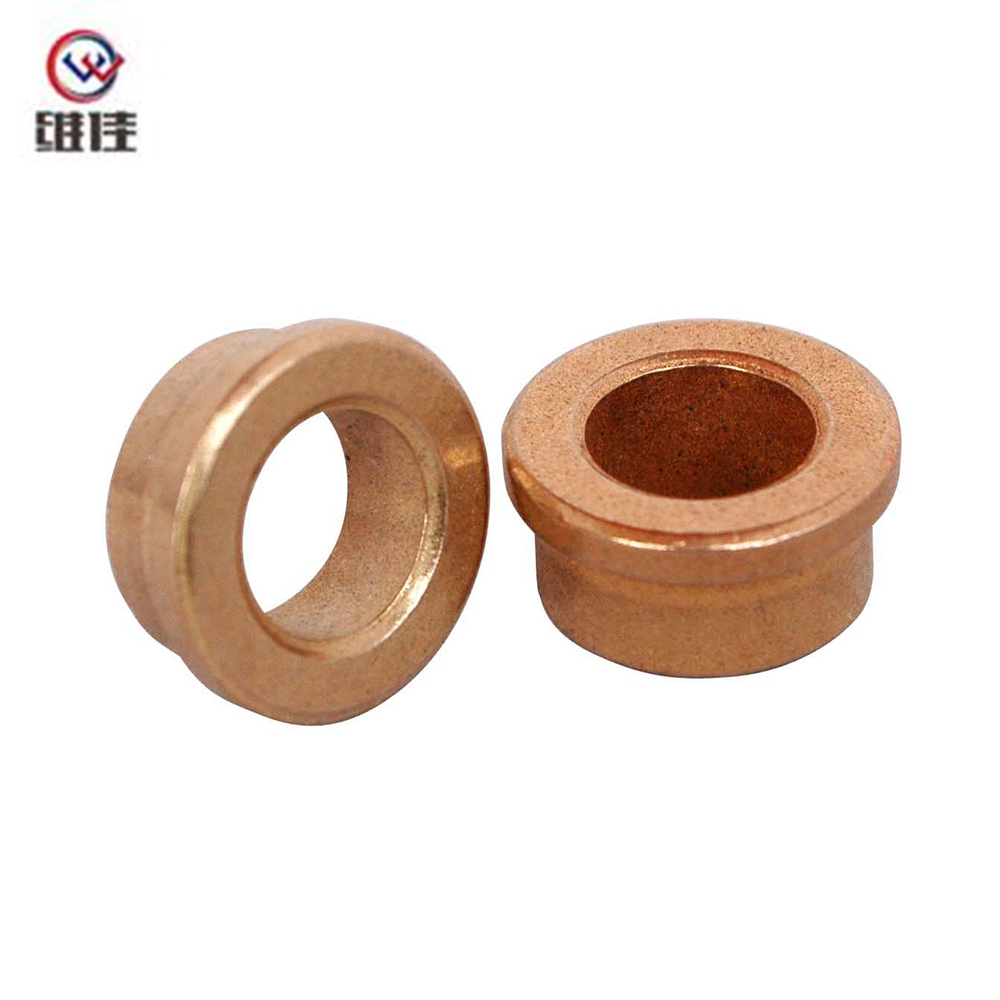
Sint B50 Powdered Metallurgy Oil-Impregnated Bronze Flange Bushing
What Is a Sint B50 Oil-Impregnated Bronze Flange Bushing?
A Sint B50 oil-impregnated bronze flange bushing is a plain bearing produced using powder metallurgy. It consists of a bronze-based sintered body with interconnected microscopic pores. These pores are filled with lubricating oil through a controlled impregnation process after the bushing has been formed and sintered.
The term “plain bearing” means that the bushing supports a moving shaft through a sliding contact surface rather than through rolling elements such as balls or rollers. The shaft rotates or oscillates inside the bushing, and the oil released from the porous bronze helps form a lubricating film between the two surfaces.
The “flange” is the radial extension located at one end of the cylindrical bushing. A standard straight bushing mainly supports radial movement, while a flange bushing can also provide component positioning and limited resistance to axial movement. This integrated geometry can eliminate the need for separate thrust washers, retaining rings, spacers, or positioning collars in suitable assemblies.
B50 refers to a specific sintered bronze material designation used for oil-impregnated bearing applications. The material is engineered to provide a controlled balance between porosity and density. Sufficient porosity is necessary to store oil, but excessive porosity can reduce mechanical strength. The manufacturing process therefore aims to create a uniform pore structure that supports both lubrication and load-bearing performance.
Key Construction Features
The bushing contains four primary functional elements: a bronze-based sintered body, a controlled pore network, impregnated lubricating oil, and a precision-finished bearing surface. Each element contributes to service performance.
The bronze-based body provides the mechanical framework. Tin bronze and related copper alloys are widely used in oil-impregnated bushings because they offer good wear resistance, thermal conductivity, dimensional stability, and compatibility with steel shafts.
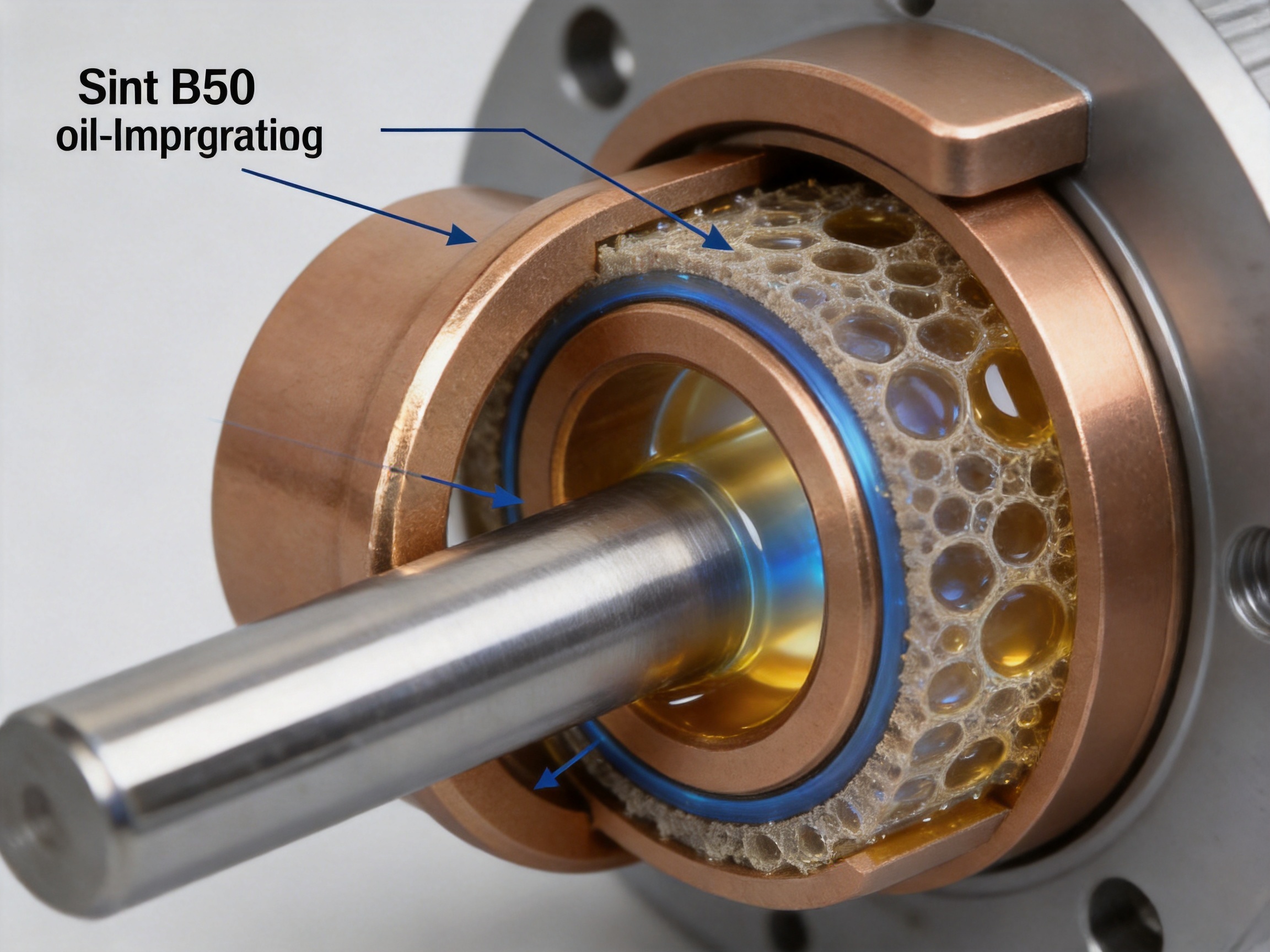
The pore network functions as an internal lubricant reservoir. During operation, oil moves from the pores to the sliding surface when frictional heat and capillary action create the conditions for lubricant migration.
The impregnated oil reduces direct metal-to-metal contact. It helps lower friction, reduce wear, suppress vibration, and maintain smooth shaft movement. The oil formulation can also be selected according to the expected temperature range and application requirements.
The finished internal surface provides the actual sliding interface. Controlled tolerances and surface quality are important because excessive roughness can increase friction, while an incorrect internal diameter can cause poor clearance, overheating, noise, or accelerated wear.
How the Self-Lubricating Principle Works
The main advantage of an oil-impregnated sintered bushing is its ability to provide lubrication from within the bearing material. Conventional solid bronze bushings normally depend on grease, oil grooves, external lubrication systems, or scheduled manual maintenance. By contrast, a porous sintered bushing contains lubricant throughout its structure before it is installed.
Microscopic Oil Reservoirs
During compaction and sintering, the bronze powder particles bond together without becoming completely dense. The remaining interconnected spaces form microscopic pores distributed through the bushing wall. After sintering, the part is placed in an oil impregnation process, often under vacuum, to remove trapped air and enable the lubricant to penetrate deeply into the pore network.
The oil is not merely applied to the outside of the bushing. It is stored throughout the material. This distinction is important because surface-applied lubricant can quickly be displaced, contaminated, or lost, whereas impregnated oil remains available inside the bearing body.
Oil Release During Operation
When the shaft begins to rotate or oscillate, friction generates heat at the sliding interface. The temperature change and movement encourage oil to migrate from the pores toward the bearing surface. The released oil forms a thin lubricating film between the shaft and the bronze surface.
This film reduces direct contact between asperities on the two mating surfaces. As a result, friction and wear are reduced, and the shaft can move more smoothly. The continuous but controlled release of oil helps the bushing maintain stable performance over extended operating periods.
Oil Reabsorption During Shutdown
When the machine stops and the bushing cools, capillary action helps draw excess lubricant back into the porous structure. The oil is therefore not consumed immediately. Instead, the bushing operates through a repeating release-and-reabsorption cycle.
This cycle does not mean that the bushing is immune to all operating limitations. Excessive load, high speed, extreme temperatures, poor shaft alignment, contamination, or unsuitable shaft hardness can still reduce service life. However, under correctly selected operating conditions, the oil-storage structure significantly reduces the need for routine lubrication.
Why the Flange Configuration Is Valuable
The flange is more than a geometric feature. It can simplify assembly design and improve the functional integration of the bearing within a mechanical system.
Radial Shaft Support
The cylindrical section of the bushing supports the shaft against radial forces. Radial support is required in motors, pivots, hinges, rollers, fans, actuators, and many other mechanisms where a rotating or oscillating shaft must remain aligned.
Axial Positioning
The flange contacts a mating shoulder or surface and helps control the axial position of the bushing or the supported component. In applications involving limited axial movement, the flange can also resist a portion of the axial force.
The actual axial-load capability depends on the flange dimensions, material condition, lubrication state, contact pressure, speed, temperature, and mating-surface design. Engineers should not assume that every flange bushing is suitable for continuous heavy thrust loads. Nevertheless, for positioning and moderate axial forces, the integrated flange can be highly effective.
Fewer Components
A standard cylindrical bushing may require a separate washer, spacer, retaining ring, or shoulder arrangement to control its position. A flanged version can combine several of these functions into one component. This reduces the part count and can simplify purchasing, inventory management, assembly, and service procedures.
Improved Installation Consistency
When the flange acts as an installation stop, the bushing can be pressed into a housing until the flange reaches the specified seating surface. This provides a consistent insertion position and helps prevent incorrect installation depth. Repeatable positioning is especially useful in automated assembly and high-volume production.
Space Efficiency
Integrating radial support and axial positioning into one component can save space in compact mechanical assemblies. This is valuable in automotive mechanisms, small motors, office equipment, power tools, and automated devices where every millimeter of available space matters.
Material Advantages of Sint B50 Sintered Bronze
The performance of an oil-impregnated bushing depends heavily on its material. Sint B50 bronze is selected for applications that require reliable sliding support, internal lubricant storage, and balanced mechanical performance.
Good Wear Resistance
Bronze is widely recognized as a suitable bearing material because it can withstand repeated sliding contact when paired with an appropriate shaft. The alloy structure and controlled sintered microstructure help resist wear under normal operating conditions.
The wear performance of the finished assembly depends on both the bushing and the shaft. A smooth, correctly hardened shaft with suitable dimensional accuracy allows the oil film to function effectively. A rough, soft, damaged, or contaminated shaft can accelerate wear even when the bushing itself is manufactured correctly.
Balanced Strength and Porosity
Oil-impregnated bushings require a carefully controlled balance between material density and pore volume. A dense material can provide higher mechanical strength but may not hold enough lubricant. A highly porous structure can store more oil but may have reduced load capacity.
The B50 material is designed to provide a practical balance. Its approximately 18% oil content supports self-lubrication while retaining sufficient bronze structure for radial support in suitable applications.
Thermal Conductivity
Copper-based alloys generally conduct heat more effectively than many nonmetallic bearing materials. This can help transfer frictional heat from the sliding interface into the surrounding housing. Effective heat dissipation is important because excessive temperature can reduce lubricant viscosity and accelerate wear.
Compatibility with Steel Shafts
Oil-impregnated bronze bushings are commonly paired with steel shafts. The combination can provide a reliable sliding interface when the shaft surface finish, hardness, clearance, and alignment are properly controlled.
Dimensional Stability
Powder metallurgy processing can provide high repeatability for large production volumes. After compaction and sintering, bushings can undergo sizing, calibration, machining, or other finishing operations to achieve the required dimensions. Consistent dimensions support dependable assembly and reduce variation between production batches.
Performance Advantages Compared with Conventional Bushing Solutions
Different bearing technologies are appropriate for different operating conditions. The Sint B50 flange bushing is particularly advantageous when low maintenance, compact design, quiet movement, and economical mass production are important.
| Performance Consideration | Sint B50 Oil-Impregnated Bronze Flange Bushing | Conventional Solid Bronze Bushing | Typical Rolling-Element Bearing |
|---|---|---|---|
| Lubrication requirement | Lubricant is stored within the porous structure; additional lubrication is often unnecessary under normal conditions | Usually requires external oil or grease maintenance | Often requires specified grease or oil lubrication |
| Noise level | Low operating noise when correctly fitted and lubricated | Depends strongly on external lubrication and surface condition | Can generate rolling and cage noise at higher speeds |
| Radial load support | Suitable for many low- to medium-load applications and selected higher-load conditions | Can support high loads when properly lubricated | Can support high loads, depending on bearing type and size |
| Axial positioning | Integrated flange provides positioning and limited axial support | Requires a separate flange or retaining arrangement unless specially machined | Usually requires additional housing and shaft-location features |
| Maintenance access | Well suited to locations where relubrication is difficult | Less suitable when regular lubrication cannot be performed | Maintenance depends on sealing and lubrication design |
| Production economics | Efficient for repeated production and near-net-shape manufacturing | Material removal and machining can increase cost | Requires multiple precision components and assembly processes |
| Compactness | Simple, lightweight, and compact plain-bearing construction | Compact but may require lubrication features | May require more surrounding space for installation and sealing |
This comparison is not intended to suggest that one bearing type replaces all others. Rolling bearings can be preferable at high speeds or where very low starting friction is required. Solid bronze bushings may be appropriate for heavy loads with an established lubrication system. The Sint B50 bushing is especially strong when the application calls for a simple, quiet, self-lubricating, and economical sliding bearing.
Reduced Maintenance
Because the bushing contains an internal oil supply, operators can often eliminate frequent manual lubrication. This lowers maintenance labor and helps reduce the possibility of missed lubrication intervals. It is particularly valuable in equipment installed in enclosed areas, elevated locations, remote facilities, or production lines where stopping the machine is expensive.
Lower Downtime Risk
Unexpected lubrication failure can lead to increased friction, overheating, shaft damage, and unplanned downtime. A correctly selected oil-impregnated bushing reduces dependence on external lubrication procedures and therefore supports more stable equipment availability.
Quiet Operation
A stable lubricating film helps reduce friction, vibration, and sliding noise. This makes the product suitable for household appliances, office equipment, medical devices, small motors, and other products in which acoustic performance affects user experience.
Efficient Material Utilization
Powder metallurgy forms components from compacted metal powders rather than removing large quantities of material from a solid bar. This can reduce material waste and improve production efficiency, particularly for high-volume parts with repeatable dimensions.
Manufacturing Process and Quality Control
Reliable performance begins with process control. A high-quality oil-impregnated bronze flange bushing is not created by oil filling alone. The composition of the powder, compaction pressure, sintering conditions, pore structure, sizing accuracy, machining quality, and impregnation process must all be controlled.
Powder Preparation
The process begins with carefully selected copper-based alloy powders. Powder characteristics such as particle size, shape, chemical composition, flowability, and apparent density influence the final product. Consistent raw materials help create uniform compaction and predictable sintering behavior.
Powders may be blended with approved processing additives to improve flow and compactability. The formulation must be controlled so that the finished part achieves the required mechanical properties and pore structure after sintering.
Precision Compaction
The blended powder is placed into a forming die and compacted under high pressure. The die determines the basic external shape, internal bore, flange geometry, and other design features.
Compaction must be uniform. Variations in density can create differences in strength, dimensional change, oil capacity, and wear behavior. Advanced presses and carefully designed tooling help achieve stable density distribution throughout the bushing.
For flanged components, special attention is required at the transition between the cylindrical body and the flange. This area must be formed consistently to reduce stress concentration and maintain accurate seating dimensions.
High-Temperature Sintering
The compacted part, often called a green compact, is heated in a controlled sintering furnace. The temperature is high enough to bond the powder particles together but is controlled to preserve the intended porosity.
Atmosphere control is important because copper-based materials can be affected by oxidation and unwanted chemical reactions. Furnace temperature, heating rate, holding time, cooling rate, and protective atmosphere all influence the final microstructure.
Proper sintering produces a stable bronze framework with interconnected pores. Insufficient sintering may result in weak particle bonding and poor strength. Excessive sintering may close pores and reduce oil storage capacity. The manufacturing objective is to achieve a repeatable balance.
Sizing and Calibration
After sintering, the bushing may undergo sizing or calibration. The part is pressed through a precision tool to improve dimensional consistency, roundness, and bore accuracy. This step is particularly useful when the bushing must be installed by press fitting into a housing or must maintain a specified running clearance with a shaft.
Precision Machining
Some designs require additional machining of the bore, flange face, outside diameter, chamfers, grooves, or other features. Precision machining can refine tolerances and provide compatibility with customer drawings or application-specific requirements.
The internal surface finish must be controlled carefully. A suitable surface allows the oil film to form effectively and prevents unnecessary abrasion of the mating shaft. Sharp edges, burrs, and irregular flange faces can create installation problems and should be removed or controlled during finishing.
Vacuum Oil Impregnation
Oil impregnation is a critical stage. Air trapped in the pores can prevent complete lubricant penetration. A vacuum process removes air from the pore network before oil is introduced, enabling the lubricant to fill the internal structure more thoroughly.
After impregnation, excess surface oil may be removed or controlled according to product requirements. The finished bushing should contain a consistent lubricant volume while maintaining a clean external surface suitable for assembly and packaging.
Inspection and Testing
Final inspection may include dimensional measurement, visual inspection, density evaluation, oil-content verification, hardness testing, surface-quality checks, and functional testing. Depending on the application, manufacturers may also evaluate radial crushing strength, wear behavior, friction performance, oil leakage, and temperature resistance.
Quality systems such as ISO 9001:2015 support process documentation, traceability, corrective action, inspection planning, and continuous improvement. For automotive-related production, IATF 16949:2016 provides additional requirements focused on risk control, process consistency, defect prevention, and customer-specific quality expectations.
Application Areas
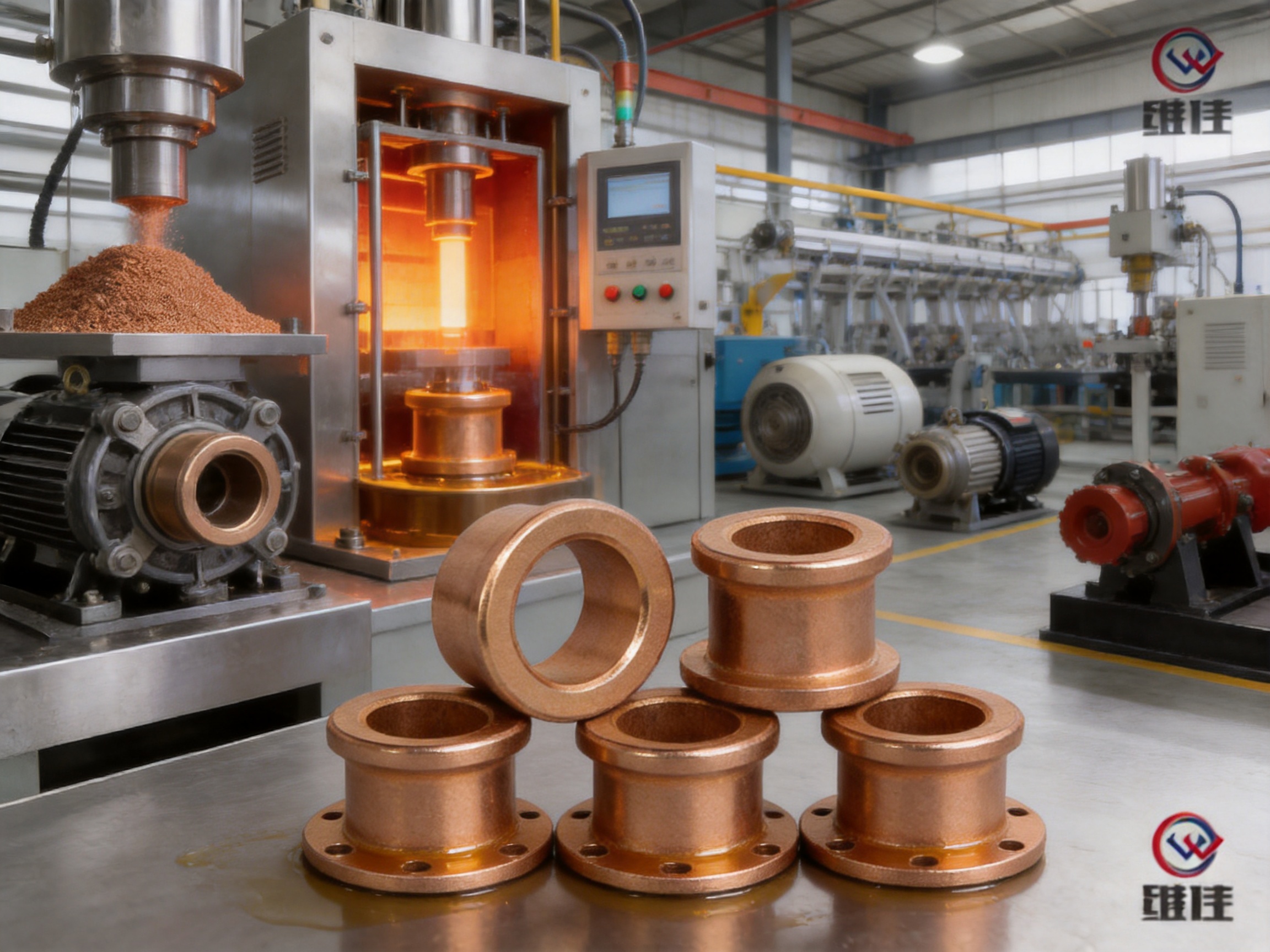
Sint B50 oil-impregnated bronze flange bushings are used in a wide range of mechanisms where shafts rotate, oscillate, pivot, or slide at moderate speeds and loads.
Automotive Components
Automotive systems often contain compact moving mechanisms with limited maintenance access. Flange bushings may be used in seat adjustment systems, windshield wiper mechanisms, sunroof assemblies, cooling fan motors, door-related mechanisms, and other auxiliary systems.
The self-lubricating structure is valuable because many automotive components must operate reliably for long periods without routine servicing. The flange can also help maintain component position in compact assemblies where separate retention hardware would increase complexity.
Household Appliances
Washing machines, air-conditioning equipment, vacuum cleaners, kitchen appliances, and other household products require dependable movement and controlled noise. Oil-impregnated bronze bushings can support fan shafts, motor components, adjustment mechanisms, hinges, and pivoting parts.
The low-maintenance characteristic is particularly useful in consumer products. Once the appliance is assembled, access to internal components may be difficult. A bushing that stores its own lubricant can help maintain smooth movement throughout the expected service period.
Industrial Automation
Automation systems often operate through repeated cycles. Conveyor equipment, packaging machinery, textile machines, printing equipment, indexing systems, and automated actuators can place continuous demands on their bearing components.
In these environments, reducing maintenance interventions can improve production availability. The bushing’s dimensional consistency also supports automated assembly and repeatable equipment performance.
Robotic and Compact Actuation Systems
Robotic joints and compact actuators may require small, quiet, and low-maintenance sliding supports. The bushing can be used in selected pivot points, linkage mechanisms, gear-drive supports, and control assemblies when the load, speed, temperature, and clearance are suitable.
Application engineers should evaluate the complete duty cycle, including start-stop frequency, oscillation angle, peak load, misalignment, and environmental contamination. The best results occur when the bushing is selected as part of an integrated shaft, housing, and lubrication design.
Agricultural Machinery
Agricultural equipment includes linkages, control mechanisms, rotating supports, and adjustment systems exposed to repeated movement. In protected or moderately contaminated locations, oil-impregnated bronze flange bushings can provide a practical low-maintenance option.
Where dust, mud, water, or abrasive particles are present, suitable seals, shields, protective housings, or alternative bearing materials may be necessary. Environmental conditions should always be considered during selection.
Hydraulic and Mechanical Equipment
Hydraulic systems and related mechanical assemblies often include pivots, levers, control linkages, and guide mechanisms. A flange bushing can provide stable support while simplifying axial positioning. The selected oil and material must be compatible with the surrounding environment and operating temperature.
How to Select the Correct Bushing
Choosing a bushing only by nominal diameter is not sufficient. Reliable selection requires an assessment of the shaft, housing, load, speed, temperature, motion, environment, and expected service life.
Load
Determine the radial load and any axial or thrust load. For oscillating mechanisms, identify both the average and peak loads. A bushing subjected to intermittent shock may require a different design from one exposed to a steady, evenly distributed load.
Speed
Rotational speed and sliding speed affect frictional heat and oil release. The pressure-velocity condition, commonly expressed as a PV value, is an important factor in plain-bearing selection. The allowable value depends on material, lubrication, load distribution, temperature, shaft condition, and duty cycle.
Temperature
Operating temperature affects oil viscosity, dimensional expansion, and material strength. Short periods of elevated temperature may be acceptable, but continuous operation at high temperature can reduce lubricant life and accelerate wear. The oil formulation and application design should be evaluated together.
Motion Type
Continuous rotation, oscillation, reciprocation, and intermittent movement create different lubrication conditions. Oscillating motion may not distribute oil in the same way as continuous rotation. The angle, frequency, dwell time, and reversal behavior should be included in the design review.
Shaft Condition
The mating shaft should have suitable hardness, roundness, straightness, and surface finish. A shaft that is too rough can damage the bushing surface. A shaft that is too soft may wear quickly. Incorrect size or excessive runout can prevent a stable oil film from forming.
Housing Fit
The outer diameter and housing bore must provide the correct interference or transition fit. An incorrect fit can cause the bushing to spin inside the housing, deform excessively, or become difficult to install. Housing material, wall thickness, thermal expansion, and installation method should also be considered.
Clearance
Running clearance must accommodate thermal expansion, oil-film formation, shaft variation, and operating load. Insufficient clearance can cause seizure or overheating. Excessive clearance can produce noise, vibration, impact loading, and poor positional accuracy.
Environment
Dust, moisture, chemicals, corrosive atmospheres, washdown, and abrasive particles can affect service life. Protective seals and shields may be required. If the bushing will be exposed to unusual chemicals or high humidity, material and lubricant compatibility should be confirmed before production.
Advantages of Customized Manufacturing
Many mechanical assemblies cannot use an off-the-shelf bushing without modification. Custom manufacturing enables the bearing to match the actual equipment design rather than forcing the equipment to adapt to a standard part.
Custom Dimensions
Manufacturers can produce customized inner diameters, outer diameters, lengths, flange diameters, flange thicknesses, chamfers, shoulders, grooves, and other geometric features based on customer drawings or samples.
Customized dimensions can improve load distribution, simplify installation, reduce the need for secondary spacers, and improve alignment between the shaft and housing.
Material and Lubricant Options
Although Sint B50 is suitable for many general industrial applications, other bronze-based formulations or lubricant types may be considered for special temperature, speed, load, or environmental requirements. Material selection should be based on measured operating conditions rather than preference alone.
OEM and ODM Support
OEM manufacturing allows a supplier to produce bushings according to the customer’s approved design. ODM support can extend further by helping optimize dimensions, material selection, manufacturing method, and production cost.
Engineering cooperation is especially valuable during the prototype stage. Potential interference, insufficient flange support, unsuitable clearance, difficult installation, or unrealistic tolerances can be identified before mass production begins.
Prototype-to-Production Control
A dependable manufacturing partner should be able to manage the transition from sample approval to repeated production. Tooling design, process parameters, inspection standards, packaging, and traceability should remain controlled as production volume increases.
Manufacturing Strengths of Jiande Welfine Technology Co., Ltd.
Jiande Welfine Technology Co., Ltd. specializes in powder metallurgy sintering and related precision machining. Established in 2001, the company integrates research and development, manufacturing, quality management, and sales support within one production system.
The company produces powder metallurgy bushings, self-lubricating bearings, and precision sintered components for automotive manufacturing, machinery, household appliances, power tools, industrial automation, and other fields.
Integrated Production Capability
An integrated production structure allows the company to control multiple stages internally, including powder preparation, compaction, sintering, sizing, precision machining, oil impregnation, inspection, and packaging. This can improve communication between engineering and production teams and help reduce delays caused by fragmented outsourcing.
Modern Production Base
The company operates a production base covering approximately 13,039 square meters. The facility includes high-efficiency presses, high-temperature sintering furnaces, precision forming equipment, machining resources, and testing equipment.
These resources support both standard production and customized components. Equipment capability is important because the quality of a sintered bushing depends on repeatable pressure control, furnace stability, dimensional calibration, and reliable inspection.
Experienced Technical Team
With more than 20 years of industry experience and over 150 skilled employees, the company has developed practical knowledge in powder metallurgy materials, tooling, sintering behavior, precision forming, and self-lubricating bearing design.
Engineering experience helps translate customer drawings and application requirements into manufacturable components. It also supports continuous improvement in dimensional accuracy, wear resistance, manufacturing efficiency, and product consistency.
Automotive-Oriented Quality Management
Jiande Welfine Technology Co., Ltd. follows ISO 9001:2015 and IATF 16949:2016 quality management systems. ISO 9001 provides a structured framework for quality planning, process control, customer satisfaction, documentation, and continual improvement.
IATF 16949 is particularly relevant to automotive supply chains because it emphasizes risk-based thinking, defect prevention, process capability, traceability, and systematic control of production variation. These practices can also benefit customers in non-automotive industries that require stable and repeatable component quality.
Stable Global Supply
A supplier with an established production system can support recurring orders, customized designs, and long-term programs more effectively than a supplier focused only on one-time transactions. Stable manufacturing capacity helps customers maintain consistent product specifications across multiple purchasing cycles.
Installation and Service Considerations
Even a well-manufactured bushing can perform poorly if installation conditions are incorrect. Proper preparation of the housing and shaft is essential.
Housing Preparation
The housing bore should be clean, round, and free from burrs. The seating shoulder should be flat and able to support the flange without distortion. Any dirt, metal chips, or damage in the bore can affect fit and alignment.
Shaft Preparation
The shaft should be inspected for correct diameter, surface finish, straightness, and damage. The shaft should enter the bushing without excessive force or impact. If the shaft has sharp edges, a suitable lead-in chamfer can reduce damage during assembly.
Press-Fit Installation
When press fitting, force should be applied evenly and in line with the bushing axis. Pressing against the flange or a suitable installation tool is preferable to striking the bushing directly. Improper force can deform the flange or damage the bearing surface.
Clean Operating Conditions
Oil-impregnated bushings should be protected from contamination during storage and assembly. Abrasive particles can enter the sliding interface and increase wear. Components should remain in clean packaging until installation, particularly in precision equipment.
Additional Lubrication
Under normal conditions, additional lubrication is usually not required. Applying an incompatible grease or oil may interfere with the original lubricant, attract contaminants, or alter friction behavior. If supplementary lubrication is necessary for a special application, the lubricant should be evaluated for compatibility with the impregnated oil and operating temperature.
Common Causes of Premature Wear
Understanding potential failure causes helps engineers achieve the expected service life.
Excessive Load or Speed
Loads and speeds beyond the design range can generate excessive heat and remove the protective oil film. Continuous operation near the limits should be validated through testing or engineering analysis.
Misalignment
Misalignment causes uneven pressure around the bearing surface. Localized contact may lead to edge loading, uneven wear, noise, and premature damage. Housing and shaft alignment should be checked during equipment design and assembly.
Incorrect Clearance
Clearance that is too small may cause the shaft to bind as temperature increases. Clearance that is too large may produce impact, vibration, and unstable movement. The correct value depends on diameter, temperature, load, speed, shaft material, and housing conditions.
Contamination
Dust, metal particles, moisture, and chemical contaminants can damage the sliding interface. Sealing, shielding, and protective design are important in harsh environments.
Improper Storage
Long-term exposure to excessive heat, moisture, or chemical vapors may affect the lubricant and the bronze surface. Bushings should be stored in clean, dry conditions and protected from unnecessary handling.
Role in Sustainable and Efficient Manufacturing
Oil-impregnated bronze bushings can contribute to equipment efficiency by reducing friction, maintenance requirements, and replacement frequency. Lower friction may reduce energy losses in suitable mechanisms, while longer service life can reduce the consumption of replacement materials.
Powder metallurgy also supports efficient use of metal resources. Because the component is formed close to its final shape, the process can generate less scrap than conventional machining from solid bar stock. This advantage is especially meaningful in high-volume production of small precision parts.
However, sustainability depends on the complete product life cycle. Material selection, lubricant formulation, manufacturing energy, service life, maintenance practices, and end-of-life recycling should all be considered. A durable bushing that prevents premature equipment replacement can provide meaningful lifecycle benefits.
Future Development of Sintered Bronze Bushings
Industrial equipment is becoming more automated, compact, connected, and energy-conscious. These trends are increasing demand for components that can deliver reliable movement with minimal maintenance.
Future powder metallurgy development is expected to focus on more consistent pore structures, improved load capacity, advanced lubricant formulations, tighter dimensional control, and better performance under challenging temperature and speed conditions.
Automation and robotics will continue to create demand for compact bearing components. Smart manufacturing equipment may require bushings capable of operating for long periods with limited human intervention. Renewable energy equipment, electric mobility systems, and advanced household products may also benefit from low-noise and maintenance-reducing bearing solutions.
Manufacturing data and process monitoring are likely to become increasingly important. Digital tracking of powder batches, compaction parameters, furnace cycles, machining results, and inspection data can improve traceability and help identify process variation before it affects production.
Frequently Asked Questions
Does the Sint B50 oil-impregnated bronze flange bushing require regular lubrication?
Under normal operating conditions, additional lubrication is generally not required. The bushing stores lubricant within its porous sintered structure and releases it during operation. The actual maintenance requirement depends on load, speed, temperature, environment, shaft condition, and service duration.
What does the 18% oil content mean?
The approximately 18% oil content indicates the lubricant capacity of the porous bronze structure. The oil occupies interconnected microscopic pores and acts as an internal reservoir. The exact performance depends on the oil type, pore distribution, operating conditions, and manufacturing consistency.
Can this bushing support axial loads?
The flange can provide positioning and support limited axial forces in addition to radial support. It is not automatically suitable for continuous heavy thrust loading. Axial load, contact pressure, speed, flange dimensions, temperature, and lubrication conditions must be reviewed for each application.
Is it suitable for high-speed applications?
Suitability depends on the pressure-velocity condition, shaft quality, temperature, clearance, and duty cycle. The bushing is generally selected for low- to moderate-speed sliding applications and selected higher-speed conditions after engineering validation. A rolling-element bearing may be more appropriate where extremely high speed and very low friction are required.
Can the bushing be used for oscillating movement?
Yes, it can be used in suitable oscillating applications. However, oscillation angle, frequency, load reversal, dwell periods, and edge loading should be evaluated because oscillating motion can produce different lubrication behavior from continuous rotation.
What shaft material is normally recommended?
Steel shafts are commonly used with oil-impregnated bronze bushings. The shaft should have appropriate hardness, dimensional accuracy, roundness, and surface finish. The exact recommendation depends on the load, speed, environment, and expected service life.
Can custom flange dimensions be manufactured?
Yes. Customized inner diameters, outer diameters, lengths, flange dimensions, chamfers, grooves, and other features can be produced according to approved drawings, samples, or technical specifications.
Can different materials or lubricants be requested?
Depending on the application, alternative bronze-based materials and lubricant options may be evaluated. Customers should provide operating temperature, speed, load, movement type, environmental conditions, and service-life requirements so that the most appropriate solution can be selected.
How should the bushing be stored before installation?
The bushing should be kept in clean, dry packaging away from excessive heat, moisture, dust, and chemical vapors. Unnecessary cleaning or solvent exposure should be avoided because it may remove or dilute the impregnated lubricant.
How can product quality be evaluated?
Important evaluation factors include raw material consistency, pore structure, oil content, dimensional accuracy, hardness, surface finish, flange geometry, press-fit performance, and wear behavior. A supplier’s quality management system, process traceability, inspection capability, and experience with customized parts should also be considered.
What certifications does the manufacturer hold?
Jiande Welfine Technology Co., Ltd. has obtained ISO 9001:2015 and IATF 16949:2016 certifications. These systems support documented quality control, process consistency, risk management, traceability, and continual improvement.
Does the company provide OEM and ODM services?
Yes. The company provides OEM and ODM support based on customer drawings, samples, technical specifications, and application requirements. Its engineering team can assist with product development, tooling, material selection, process optimization, and production transition.
Conclusion
The Sint B50 oil-impregnated bronze flange bushing combines the functional advantages of porous sintered bronze with the practical benefits of an integrated flange. Its approximately 18% oil content supports internal lubrication, while the bronze structure provides wear resistance, thermal conductivity, dimensional stability, and dependable radial support.
Compared with conventional bushings that require regular lubrication, the self-lubricating design can reduce maintenance labor, equipment downtime, and operating noise. Compared with more complex bearing arrangements, the flange configuration can simplify assembly, provide axial positioning, reduce part count, and save installation space.
The product is suitable for many automotive, appliance, industrial, agricultural, hydraulic, power-tool, and automation applications. Its successful use depends on appropriate selection of load, speed, temperature, clearance, shaft condition, housing fit, and environmental protection.
Manufacturing quality is equally important. Consistent powder preparation, controlled compaction, stable sintering, accurate sizing, precision machining, effective vacuum oil impregnation, and final inspection all contribute to reliable performance. Jiande Welfine Technology Co., Ltd. supports these requirements through an integrated powder metallurgy production system, modern equipment, experienced personnel, OEM and ODM capabilities, and ISO 9001:2015 and IATF 16949:2016 quality certifications.
For equipment designers seeking a compact, quiet, economical, and low-maintenance plain-bearing solution, the Sint B50 oil-impregnated bronze flange bushing offers a strong combination of performance and manufacturing flexibility.
References
1. Powder Metallurgy Materials and Processes, technical reference literature on compacting, sintering, porosity, and dimensional control.
2. Plain Bearings—Design, Lubrication, and Application Engineering, engineering reference literature on sliding bearings and operating conditions.
3. Copper-Based Bearing Alloys, materials reference literature on bronze wear resistance, thermal conductivity, and shaft compatibility.
4. ISO 9001:2015, Quality Management Systems—Requirements.
5. IATF 16949:2016, Quality Management System Requirements for Automotive Production and Relevant Service Parts Organizations.
6. Powder Metallurgy Design Guidelines, industry reference material on near-net-shape production, density control, and process capability.
Product: Sint B50 Powdered Metallurgy Oil-Impregnated Bronze Flange Bushing
Related products
-
-
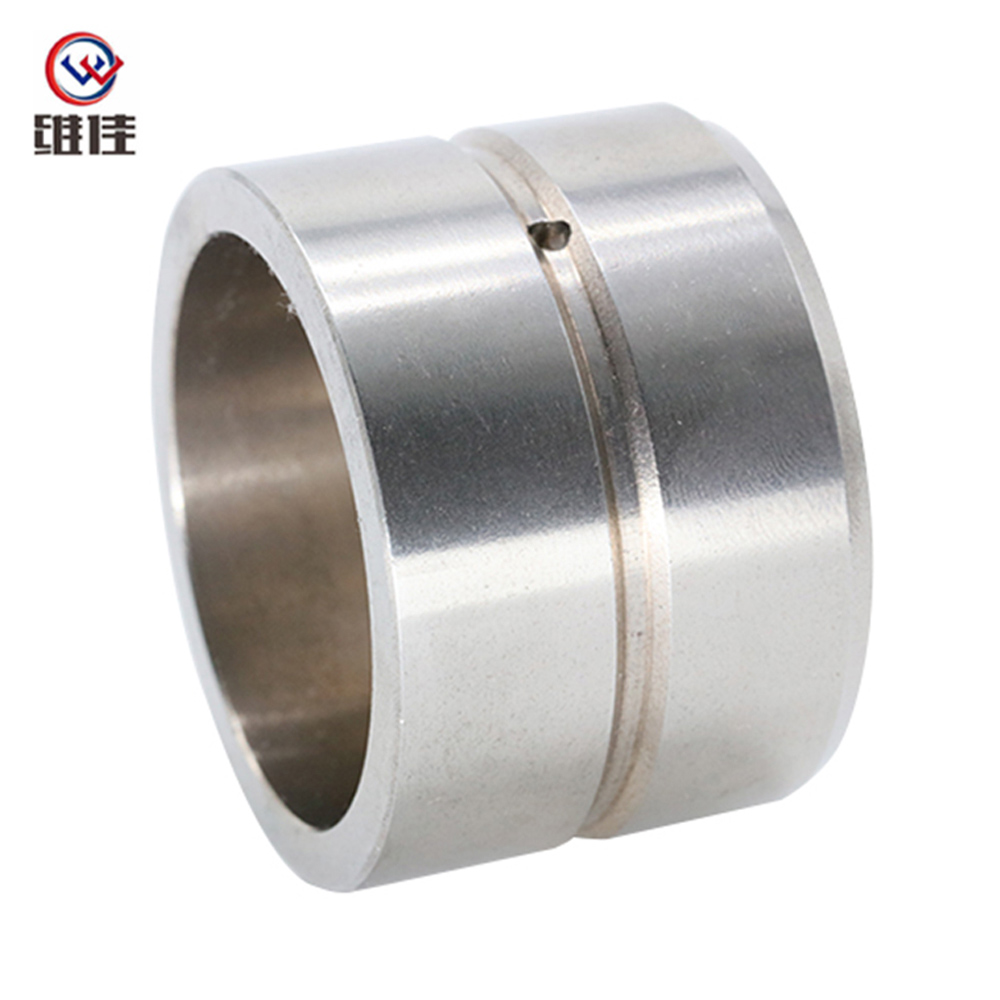
Our sintered bronze self-lubricating bearings are engineered for demanding industrial applications where traditional lubrication is impractical. Designed with advanced powder metallurgy technology, th...
See Details
Copyright © Jiande Welfine Technology Co., Ltd. All Rights Reserved. Custom Self-lubricating Sintered Bushing Manufacturers
