E-mail us: [email protected]
Tel: +86-15239857375
 English
 中文简体
中文简体

 Home / Author / Tan Xinyue — After-Sales Technical Coordinator / SAE841 Tin Bronze Open-Type Bushings for Long-Life Self-Lubricating Motion
 SAE841 Tin Bronze Open-Type Bushings for Long-Life Self-Lubricating Motion
 2026.06.18
 Tan Xinyue — After-Sales Technical Coordinator
Content
- 1 Product Overview
- 2 Why SAE841 Tin Bronze Is a Preferred Bearing Material
- 3 Advantages of the Open-Type Structure
- 4 Manufacturing Process and Its Impact on Performance
- 5 Core Product Characteristics
- 6 Performance Advantages Over Competing Solutions
- 7 Application in Vegetable Greenhouse Top Systems
- 8 Broader Industrial Application Potential
- 9 Quality Control Requirements for Reliable Bushings
- 10 Company Manufacturing Strengths
- 11 Why Precision Matters in an Open-Type Bushing
- 12 Maintenance-Free Performance and Its Economic Value
- 13 Packaging, Storage, and Handling
- 14 Customization Possibilities
- 15 Engineering Considerations for Selection
- 16 Comparison With Conventional Bronze Bushings
- 17 Role in Sustainable and Efficient Equipment Design
- 18 Q&A Section
- 18.1 What is the SAE841 Tin Bronze Open-Type Bushing used for?
- 18.2 Does the bushing require external lubrication?
- 18.3 Why is SAE841 tin bronze better than ordinary bronze for this application?
- 18.4 What advantages does the open-type design provide?
- 18.5 Is this bushing suitable for humid greenhouse environments?
- 18.6 What is the manufacturing process?
- 18.7 Can the product be customized?
- 18.8 What quality systems support production?
- 18.9 Is the bushing suitable for high-speed applications?
- 18.10 How should the bushing be stored before use?
- 19 Conclusion
- 20 References
- 21 Product: SAE841 Tin Bronze Bushing Open-Type Component
In modern mechanical assemblies, a small bushing can determine whether a system runs smoothly for years or suffers from friction, noise, seizure, and repeated maintenance. The SAE841 Tin Bronze Open-Type Bushing is designed for applications where reliable sliding performance, corrosion resistance, dimensional stability, and low maintenance are required. Made from oil-impregnated tin bronze powder metallurgy material, this component combines the durability of bronze with the self-lubricating benefit of controlled porosity.
This product is especially suitable for vegetable greenhouse top systems, including film rolling mechanisms, ventilation devices, shading systems, and agricultural automation accessories. These operating environments often include humidity, outdoor exposure, dust, seasonal temperature changes, and long service intervals. Under such conditions, conventional bushings may require frequent lubrication or replacement. The SAE841 tin bronze open-type structure offers a practical solution by storing lubricating oil inside its porous matrix and releasing it gradually during operation.
Jiande Welfine Technology Co., Ltd. manufactures this product through a controlled powder metallurgy process that includes compaction, sintering at approximately 720°C, sizing, oil impregnation, and coil packaging. With more than 20 years of experience in powder metallurgy sintering and precision machining, the company provides OEM and ODM solutions for self-lubricating bushings and sintered metal components used in agricultural equipment, industrial machinery, automotive systems, home appliances, automation devices, and many other fields.
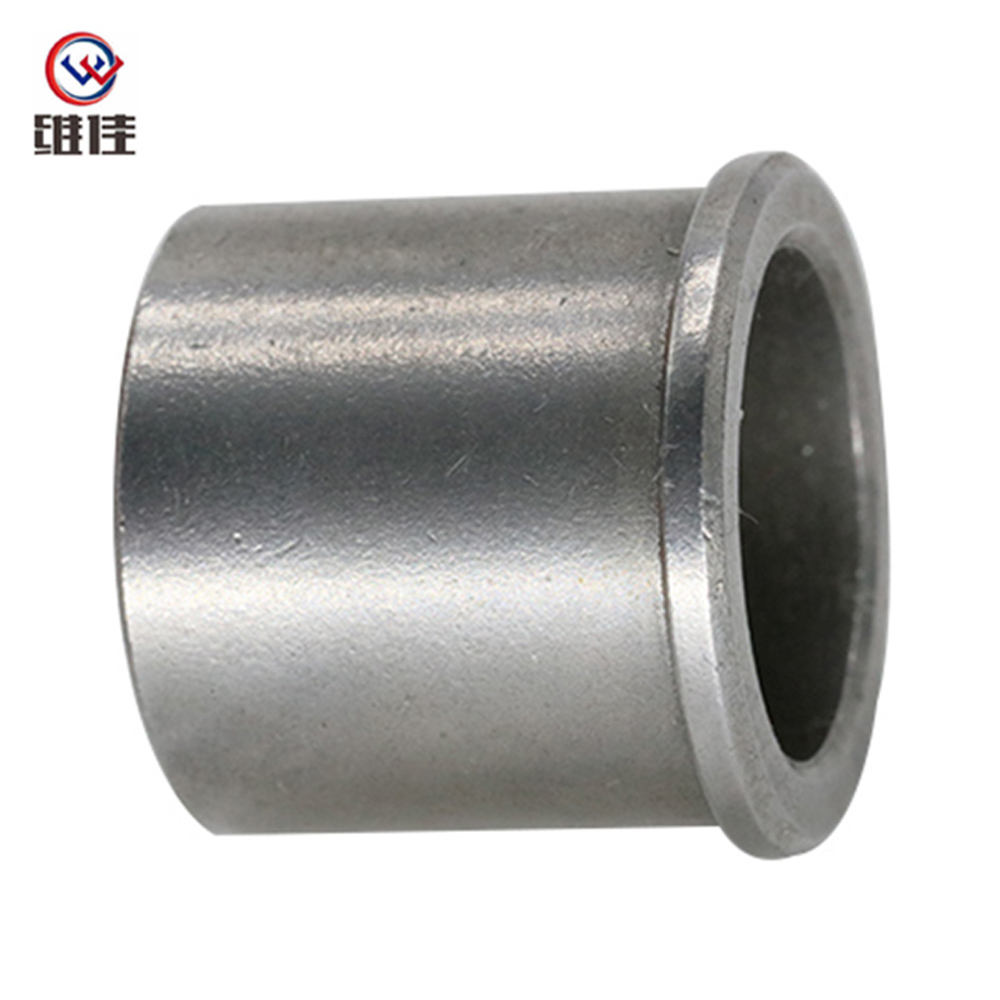
SAE841 Tin Bronze Bushing Open-Type Component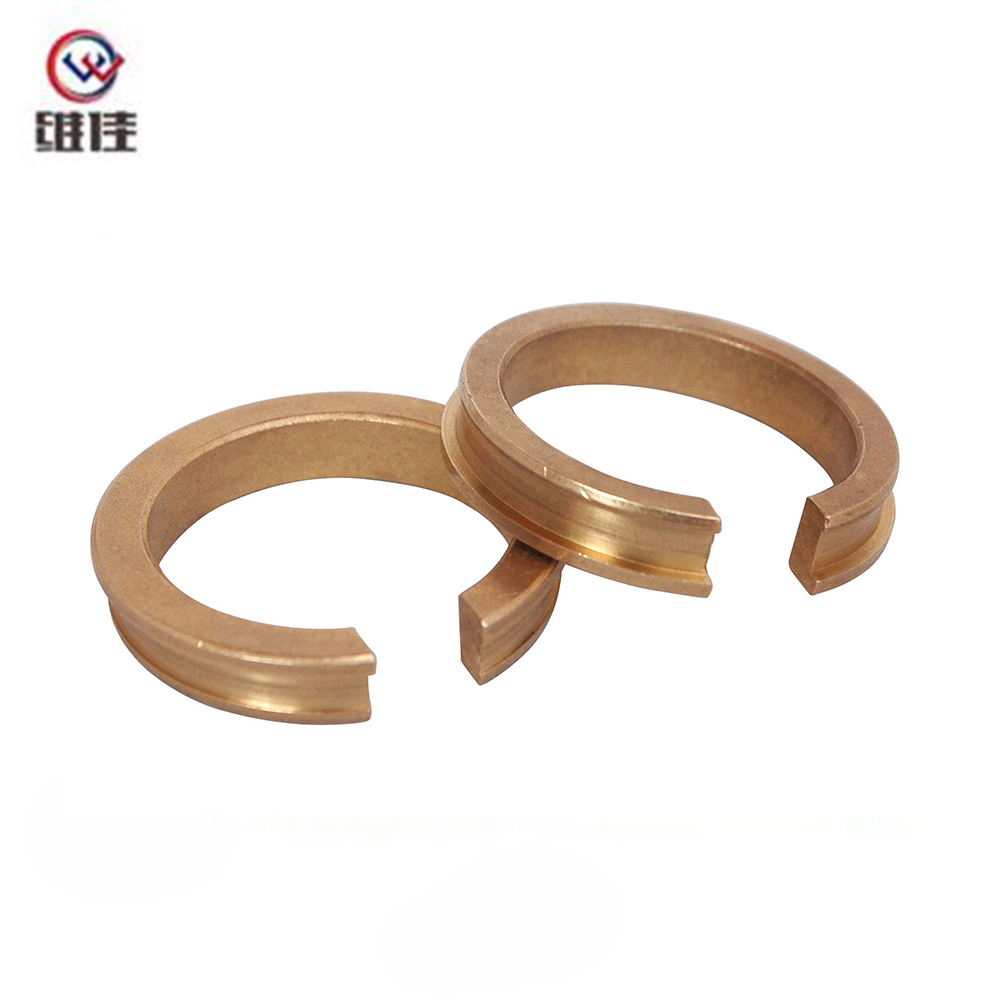
Product Overview
The SAE841 Tin Bronze Open-Type Bushing is an open-structure self-lubricating component made from SAE841 tin bronze. Its material and structure are specifically selected to provide stable performance in medium-load and medium-speed sliding applications. Unlike a fully solid cylindrical sleeve, the open-type design includes a split structure that improves assembly flexibility and allows the component to compensate for minor installation variations.
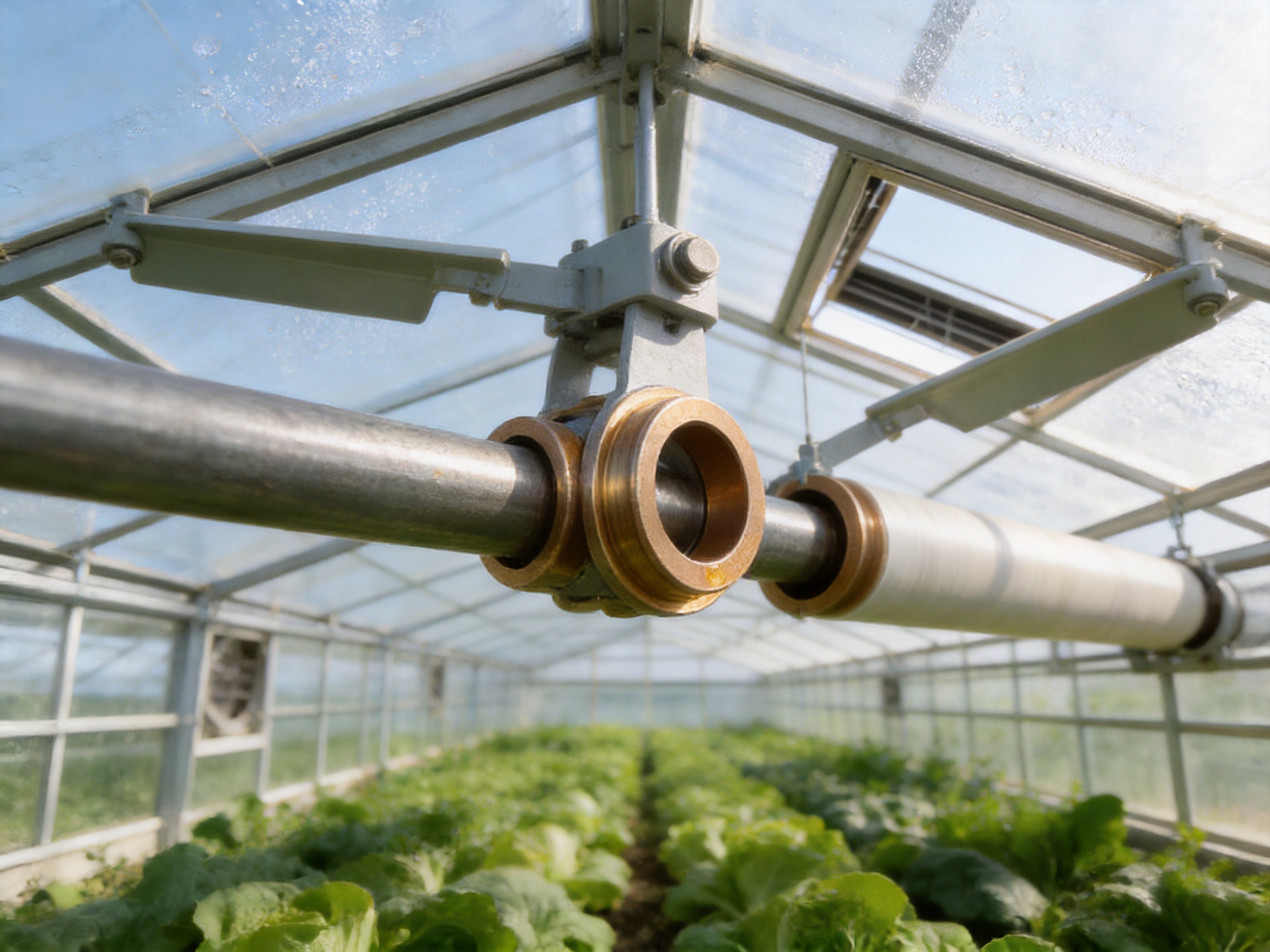
The product described here is designed as a top part for vegetable greenhouses. In greenhouse equipment, bushings often support rotating or sliding parts used in film rolling, ventilation opening, and shading systems. These systems may not operate continuously at high speed, but they must function reliably after long periods of exposure to moisture, condensation, temperature fluctuation, and outdoor contaminants. A seized or noisy bushing can affect ventilation, crop protection, and automated greenhouse operation.
The SAE841 tin bronze material offers an excellent balance between wear resistance and self-lubrication. Through powder metallurgy, the bushing contains interconnected pores that hold oil. When the shaft moves, frictional heat and mechanical pressure encourage oil to migrate to the contact surface. This forms a thin lubricating film between the shaft and the bushing, reducing metal-to-metal contact and lowering wear.
Basic product parameters include a material of SAE841 tin bronze, an open structure, a sintering temperature of approximately 720°C with process tolerance, and a manufacturing route of compaction, sintering, sizing, oil impregnation, and coil packaging. The reference dimensions are 34.7 × 42.8 × 44.5 × 1.5 × 7.5K, with customization available according to customer drawings or samples.
Why SAE841 Tin Bronze Is a Preferred Bearing Material
SAE841 is a widely recognized oil-impregnated bronze material used in self-lubricating bearings and sliding components. Its performance comes from both the bronze alloy composition and the powder metallurgy structure. Tin bronze has good mechanical strength, wear resistance, corrosion resistance, and anti-seizure behavior. When manufactured as a porous sintered material, it also becomes an effective oil reservoir.
Compared with ordinary cast bronze, SAE841 oil-impregnated bronze can operate with less external lubrication. Cast bronze is dense and strong, but it does not naturally store oil throughout its structure. Once the surface lubricant is consumed or contaminated, friction may increase. By contrast, the sintered porous bronze structure releases oil from within the part during operation, helping the contact surface maintain lubrication over a longer period.
Compared with certain plastic bushings, SAE841 tin bronze provides better thermal stability, load capacity, and dimensional reliability in many industrial environments. Plastics may offer low friction and low noise, but some grades can creep, swell, soften, or deform under heat, load, oil exposure, or outdoor conditions. Bronze-based bushings are often preferred when metallic strength, stable geometry, and long service life are priorities.
Compared with steel-backed composite bushings, an oil-impregnated bronze bushing can offer a simpler homogeneous bearing structure. Steel-backed materials may perform well in specific applications, but they depend on layered construction and coating integrity. SAE841 bronze provides lubrication through the material’s pore network, making it suitable for many medium-load applications where simple, robust construction is preferred.
For greenhouse and agricultural use, the material’s corrosion resistance is especially valuable. Greenhouse environments may contain water vapor, fertilizers, soil dust, and cleaning agents. Tin bronze is more resistant to corrosion than plain carbon steel, and the impregnated oil also contributes to surface protection. This helps extend service life and reduce the likelihood of rust-related sticking.
Advantages of the Open-Type Structure
The open-type structure is a key feature of this product. A split or open bushing can be easier to install than a rigid closed sleeve, particularly in high-volume assembly or applications where the housing bore may vary slightly. The opening provides a limited elastic adjustment during installation, helping the bushing seat properly in the housing.
For agricultural greenhouse mechanisms, open-type bushings can simplify repair or replacement work. Greenhouse systems often extend over long spans and may include many moving joints. A component that can be installed efficiently helps reduce assembly time and maintenance difficulty. The open structure can also accommodate small thermal expansion changes during outdoor service.
Another advantage is improved adaptability. In real-world equipment, housings, shafts, brackets, and frames may experience tolerance stack-up. A fully rigid bushing may be more sensitive to small deviations. The open-type design allows a degree of flexibility while still providing a stable bearing surface after installation.
The open structure also supports coil packaging. Coil packaging can be convenient for large-scale use and automated assembly because components can be supplied in a format that supports efficient handling. For manufacturers producing greenhouse equipment, film rolling devices, or automation accessories, this can contribute to lower assembly cost and more consistent production flow.
Although open-type bushings provide flexibility, proper engineering selection remains important. Housing fit, shaft hardness, surface finish, load, alignment, and operating speed all influence performance. When these factors are properly controlled, the SAE841 tin bronze open-type bushing can deliver reliable, low-maintenance operation.
Manufacturing Process and Its Impact on Performance
The quality of a self-lubricating powder metallurgy bushing depends heavily on manufacturing control. The process is not simply about forming a bronze shape. It requires precise control of powder characteristics, pressing pressure, sintering temperature, dimensional calibration, oil content, and final inspection.
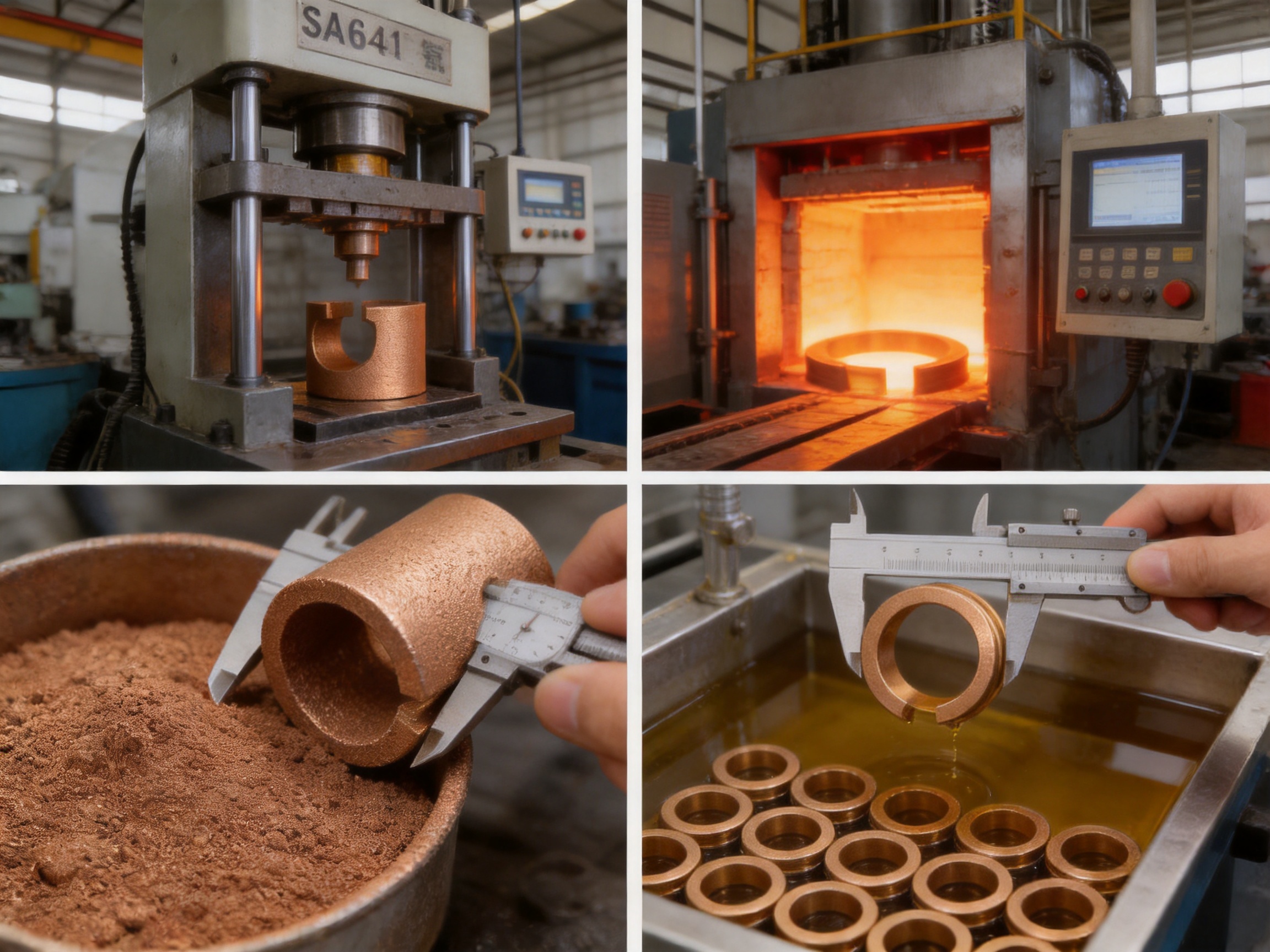
Jiande Welfine Technology Co., Ltd. manufactures SAE841 tin bronze open-type bushings through a process that begins with powder compaction. Bronze powder is pressed in a precision mold to create the initial form. This step determines the green density and influences the final porosity distribution. Uniform compaction is essential because uneven density can cause inconsistent oil storage, strength differences, or dimensional instability.
After compaction, the parts are sintered at approximately 720°C. Sintering bonds the metal particles together and develops the final porous structure. Temperature control is critical. If sintering is insufficient, the component may lack strength. If the process is excessive or poorly controlled, porosity may be reduced or distorted, affecting oil impregnation and self-lubricating performance.
Sizing follows sintering. During sizing, the bushing is precisely calibrated to achieve the required dimensions and surface accuracy. This step is particularly important for bearing components because internal diameter, external diameter, roundness, and wall thickness affect fit, friction, noise, and service life. High-dimensional precision supports stable assembly and reliable running performance.
Oil impregnation is then performed, commonly using a vacuum process. The interconnected pores absorb lubricating oil, transforming the sintered bronze component into a self-lubricating bearing. The oil content must be sufficient and consistent. Too little oil can shorten service life, while uncontrolled impregnation may affect cleanliness or packaging. Proper oil impregnation is one of the main reasons SAE841 bushings can operate with reduced external lubrication.
The final step for this product is coil packaging. Professional coil packaging supports easy storage, transport, and use, especially for customers requiring large quantities or automated assembly. Packaging must also protect the parts from moisture, contamination, and corrosion before installation.
Core Product Characteristics
| Feature | SAE841 Tin Bronze Open-Type Bushing Benefit | Practical Value for Users |
| Oil-impregnated porous structure | Stores and releases lubricant during operation | Reduces maintenance frequency and improves smooth movement |
| Tin bronze material | Provides wear resistance, corrosion resistance, and anti-seizure behavior | Supports long service life in humid or outdoor environments |
| Open-type design | Allows easier installation and tolerance compensation | Improves assembly efficiency and replacement convenience |
| Precision sizing | Improves dimensional accuracy after sintering | Promotes stable fit, low noise, and reliable operation |
| Coil packaging | Supports efficient storage and high-volume use | Helps customers manage production and assembly more effectively |
Performance Advantages Over Competing Solutions
When selecting a bushing, buyers often compare several options: solid bronze sleeves, plastic bushings, steel sleeves, composite bushings, needle bearings, and oil-impregnated sintered bronze bushings. Each option has value, but the SAE841 tin bronze open-type bushing offers a strong combination of performance, cost efficiency, and low maintenance for many applications.
Against solid bronze bushings, the main advantage is self-lubrication. Solid bronze is durable but usually requires periodic lubrication. In hard-to-reach greenhouse top assemblies, regular lubrication may be inconvenient. SAE841 material stores oil inside its porous structure, reducing the need for manual lubrication under suitable operating conditions.
Against plain steel sleeves, SAE841 tin bronze provides better friction behavior and corrosion resistance. Steel sleeves may be strong, but they can rust and may seize without adequate lubrication. In humid agricultural applications, corrosion can quickly become a problem. Bronze-based oil-impregnated materials are better suited to resisting moisture-related issues.
Against plastic bushings, SAE841 tin bronze often provides superior dimensional stability, load capacity, and resistance to creep. Plastics can be excellent in light-duty applications, but under repeated load, heat, or outdoor exposure, dimensional changes may occur. A sintered bronze component is more stable in many mechanical systems.
Against needle bearings, the SAE841 bushing is simpler and often more tolerant of contamination. Needle bearings can provide low rolling friction, but they require precise alignment, good sealing, and clean lubrication. In dusty or humid agricultural equipment, a plain self-lubricating bushing can be more practical and cost-effective.
Against graphite-plugged bronze bearings, SAE841 oil-impregnated bronze may be more suitable for small, precision, or high-volume components. Graphite-plugged bearings are useful in heavy-load or high-temperature applications, but they can be more expensive and may not be necessary for medium-load greenhouse mechanisms. SAE841 provides a balanced solution with good wear resistance and economical production.
Application in Vegetable Greenhouse Top Systems
The product’s stated application is top parts for vegetable greenhouses. This is a demanding but often underestimated operating environment. Greenhouse roof systems must support controlled movement for ventilation, shading, and film rolling. These movements may occur daily or seasonally, depending on climate and crop requirements.
Film rolling mechanisms require smooth rotation or sliding to open and close plastic films. If bushings wear out or seize, the film may not roll evenly, causing gaps, tearing, or poor environmental control. A self-lubricating bronze bushing helps maintain smooth movement and reduces friction at rotating joints.
Ventilation and window opening systems also benefit from stable bushings. Greenhouse ventilation often depends on synchronized opening and closing to control temperature and humidity. A stuck or noisy mechanism can interfere with automation and may require manual intervention. SAE841 bushings help provide reliable motion even when maintenance access is limited.
Sunshade net driving and sliding systems require components that can withstand outdoor conditions and repeated movement. Moisture, dust, and temperature changes can accelerate wear in poorly selected materials. Tin bronze’s corrosion resistance and the oil-impregnated structure help extend service life in these conditions.
Agricultural greenhouse automation equipment increasingly demands consistent components. As more greenhouses adopt motorized film rollers, automatic vents, and intelligent shading controls, the need for maintenance-free or low-maintenance bearing parts grows. The SAE841 tin bronze open-type bushing matches this trend by offering stable mechanical support without complex lubrication systems.
Broader Industrial Application Potential
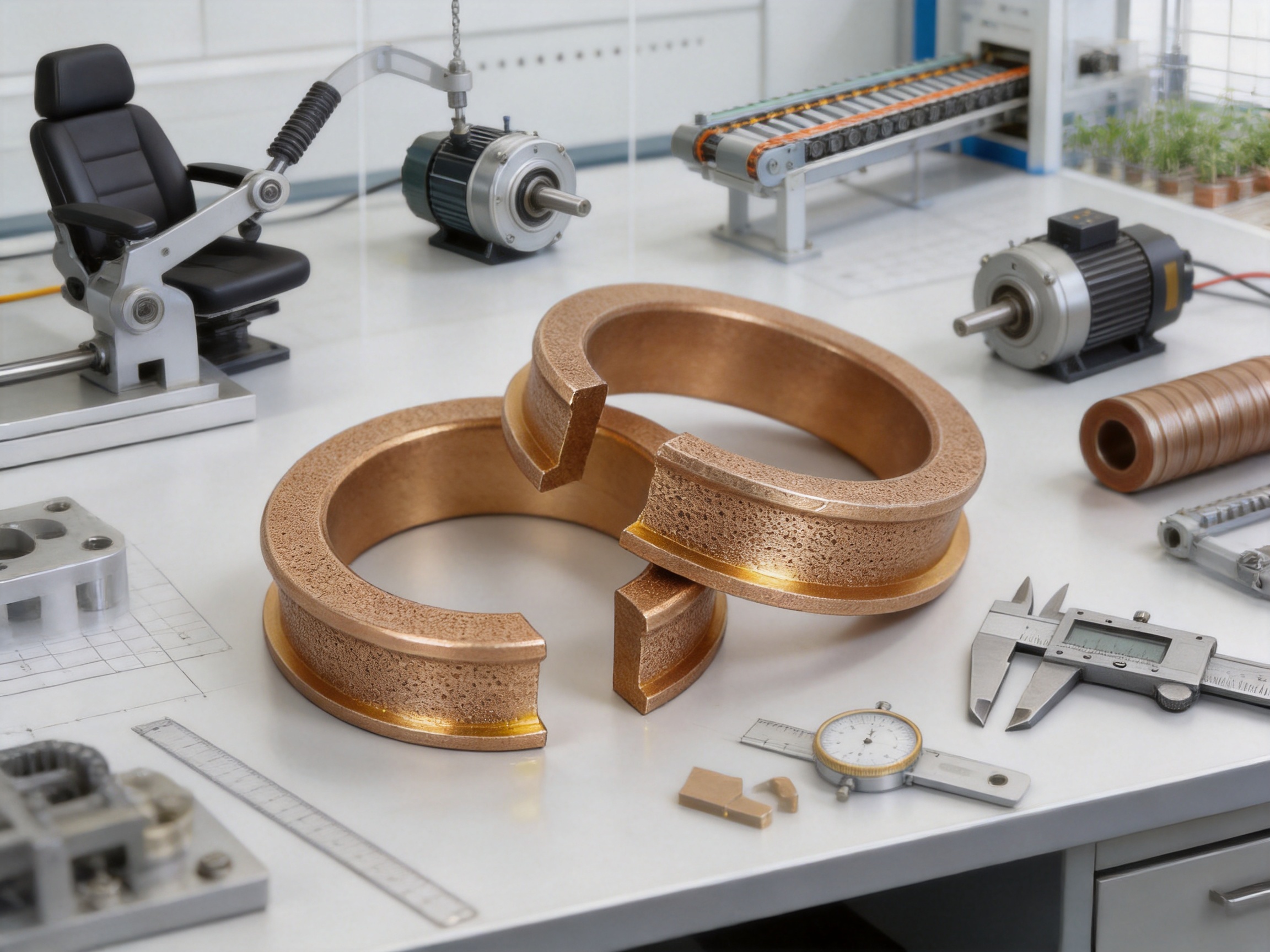
Although this product is designed for greenhouse top applications, SAE841 tin bronze open-type bushings are widely applicable in many industries. Their self-lubricating function, good wear resistance, and compact structure make them suitable for medium-speed and medium-load motion systems.
In the automotive industry, self-lubricating bushings can be used in seat adjustment mechanisms, small motor assemblies, hinges, linkages, and auxiliary devices. Automotive applications require stable quality, repeatability, and long-term reliability. A manufacturer with IATF 16949:2016 certification is better positioned to meet these strict requirements.
In industrial automation, bushings are used in conveyors, reduction mechanisms, guide systems, and light-duty rotating joints. Equipment downtime can be expensive, so a low-maintenance bearing component can reduce service interruptions and improve productivity.
In home appliances and power tools, bushings must often be compact, quiet, and cost-effective. SAE841 bushings provide low friction and controlled wear, supporting smooth operation in fans, washing machines, small motors, and similar products.
In office equipment, such as printers and copiers, bushings support rollers and moving parts. Quiet operation and dimensional consistency are important. Oil-impregnated bronze components help reduce noise and maintain stable motion over repeated cycles.
In new energy equipment and smart devices, compact mechanical systems often require reliable small sliding components. As equipment becomes more automated, demand for stable, self-lubricating, and customizable bushings will continue to grow.
Quality Control Requirements for Reliable Bushings
A bushing may look simple, but its quality depends on many hidden parameters. For an oil-impregnated sintered bronze part, porosity, density, oil content, dimensional precision, surface condition, and material consistency all matter. A failure in any of these areas can reduce service life.
Full-dimensional inspection is important because bushings must fit correctly into housings and around shafts. If the inner diameter is too small, friction and heat may increase. If it is too large, vibration, noise, and misalignment may occur. If the outer diameter is inconsistent, the bushing may not seat securely.
Oil content inspection ensures that the self-lubricating function is reliable. A bushing with insufficient oil may perform well during initial testing but fail prematurely in actual service. Consistent impregnation helps maintain long-term lubrication.
Appearance inspection also matters. Cracks, deformation, burrs, contamination, or surface defects can affect installation and performance. For open-type components, the split structure must be formed accurately to allow proper assembly behavior.
Jiande Welfine Technology Co., Ltd. applies strict process control from powder to finished product. The company’s production base is equipped with high-efficiency presses, high-temperature sintering furnaces, precision forming machines, and testing equipment. This manufacturing foundation supports stable output for both standard and customized products.
The company has passed ISO 9001:2015 and IATF 16949:2016 certifications. These quality systems emphasize process management, traceability, risk prevention, corrective action, and continuous improvement. For customers sourcing bushings in large quantities, such certifications are important indicators of manufacturing reliability.
Company Manufacturing Strengths
Jiande Welfine Technology Co., Ltd. was established in 2001 and has developed into a high-tech enterprise integrating research, development, production, and sales. The company focuses on powder metallurgy sintering and related precision machining, with products including powder metallurgy bushings, self-lubricating bushings, and various precision sintered parts.
The company operates a modern production base covering 13,039 square meters. This scale supports stable production capacity, systematic workflow, and the ability to serve both domestic and international customers. More than 150 skilled employees contribute to production, engineering, quality inspection, and customer support.
Advanced manufacturing equipment is essential for powder metallurgy components. High-efficiency presses help ensure consistent compacting density. High-temperature sintering furnaces support reliable metallurgical bonding and controlled porosity. Precision forming and sizing machines improve dimensional accuracy. Testing equipment verifies that finished products meet technical requirements before delivery.
With more than 20 years of industry experience, the company understands not only how to manufacture parts but also how to match bushing materials and structures to customer applications. This is important because a technically correct bushing must be selected according to load, speed, shaft material, temperature, lubrication conditions, and installation method.
The company offers OEM and ODM customization based on drawings or samples. Customers can request specific dimensions, material adjustments, surface treatments, packaging formats, and production quantities. This flexibility is valuable for equipment manufacturers who require unique components that cannot be satisfied by standard catalog sizes.
Stable supply capacity is another competitive strength. For customers manufacturing greenhouse systems, industrial equipment, automotive assemblies, or appliances, delayed component delivery can disrupt production schedules. A supplier with mature production planning and quality control provides long-term value beyond the unit price of a bushing.
Why Precision Matters in an Open-Type Bushing
Open-type bushings require careful dimensional control because the split structure must work with the housing to form the final installed geometry. If the part is too loose, it may shift during operation. If it is too tight, installation may deform the bearing surface. Precision sizing helps ensure the correct balance.
The wall thickness and open gap also influence performance. Uneven wall thickness can cause localized loading and accelerated wear. An inconsistent gap may affect installation force or fit. For automated assembly, consistency becomes even more important because machines rely on predictable component geometry.
The inner surface finish affects friction. A properly controlled bearing surface supports the formation of the oil film and reduces shaft wear. If the surface is too rough, it may increase friction. If it is damaged or contaminated, lubrication may be disrupted. Precision manufacturing and inspection help avoid these problems.
Dimensional stability is especially important in outdoor greenhouse systems. Temperature changes can cause expansion and contraction in frames, shafts, and housings. The open-type bushing’s structure gives it some adaptability, while the bronze material retains good mechanical stability compared with many polymer alternatives.
Maintenance-Free Performance and Its Economic Value
One of the strongest selling points of the SAE841 tin bronze open-type bushing is reduced maintenance. In many applications, maintenance cost is not limited to the price of grease or replacement parts. It also includes labor, equipment downtime, accessibility challenges, and production interruption.
In greenhouse systems, maintenance may require workers to access elevated structures, stop automatic systems, or work around crops and irrigation equipment. A self-lubricating bushing can reduce the need for frequent manual lubrication, saving time and improving operational reliability.
In industrial machinery, downtime can be much more costly than the bushing itself. A low-cost component that fails early can create expensive consequences. Therefore, selecting a high-quality oil-impregnated bronze bushing can reduce total ownership cost even if its initial purchase price is higher than a basic sleeve.
For equipment manufacturers, using reliable bushings can also improve product reputation. Customers judge machinery by noise, smoothness, durability, and service requirements. A well-selected bushing contributes to better user experience and fewer warranty issues.
Packaging, Storage, and Handling
Because SAE841 bushings contain impregnated oil and have precision dimensions, packaging and storage are important. Professional anti-rust and moisture-proof treatment helps protect parts before installation. Coil packaging supports convenient transportation and efficient use in production environments.
Products should be stored in a dry, ventilated, and non-corrosive environment. Exposure to excessive moisture, corrosive chemicals, or contamination should be avoided. Clean handling helps maintain the bearing surface and prevents foreign particles from entering the sliding interface during assembly.
Before installation, users should verify that the housing bore and shaft are clean and within tolerance. Sharp edges, burrs, and misalignment should be corrected. Even a high-quality self-lubricating bushing can underperform if installed in a damaged or poorly prepared assembly.
Customization Possibilities
The SAE841 tin bronze open-type bushing can be customized according to customer drawings and samples. This is important because different applications require different dimensions, tolerances, oil types, packaging methods, and sometimes material modifications.
Customers may request adjustments in inner diameter, outer diameter, length, wall thickness, open gap, chamfer, groove, or other structural details. For automated assembly, packaging and feeding requirements can also be discussed. For special operating environments, oil selection or surface treatment may need to be evaluated.
Sample testing is available for customers who need to validate performance before mass production. Small-batch production can support prototype development, while mass production supports long-term supply after the design is approved.
OEM and ODM service is especially useful for equipment manufacturers that want a component optimized for their system rather than a generic replacement. By working with an experienced powder metallurgy supplier, customers can improve fit, reduce noise, extend service life, and control cost.
Engineering Considerations for Selection
To achieve the best performance from an SAE841 tin bronze open-type bushing, engineers should consider operating load, speed, shaft material, shaft hardness, surface finish, temperature, environment, and alignment. The bushing is generally suitable for medium-speed and medium-load applications, but final selection should be based on actual operating conditions.
Shaft quality is important. A smooth, properly hardened shaft can reduce wear and help maintain a stable lubricating film. A rough, soft, or corroded shaft may damage the bushing surface and shorten service life.
Housing fit must be controlled. The bushing relies on correct installation to achieve proper roundness and support. If the housing is oversized, the bushing may move. If it is undersized, excessive compression may reduce clearance and increase friction.
Temperature should also be evaluated. SAE841 bronze performs well in many normal industrial and agricultural environments, but extreme heat may require special lubricant selection or an alternative bearing material. High load or high speed may also require additional lubrication or design modification.
Contamination should be considered. Although plain bushings can be more tolerant than rolling bearings in some dirty environments, abrasive particles can still accelerate wear. Sealing, shielding, or periodic cleaning may be useful in dusty applications.
Comparison With Conventional Bronze Bushings
Conventional bronze bushings remain common because bronze is strong, machinable, and wear resistant. However, many conventional bronze sleeves are dense and require regular external lubrication. If lubrication is missed, friction increases and seizure may occur.
The SAE841 tin bronze open-type bushing improves this situation by integrating lubrication into the material itself. Its porous structure stores oil throughout the bushing wall. During operation, oil is released to the surface and then can be reabsorbed when the system stops. This dynamic lubrication behavior helps reduce friction and wear.
The open-type structure further differentiates it from a standard cylindrical sleeve. Installation flexibility can be valuable in high-volume production and field service. For greenhouse systems where components may be installed across long frames or repeated mechanisms, easier installation has real practical value.
In terms of total cost, SAE841 bushings can reduce maintenance, downtime, and replacement frequency. The initial part cost should be evaluated together with service life and labor savings. For many medium-duty applications, the oil-impregnated open-type bushing offers a more economical long-term solution.
Role in Sustainable and Efficient Equipment Design
Modern equipment design increasingly emphasizes energy efficiency, reduced maintenance, and longer service life. Friction losses in mechanical systems may seem small at individual bearing points, but across many moving joints they can affect power consumption and system reliability.
By lowering friction, SAE841 tin bronze bushings can help reduce driving resistance in mechanical assemblies. In greenhouse automation, this may support smoother motor operation and reduce stress on actuators. In industrial systems, lower friction contributes to better efficiency and less heat generation.
Reduced maintenance also has sustainability value. Fewer lubrication operations mean less lubricant consumption and less risk of improper disposal. Longer component life reduces replacement frequency and material waste. A durable self-lubricating bushing therefore supports both economic and environmental goals.
The powder metallurgy process itself is also material-efficient compared with some traditional machining methods. Powder is compacted close to final shape, reducing material waste. For high-volume precision parts, this near-net-shape advantage is one reason powder metallurgy remains widely used.
Q&A Section
What is the SAE841 Tin Bronze Open-Type Bushing used for?
It is used as a self-lubricating sliding component in mechanical assemblies. The product described here is especially designed for top parts of vegetable greenhouses, including film rolling mechanisms, ventilation systems, shading systems, and agricultural automation equipment.
Does the bushing require external lubrication?
Under suitable operating conditions, the bushing can provide long-term self-lubrication because oil is stored inside its porous SAE841 bronze structure. However, supplementary lubrication may be recommended for high-load, high-speed, high-temperature, or highly contaminated applications.
Why is SAE841 tin bronze better than ordinary bronze for this application?
SAE841 tin bronze is manufactured as an oil-impregnated porous material. Unlike dense ordinary bronze, it stores lubricating oil and releases it during operation. This reduces friction, lowers maintenance needs, and improves service life in many medium-duty applications.
What advantages does the open-type design provide?
The open-type design improves installation flexibility, allows limited tolerance compensation, and can simplify assembly or replacement. It is useful for high-volume production and applications where slight housing or thermal variations may occur.
Is this bushing suitable for humid greenhouse environments?
Yes. Tin bronze provides good corrosion resistance, and the oil-impregnated structure supports smooth operation in humid or outdoor environments. Proper storage, installation, and system design further improve service life.
What is the manufacturing process?
The process includes powder compaction, sintering at approximately 720°C, sizing, vacuum oil impregnation, and coil packaging. Each step affects strength, porosity, dimensional accuracy, oil content, and final bearing performance.
Can the product be customized?
Yes. Jiande Welfine Technology Co., Ltd. provides OEM and ODM customization according to customer drawings or samples. Dimensions, materials, surface treatments, packaging, and batch quantities can be discussed according to project requirements.
What quality systems support production?
The company has ISO 9001:2015 and IATF 16949:2016 certifications. These systems support consistent manufacturing, process control, traceability, and continuous quality improvement.
Is the bushing suitable for high-speed applications?
It is generally optimized for medium-speed and medium-load conditions. For high-speed, high-impact, or extreme-temperature applications, engineering evaluation is recommended to confirm suitability or identify a better bearing solution.
How should the bushing be stored before use?
It should be stored in a dry, ventilated, and non-corrosive environment. Moisture, dust, corrosive chemicals, and mechanical damage should be avoided to preserve the bearing surface and oil-impregnated function.
Conclusion
The SAE841 Tin Bronze Open-Type Bushing is a practical, reliable, and cost-effective solution for applications requiring self-lubrication, wear resistance, corrosion resistance, and installation flexibility. Its oil-impregnated porous bronze structure reduces dependence on frequent external lubrication, while the open-type design supports easier assembly and tolerance adaptability.
For vegetable greenhouse top systems, the bushing offers clear advantages in film rolling, ventilation, shading, and automation mechanisms. It is well suited to humid and outdoor conditions where maintenance access may be limited and long-term stability is essential.
Compared with solid bronze, steel, plastic, needle bearing, and some composite alternatives, SAE841 tin bronze open-type bushings provide a balanced combination of durability, self-lubrication, dimensional stability, and economic value. Their performance depends not only on material selection but also on manufacturing precision.
Jiande Welfine Technology Co., Ltd. strengthens this product value through more than 20 years of powder metallurgy experience, a 13,039-square-meter production base, advanced pressing and sintering equipment, precision sizing capability, strict inspection, and ISO 9001:2015 and IATF 16949:2016 quality certifications. With OEM and ODM customization, the company can support customers requiring standard or application-specific bushing solutions.
As agricultural automation, industrial machinery, and smart equipment continue to demand low-maintenance components, SAE841 tin bronze open-type bushings will remain an important choice for dependable sliding motion and long service life.
References
ASTM International. Standard practices and specifications related to powder metallurgy materials and self-lubricating bearings.
Metal Powder Industries Federation. Powder Metallurgy Design Manual.
ASM International. ASM Handbook: Powder Metallurgy.
SAE International. Technical references on oil-impregnated bronze bearing materials.
ISO 9001:2015. Quality Management Systems Requirements.
IATF 16949:2016. Automotive Quality Management System Standard.
Engineering literature on porous bronze bearings, boundary lubrication, and sliding wear mechanisms.
Product: SAE841 Tin Bronze Bushing Open-Type Component

Related products
-
-
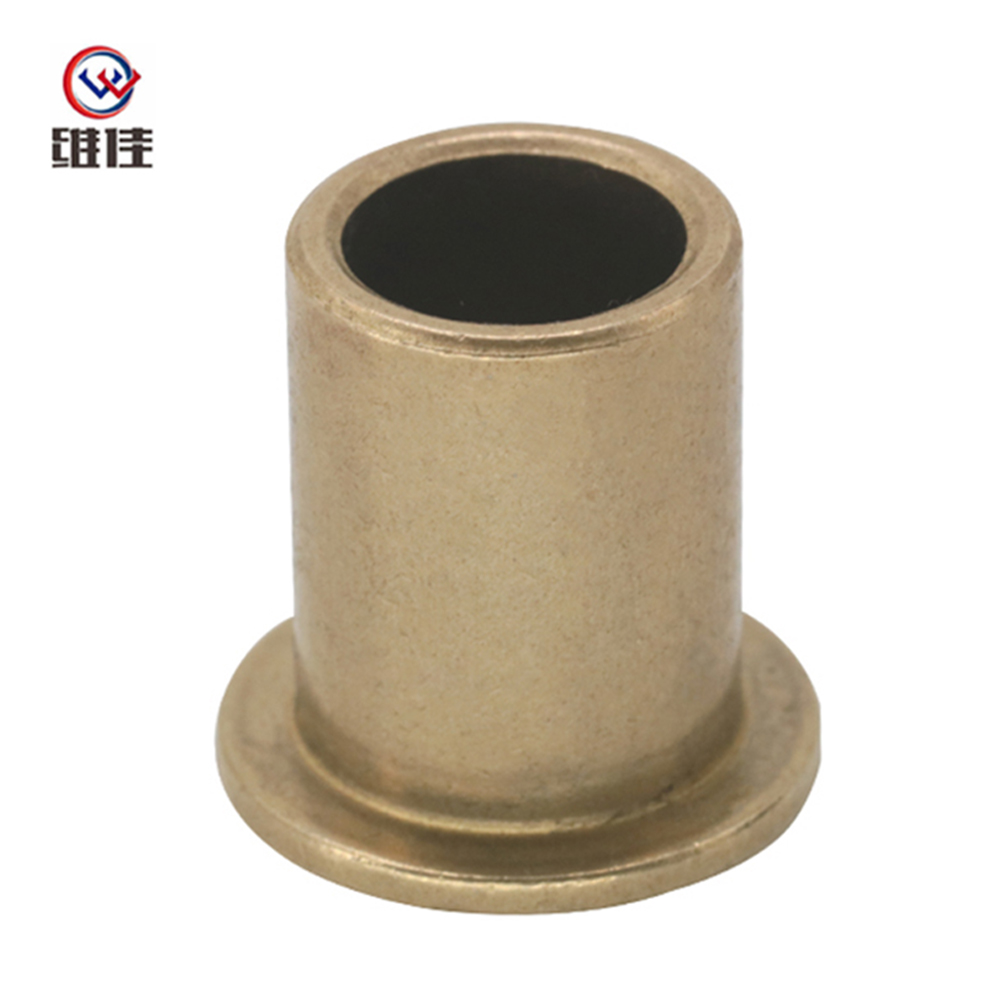
Our sintered bronze self-lubricating bearings are engineered for demanding industrial applications where traditional lubrication is impractical. Designed with advanced powder metallurgy technology, th...
See Details
Copyright © Jiande Welfine Technology Co., Ltd. All Rights Reserved. Custom Self-lubricating Sintered Bushing Manufacturers
