E-mail us: [email protected]
Tel: +86-15239857375
 English
 中文简体
中文简体

 Home / Author / Tan Xinyue — After-Sales Technical Coordinator / Powder Metallurgy Self-Lubricating Tin Bronze Flanged Bushings for Reliable Pump Performance
 Powder Metallurgy Self-Lubricating Tin Bronze Flanged Bushings for Reliable Pump Performance
 2026.07.26
 Tan Xinyue — After-Sales Technical Coordinator
Content
- 1 What Is a Powder Metallurgy Self-Lubricating Tin Bronze Flanged Bushing?
- 2 Why Tin Bronze Is Suitable for Flanged Bushings
- 3 How the Self-Lubricating Mechanism Works
- 4 Main Advantages of the Flanged Design
- 5 Performance Benefits in Pump Applications
- 6 Advantages Compared with Conventional Bronze Bushings
- 7 Reference Technical Parameters
- 8 Manufacturing Process for Consistent Bushing Quality
- 9 Engineering Benefits of Near-Net-Shape Production
- 10 Customization for Pump and Industrial Equipment Manufacturers
- 11 Applications Across Pump Systems
- 12 Applications Beyond Pumps
- 13 Installation Recommendations
- 14 Factors That Affect Service Life
- 15 Why Choose Welfine for Custom Sintered Bushings?
- 16 How to Select the Correct Bushing Specification
- 17 Frequently Asked Questions
- 17.1 What makes a flanged bushing self-lubricating?
- 17.2 Why is a flange useful on a bronze bushing?
- 17.3 Are these bushings suitable for pumps?
- 17.4 Do self-lubricating bushings require any additional oil?
- 17.5 What materials are available?
- 17.6 What dimensions can be customized?
- 17.7 What is the typical dimensional accuracy?
- 17.8 Can the bushing be used in high-temperature applications?
- 17.9 How does powder metallurgy reduce cost?
- 17.10 Can Welfine produce trial quantities?
- 17.11 What quality certifications does Welfine have?
- 17.12 How should the bushing be stored?
- 18 Conclusion
- 19 References
- 20 Product: Powder Metallurgy Self-lubricating Tin Bronze Flanged Bushing
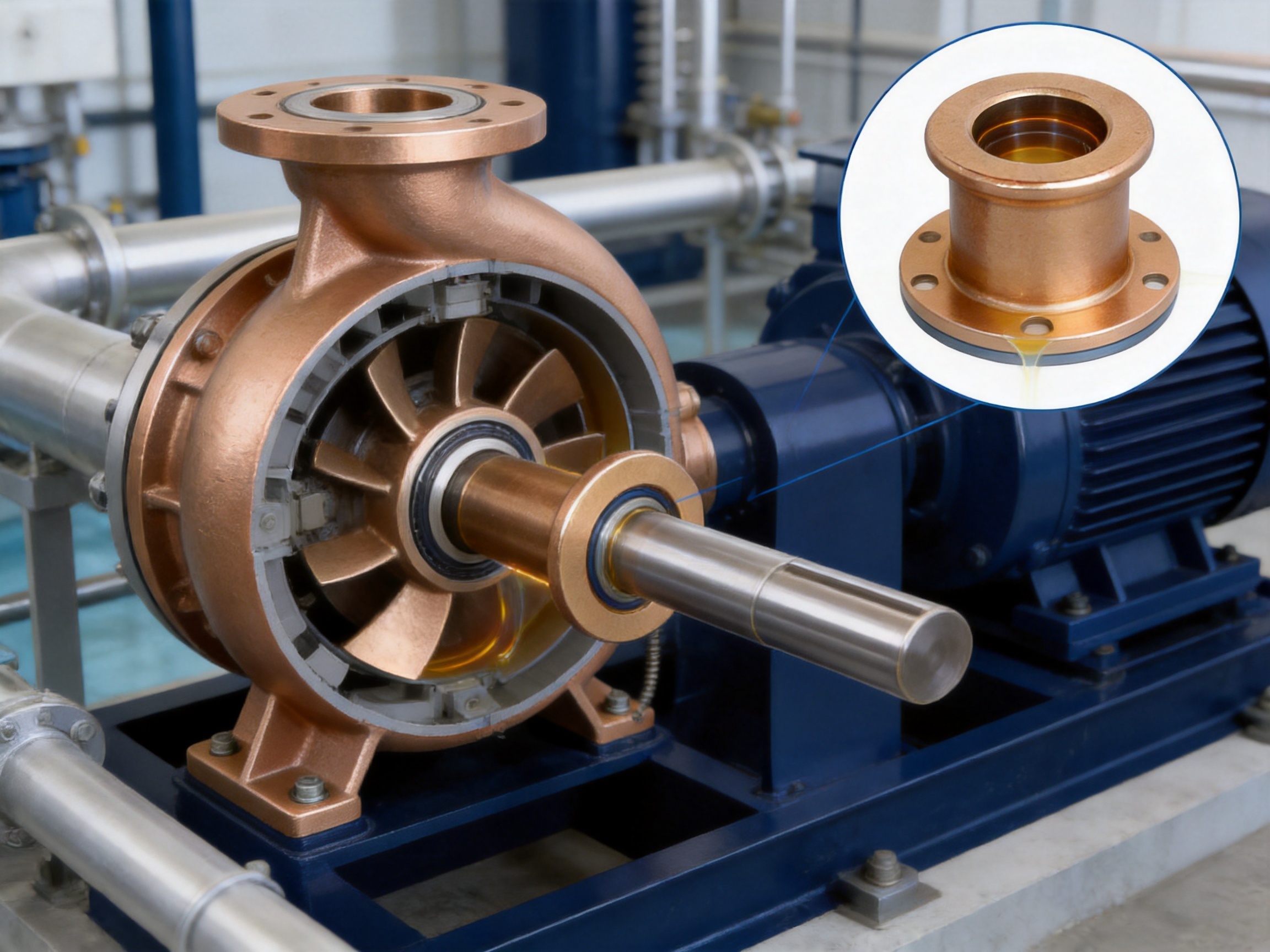
Industrial pumps are expected to operate reliably under continuous loads, changing temperatures, vibration, and demanding environmental conditions. Within many pump assemblies, the bushing is a small component with a major influence on efficiency, alignment, noise, wear, and service life. When a bushing loses lubrication, develops excessive clearance, or suffers seizure, the result can be shaft damage, vibration, leakage, unplanned maintenance, and costly production downtime.
Powder metallurgy self-lubricating tin bronze flanged bushings provide a practical solution for applications that require stable low-friction performance with limited routine maintenance. Their porous bronze structure stores lubricating oil inside the component and releases it automatically during operation. At the same time, the integrated flange supports axial positioning, simplifies assembly, and helps maintain the correct relationship between the shaft and surrounding components.
Jiande Welfine Technology Co., Ltd. manufactures customized powder metallurgy bushings and precision sintered metal components for industrial customers. With more than 20 years of experience, a modern 13,039-square-meter production base, advanced forming and sintering equipment, and certified quality management systems, the company supports OEM and ODM projects based on drawings, samples, and application requirements.
This article explains the structure, working principle, material characteristics, manufacturing process, performance advantages, application suitability, customization capabilities, inspection standards, and purchasing considerations associated with self-lubricating tin bronze flanged bushings.
What Is a Powder Metallurgy Self-Lubricating Tin Bronze Flanged Bushing?
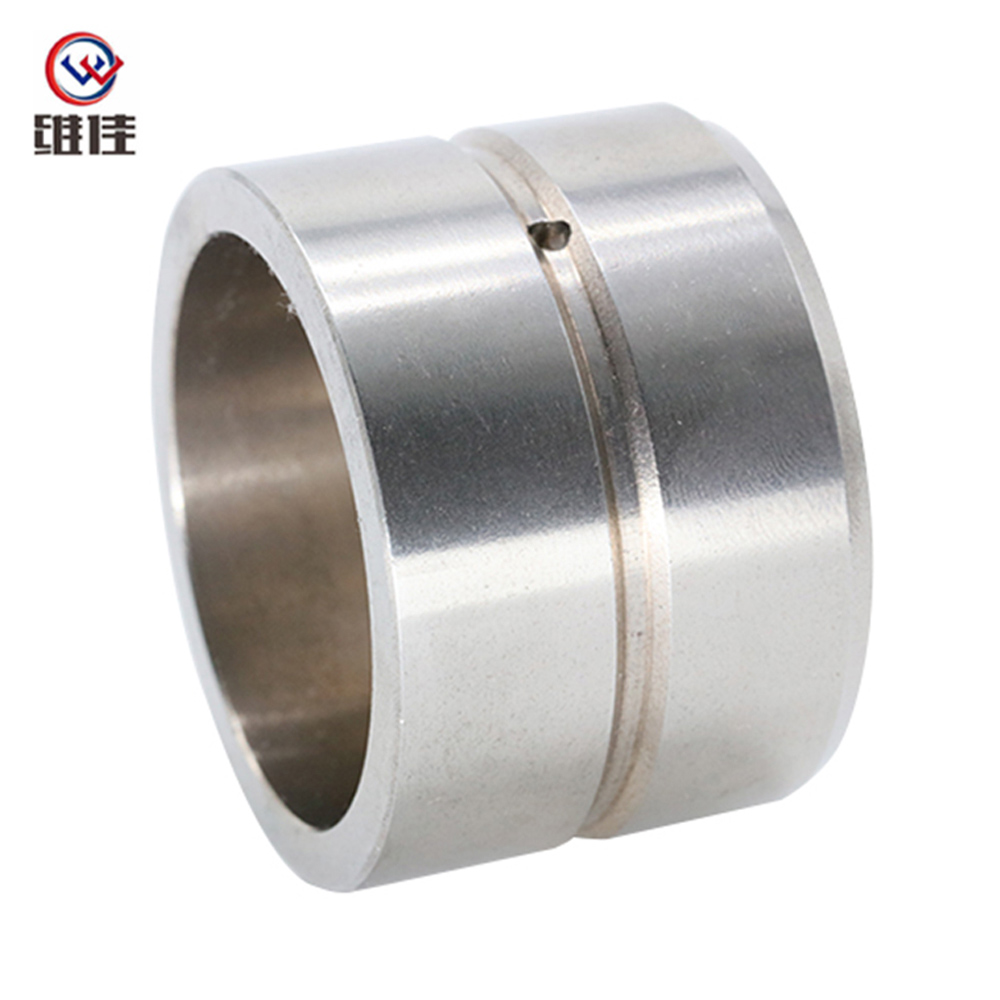
A self-lubricating flanged bushing is a plain bearing component with a cylindrical bearing surface and an integrated flange. The cylindrical section supports radial movement between a shaft and housing, while the flange provides axial positioning or axial load support. Unlike a standard solid bronze bushing that normally depends on grease or oil supplied from outside, an oil-impregnated powder metallurgy bushing contains lubricant within its internal pore network.
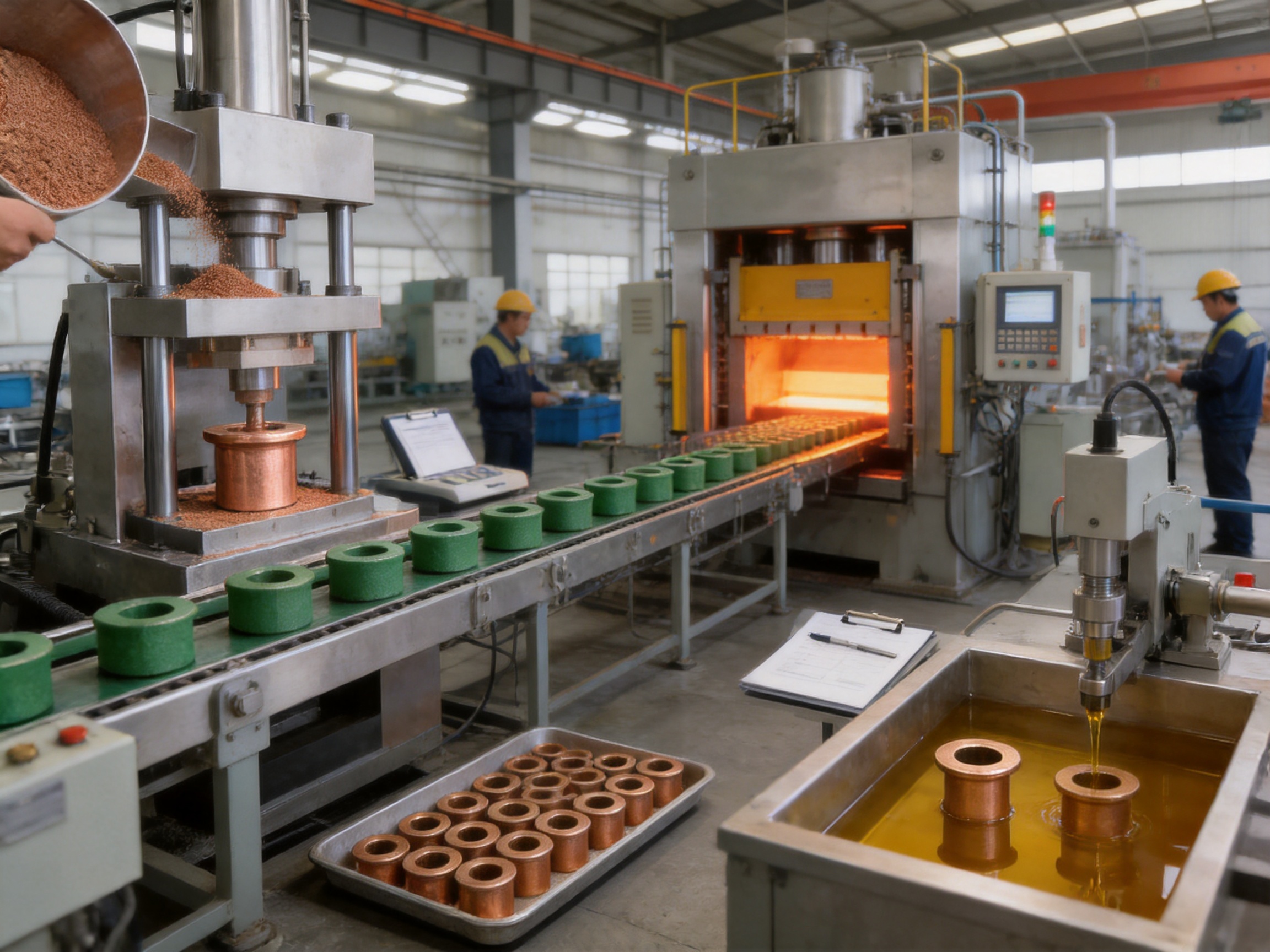
The bushing is produced by compacting tin bronze powder in a precision die, sintering the compact at high temperature, sizing it to improve dimensional accuracy, and impregnating the finished porous component with lubricating oil. The resulting material combines the strength and wear resistance of bronze with the maintenance advantages of an internally lubricated bearing.
Because the bushing is formed close to its final shape, powder metallurgy can reduce machining requirements and material waste. It also allows engineers to control density, porosity, dimensions, and oil content according to the needs of a particular application.
Why Tin Bronze Is Suitable for Flanged Bushings
Tin bronze is widely used for bearing applications because it provides a balanced combination of mechanical strength, toughness, wear resistance, and compatibility with steel shafts. Tin additions improve the hardness and load-carrying characteristics of copper-based materials while helping the bearing surface resist deformation.
In a powder metallurgy structure, the tin bronze matrix supports the load while interconnected pores retain lubricant. The matrix must remain strong enough to resist wear and seizure, while the pore system must provide sufficient oil storage and controlled oil release. This balance is essential for reliable performance.
Typical material options include CuSn6 and CuSn8 grades, depending on the required strength, hardness, wear resistance, and operating conditions. The material selection may be adjusted for shaft speed, radial load, temperature, environmental exposure, lubrication requirements, and the presence of dust or moisture.
Compared with softer copper-based alternatives, tin bronze offers improved resistance to surface damage under many heavy-load conditions. Compared with certain harder bearing materials, it can provide better conformability and compatibility with mating shafts. This makes it suitable for pumps, motors, reducers, hydraulic equipment, automotive mechanisms, and general industrial machinery.
How the Self-Lubricating Mechanism Works
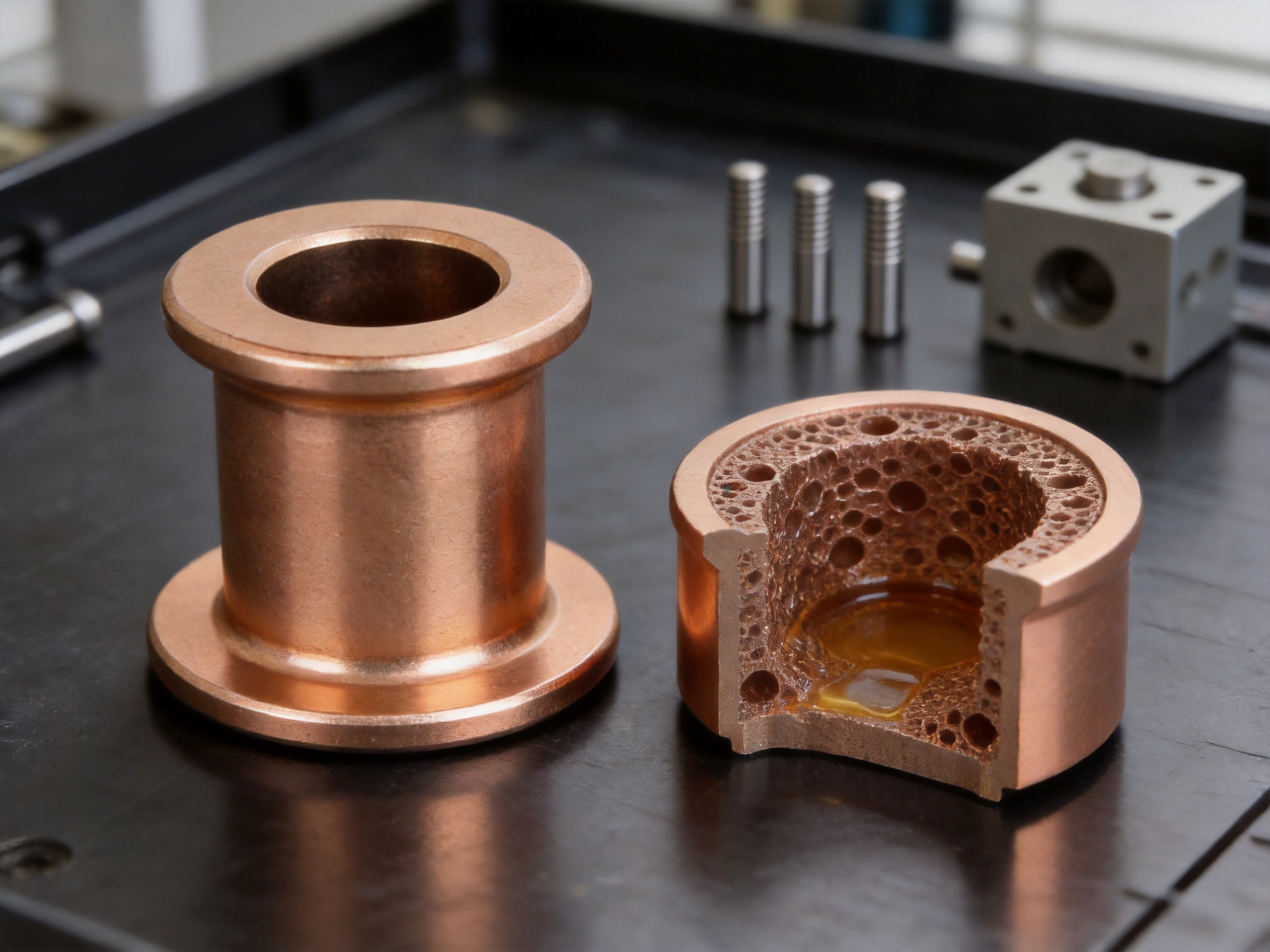
Powder metallurgy creates a controlled porous structure throughout the bushing. After sintering and sizing, the component is placed in lubricating oil under controlled conditions so that the oil fills the available pores. Typical oil content for this product is at least 18 percent, while density is generally within the range of 6.2 to 6.8 grams per cubic centimeter, depending on the material grade and design.
During operation, the shaft rotates or oscillates against the bearing surface. Friction generates heat at the sliding interface. As the temperature rises, a small amount of stored oil migrates from the pores toward the surface of the bushing. The oil creates a lubricating film between the shaft and the bronze matrix, reducing direct metal-to-metal contact.
When the equipment stops or the operating temperature decreases, excess oil can return to the internal pores. This reversible release and absorption process allows the bushing to replenish its surface lubrication repeatedly during normal operation.
- Internal pores act as microscopic oil reservoirs.
- Operating heat encourages lubricant migration toward the bearing surface.
- The lubricant film reduces friction and protects the sliding surfaces.
- When the temperature falls, excess oil is reabsorbed into the porous structure.
- The cycle continues throughout normal operating conditions.
This mechanism does not mean that every application can operate without any design restrictions. Correct shaft finish, suitable clearance, proper installation, appropriate load and speed, and compatibility between the lubricant and operating environment remain important. However, it substantially reduces dependence on frequent external lubrication.
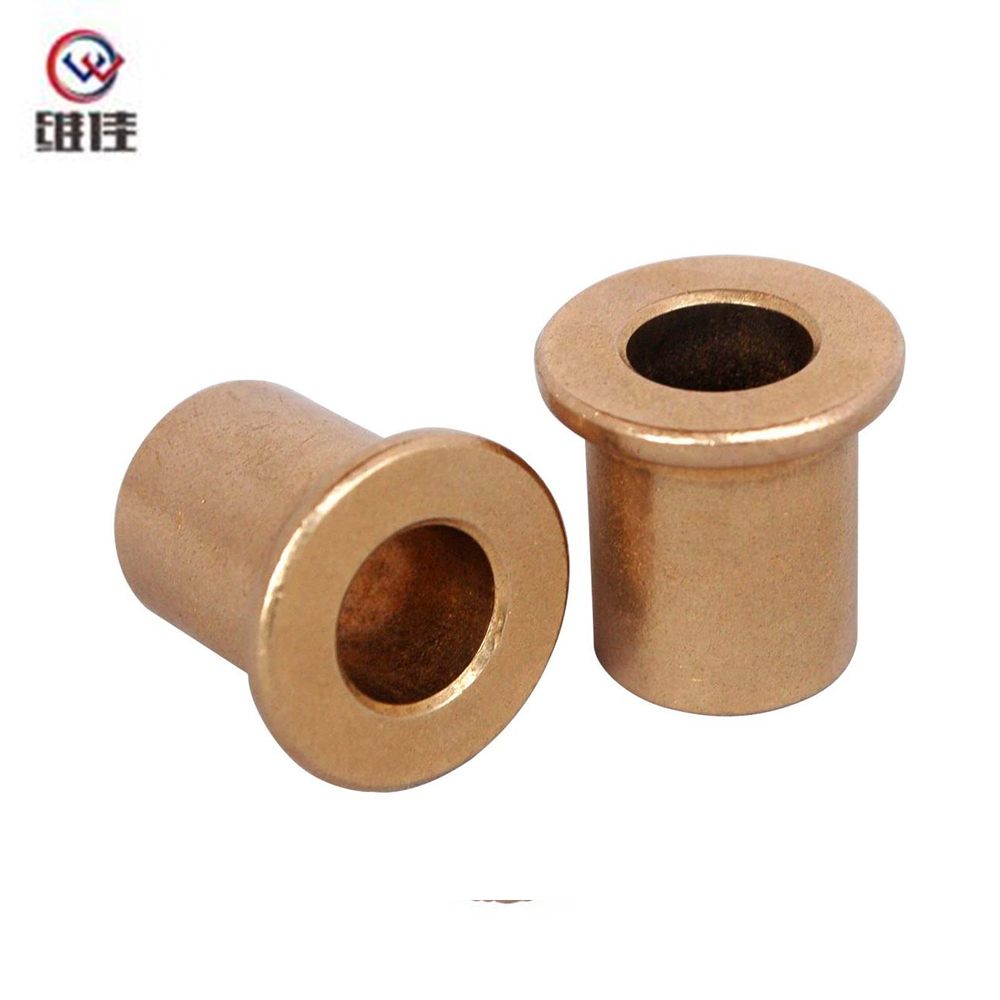
Powder Metallurgy Self-lubricating Tin Bronze Flanged Bushing
Main Advantages of the Flanged Design
Automatic Axial Positioning
The integrated flange functions as a locating shoulder. During installation, it can stop against a machined housing surface, reducing the risk of incorrect insertion depth. This is especially useful when the bushing must occupy a precise axial position within a pump body, bearing housing, lever, or structural assembly.
Improved Assembly Efficiency
A flanged bushing can often be installed with fewer separate retaining components. Depending on the housing design, the flange may reduce the need for external collars, spacers, circlips, or additional positioning features. This can simplify assembly and reduce the number of parts that must be controlled during production.
Axial Load Support
In addition to positioning, the flange may support limited axial forces. It helps distribute axial contact over a larger surface and can reduce movement caused by thrust or repeated reciprocating loads. The actual axial load capacity depends on flange thickness, diameter, material density, contact pressure, lubrication, and operating conditions.
Improved Alignment Stability
Correct axial positioning helps keep the shaft and surrounding components aligned. Stable positioning can reduce uneven contact, edge loading, vibration, and localized wear. In pump systems, this contributes to smoother rotation and more predictable operation.
Performance Benefits in Pump Applications
Reduced Friction
The oil film generated by the porous bronze structure reduces sliding resistance between the shaft and bushing. Lower friction can decrease the torque required to drive the pump and may help reduce energy losses in continuously operating equipment.
Reduced friction also limits heat generation at the bearing interface. Lower temperatures help protect the bushing, shaft, seals, and nearby components from thermal degradation or dimensional changes.
Improved Wear Resistance
The tin bronze matrix provides a durable bearing surface, while the internal lubricant limits direct contact. This combination helps resist wear during continuous rotation, intermittent motion, and repeated start-stop cycles. Properly designed bushings can maintain functional clearance for longer periods than poorly lubricated conventional bushings.
Lower Risk of Seizure
Seizure occurs when excessive friction and heat cause the shaft and bearing surfaces to adhere or severely damage one another. Oil impregnation helps maintain lubrication during operation and reduces the likelihood of severe contact under suitable load and speed conditions.
Although no bushing is immune to seizure under overload, incorrect clearance, contamination, or inadequate shaft finish, self-lubricating bronze provides an additional layer of protection against lubrication-related failure.
Reduced Vibration and Noise
Uneven wear and inadequate lubrication can increase clearance variation, vibration, and operating noise. A stable bearing surface with continuous internal lubrication helps maintain smoother shaft movement. This is valuable in water circulation pumps, industrial cooling systems, chemical transfer equipment, and other machines where vibration can affect seals, couplings, and connected components.
Reduced Maintenance Requirements
Traditional solid bushings often depend on scheduled grease or oil application. In difficult-to-access installations, lubrication may be delayed, forgotten, or contaminated. An oil-impregnated bushing stores lubricant internally, reducing the number of routine service operations required.
Lower maintenance demand can reduce labor costs, limit equipment shutdowns, and improve operational consistency. It is particularly beneficial for pumps installed in remote locations, enclosed machinery, agricultural systems, water treatment facilities, and continuous production lines.
Better Resistance to External Contamination
External grease systems may collect dust, abrasive particles, or moisture on exposed surfaces. Since the primary lubricant is contained within the bushing, the bearing surface is less dependent on an exposed grease film. This can be helpful in mining, agricultural, construction, and manufacturing environments.
However, contamination can still damage the shaft and bearing interface. Proper seals, protective covers, clean installation practices, and suitable housing design remain necessary for demanding conditions.
Advantages Compared with Conventional Bronze Bushings
Conventional bronze bushings can provide excellent service when lubrication is properly supplied and maintained. However, they generally require an external lubrication system, grease fittings, oil grooves, or scheduled manual service. Their performance may decline if lubrication is insufficient, contaminated, or incorrectly selected.
Self-lubricating powder metallurgy bushings offer a different maintenance and performance profile:
| Performance Factor | Self-Lubricating Tin Bronze Flanged Bushing | Conventional Solid Bronze Bushing |
| Lubrication Method | Internal oil impregnation with automatic release | External grease or oil supply |
| Routine Lubrication | Usually very limited | Required at scheduled intervals |
| Installation Positioning | Integrated flange provides axial location | Additional positioning features may be required |
| Maintenance Dependence | Lower dependence on operator maintenance | More dependent on correct service intervals |
| Risk from Missed Lubrication | Reduced under suitable conditions | Higher |
| Material Utilization | Near-net-shape powder metallurgy production | More machining may be required |
| Customization | Designed through tooling and process control | Often dependent on machining capacity |
| Typical Application Advantage | Continuous operation and restricted-access equipment | Applications with accessible lubrication systems |
The appropriate choice depends on the application. A conventional bronze bushing may be preferred where high external lubrication flow is available or where the design requires a fully dense material. A self-lubricating bushing is often more attractive where maintenance reduction, compact integration, and consistent lubrication are priorities.
Reference Technical Parameters
The following values provide a general reference for powder metallurgy self-lubricating tin bronze flanged bushings. Final specifications should be confirmed according to the drawing, material grade, load, speed, temperature, shaft condition, and operating environment.
| Parameter | Reference Value |
| Material | Tin bronze, including CuSn6 or CuSn8 options |
| Oil Content | 18 percent or higher, depending on specification |
| Density | Approximately 6.2–6.8 g/cm³ |
| Inner Diameter Range | 3–100 mm |
| Outer Diameter Range | 6–120 mm |
| Length Range | 5–100 mm |
| Flange Diameter | Typically 2–10 mm larger than the outer diameter |
| Dimensional Accuracy | Generally up to IT7–IT8 after sizing, subject to geometry |
| Operating Temperature | Approximately -40°C to +220°C |
| Ultimate PV Value | Up to approximately 2.5 MPa·m/s without additional oil lubrication |
| Surface Options | Natural finish, phosphating, or tin plating |
PV value represents the relationship between bearing pressure and sliding velocity. It is an important reference for plain bearing selection, but it should not be used as the only design criterion. Start-stop conditions, oscillation, shock loads, temperature, shaft hardness, surface finish, environmental contaminants, and lubrication compatibility must also be evaluated.
Manufacturing Process for Consistent Bushing Quality
Powder Selection and Material Preparation
The manufacturing process begins with the selection and preparation of copper-based alloy powders. The powder composition influences the final strength, density, pore structure, dimensional behavior, and wear characteristics of the bushing.
Powder preparation must be controlled to promote uniform filling, stable compaction, and consistent sintering. Material handling procedures help reduce contamination, segregation, and variation between batches. For customized products, the powder formulation can be selected according to the required balance between mechanical strength and oil retention.
Precision Powder Compaction
During compaction, prepared powder is filled into a precision tool and compressed under controlled pressure. The die defines the internal diameter, outer diameter, length, flange profile, and other important geometric features.
Accurate compaction is essential because density distribution affects strength, shrinkage, porosity, and dimensional stability. The flange and cylindrical body must be formed consistently so that the finished part can be installed correctly and carry its intended loads.
Advanced presses and precision forming machines support repeatable production of standard and custom geometries. Tooling can be developed from customer drawings, physical samples, or engineering specifications.
High-Temperature Sintering
The compacted parts are heated in a controlled sintering furnace. At elevated temperature, powder particles bond together without completely eliminating the designed pore structure. This creates a strong, integrated bronze matrix with interconnected pores capable of retaining lubricating oil.
Furnace temperature, atmosphere, heating rate, holding time, and cooling conditions influence the final structure. Careful process control helps achieve uniform bonding, stable dimensions, and predictable mechanical performance.
High-quality sintering is especially important for flanged bushings because the flange must remain structurally connected to the cylindrical bearing section. Poor sintering can produce weak areas, excessive variation, or insufficient resistance to cracking and deformation.
Sizing and Dimensional Calibration
After sintering, the parts may undergo sizing. This process uses a forming operation to improve dimensional accuracy, roundness, straightness, and surface consistency. Sizing is valuable for applications requiring controlled shaft clearance and accurate housing fits.
For pump components, dimensional accuracy can influence shaft alignment, friction, vibration, and leakage protection. Welfine supports dimensional control up to IT7–IT8 for suitable geometries and process conditions.
Oil Impregnation
After the porous bronze structure has been formed and sized, the bushings are impregnated with lubricating oil. The oil fills the internal pores and creates the self-lubricating function.
Impregnation conditions must be controlled to achieve consistent oil absorption. The selected oil should be compatible with the operating temperature, shaft material, surrounding seals, process fluid, and application environment. Customers should provide operating information when the bushing will be exposed to chemicals, high temperatures, vacuum, water, or special process fluids.
Surface Treatment
Several surface treatment options are available depending on the intended environment. Natural finishes are suitable for many general-purpose applications. Phosphating may improve corrosion protection and surface performance, while tin plating can provide additional protection or improve compatibility in specific assemblies.
Surface treatment should be selected together with the housing material, shaft material, surrounding atmosphere, and required service life. It should not interfere with the pore structure or the intended oil-release behavior.
Inspection and Quality Control
Quality control extends throughout the process rather than being limited to final inspection. Typical controls may include raw material verification, powder preparation checks, compaction monitoring, furnace process records, dimensional inspection, density measurement, oil content verification, and visual examination.
Welfine operates under ISO 9001:2015 and IATF 16949:2016 quality management certifications. These systems support documented procedures, traceability, process monitoring, corrective action, and continuous improvement. Material and dimensional inspection reports can be provided for individual production batches according to customer requirements.
Engineering Benefits of Near-Net-Shape Production
Powder metallurgy is efficient because components can be formed close to their final dimensions. Compared with producing a bushing from a large solid bronze bar and removing material through extensive machining, powder compaction can reduce scrap and machining allowance.
This near-net-shape approach provides several benefits:
- More efficient use of raw materials.
- Reduced machining time for suitable geometries.
- Lower production costs for repeat orders.
- Consistent production of integrated flange profiles.
- Controlled porosity for oil storage and release.
- Good repeatability across large production batches.
For customers replacing traditional copper bushings, the process may reduce total component cost by more than 30 percent, depending on geometry, volume, machining requirements, and tooling conditions. The actual cost benefit should be evaluated through a technical quotation and production assessment.
Customization for Pump and Industrial Equipment Manufacturers
Different pump designs require different bushing dimensions and performance characteristics. Welfine supports customized production based on engineering drawings, samples, or application data.
Dimensional Customization
Customers can specify the inner diameter, outer diameter, bushing length, flange diameter, flange thickness, corner radii, chamfers, grooves, and other features. Proper control of these dimensions ensures compatibility with the shaft, housing, seals, washers, and adjacent components.
Material Customization
CuSn6 and CuSn8 tin bronze options can be considered for different load, wear, and strength requirements. Material selection should be based on the complete operating profile rather than only the nominal shaft diameter.
Oil and Lubrication Customization
The impregnating oil can be selected according to temperature, speed, load, environmental exposure, and compatibility requirements. When an application involves water, chemicals, food-processing equipment, vacuum, or elevated temperature, the customer should communicate these conditions before production.
Surface Treatment Customization
Natural finish, phosphating, and tin plating are available for different corrosion protection and assembly requirements. Additional machining or finishing operations may also be considered where the design requires tighter tolerances or special interfaces.
Small-Batch and Trial Production
Product development often begins with a prototype or small trial order. Welfine supports rapid development based on drawings or samples and can assist with trial production before volume manufacturing. This enables customers to verify fit, clearance, lubrication behavior, wear performance, and assembly efficiency before committing to a larger production program.
Applications Across Pump Systems
Centrifugal Pumps
Centrifugal pumps may use bushings to support rotating shafts, guide internal components, or maintain alignment within the pump assembly. Self-lubricating bushings can be useful where access for routine lubrication is limited and stable operation is required.
Water Circulation Pumps
Water circulation equipment often operates for long periods with limited service interruptions. A self-lubricating bushing can reduce maintenance requirements in industrial cooling systems, building services, water treatment installations, and circulation machinery.
Chemical Transfer Pumps
Chemical pump applications require careful material and lubricant compatibility review. Where the operating temperature and chemical environment are suitable, tin bronze bushings can provide a durable sliding interface. Protective seals and appropriate surface treatment may be necessary for corrosive environments.
Agricultural Irrigation Pumps
Irrigation equipment may operate in dusty, humid, or remote locations. Reduced dependence on external grease application is valuable where maintenance access is irregular. The bushing design should be selected together with suitable sealing and contamination protection.
Industrial Cooling Pumps
Cooling pumps often operate continuously and may be integrated into production systems where unexpected downtime is expensive. Stable lubrication, reduced friction, and axial positioning can contribute to reliable long-term operation.
Marine and Hydraulic Equipment
Marine pump systems and hydraulic equipment can experience vibration, moisture, and restricted service access. Custom flange geometry, suitable oil selection, and corrosion-conscious surface treatment can help adapt the bushing to these operating conditions.
Applications Beyond Pumps
The same self-lubricating flanged bushing technology is suitable for many other industrial assemblies.
- Automotive steering mechanisms.
- Brake pedal assemblies.
- Seat adjustment systems.
- Excavator and loader pin joints.
- Hydraulic pump and valve groups.
- Textile machinery.
- Printing equipment.
- Office equipment mechanisms.
- Motors and gear reducers.
- Conveyor equipment.
- General bearing housings.
- Transmission components.
In each case, the primary benefits are low maintenance, controlled lubrication, compact integration, wear resistance, and repeatable dimensional performance.
Installation Recommendations
Inspect the Housing and Shaft
Before installation, inspect the housing bore and shaft for burrs, dirt, corrosion, damage, and incorrect dimensions. The shaft should have a suitable surface finish and hardness for the selected bushing. A damaged shaft can rapidly wear the bearing surface even when the bushing itself is properly manufactured.
Confirm Correct Clearance
Correct running clearance is essential. Excessive clearance can increase vibration and uneven loading, while insufficient clearance can prevent the oil film from forming correctly and may cause overheating or seizure. Clearance should be determined according to diameter, speed, load, temperature, shaft material, and operating environment.
Use Proper Press-Fitting Methods
When a press fit is required, apply force evenly to the cylindrical body or an approved installation surface. Do not strike the flange directly with a hard tool, and do not force the bushing into a housing with misalignment. A suitable mandrel can help distribute the installation force evenly.
Protect the Flange
The flange should seat fully against the intended locating surface. Any burr, foreign material, or angular misalignment can prevent correct seating and may create uneven axial loading. Confirm that the flange does not interfere with seals, rotating components, or adjacent parts.
Clean the Assembly
Keep the shaft, housing, and bushing clean during installation. Abrasive particles can become embedded in the bearing surface and accelerate wear. Avoid using cleaning agents that may remove or chemically degrade the impregnated lubricant unless the manufacturer has approved the cleaning procedure.
Check Initial Operation
After assembly, rotate or move the shaft manually where possible. Check for binding, abnormal resistance, interference, or uneven movement. During initial operation, monitor temperature, vibration, noise, and shaft movement. Early inspection can identify installation problems before they cause permanent damage.
Factors That Affect Service Life
The service life of a self-lubricating bushing depends on more than material selection. Load, speed, temperature, clearance, shaft finish, alignment, contamination, duty cycle, and installation quality all influence performance.
Load and Speed
Higher radial pressure and sliding velocity increase heat generation and wear. The product should be selected within an appropriate PV range, with allowances for starting, stopping, shock, and intermittent overloads.
Temperature
The reference operating range is approximately -40°C to +220°C, but the actual limit depends on the bronze grade, impregnating oil, surface treatment, and application conditions. At high temperatures, lubricant viscosity and evaporation behavior may change. At low temperatures, lubricant flow may decrease.
Shaft Quality
A smooth, properly hardened shaft helps distribute contact and reduces abrasive wear. A rough, soft, corroded, or misaligned shaft can damage the bushing and consume lubricant more quickly.
Alignment
Misalignment creates edge loading and concentrates stress in a small area. The flange helps with axial location but cannot correct major housing or shaft misalignment. The pump assembly should be designed and assembled to maintain concentricity.
Contamination and Sealing
Dust, abrasive particles, water, and chemicals can reduce service life. Seals, covers, filters, and clean operating procedures should be used where contamination is expected. The bushing material and oil should also be reviewed for compatibility with the process environment.
Operating Cycle
Frequent starts and stops, oscillating motion, shock loading, and long idle periods may place different demands on the bearing than steady continuous rotation. These factors should be included in the technical evaluation.
Why Choose Welfine for Custom Sintered Bushings?
Jiande Welfine Technology Co., Ltd. was established in 2001 and specializes in powder metallurgy sintering and related precision machining. The company combines research and development, production, quality control, and sales support to provide customized bushing solutions.
Its production base covers approximately 13,039 square meters and includes high-efficiency presses, high-temperature sintering furnaces, precision forming machines, and testing equipment. This manufacturing infrastructure supports both standard production and custom OEM or ODM programs.
With more than 150 skilled employees and over 20 years of industry experience, Welfine can support customers through product development, tooling, sample approval, trial production, and repeat manufacturing. Customers may provide technical drawings, physical samples, or application requirements for evaluation.
The company focuses on powder metallurgy bushings, self-lubricating bushings, and precision sintered components for automotive, construction, machinery, equipment, and other industrial markets.
Engineering and Development Support
Welfine can review product dimensions, material requirements, operating conditions, and production quantities before quotation. This helps identify potential issues involving clearance, flange geometry, tooling feasibility, sintering behavior, and oil impregnation.
Stable Production Quality
Documented quality procedures, process inspection, dimensional measurement, and batch traceability support consistent production. Material and dimensional inspection reports can be supplied according to customer requirements.
Cost Optimization
Near-net-shape manufacturing can reduce raw material waste and machining requirements. For suitable designs, this can lower the cost compared with traditional machined copper or bronze bushings while retaining the required bearing function.
Flexible Delivery
Standard products may be available from stock, while customized components can be delivered according to tooling, quantity, approval, and production requirements. Custom parts are commonly scheduled within 7–15 days after the relevant technical and production conditions are confirmed.
After-Sales Technical Support
Technical assistance is available for product selection, installation, maintenance, and application evaluation. The standard warranty period is 12 months, with replacement support for defects or damage not caused by improper use, installation, or external factors.
How to Select the Correct Bushing Specification
Purchasers and engineers should provide as much application information as possible when requesting a quotation. The following data helps determine whether a self-lubricating flanged bushing is suitable:
- Inner diameter and shaft diameter.
- Housing bore and required outer diameter.
- Bushing length and flange dimensions.
- Radial and axial loads.
- Rotational speed or oscillating frequency.
- Operating temperature range.
- Duty cycle and start-stop frequency.
- Shaft material, hardness, and surface finish.
- Presence of water, dust, chemicals, or abrasive particles.
- Required surface treatment.
- Annual quantity and batch size.
- Required inspection documents and certifications.
Providing this information at the design stage can improve product selection and reduce the risk of dimensional or performance problems during assembly.
Frequently Asked Questions
What makes a flanged bushing self-lubricating?
The bushing contains a porous sintered bronze structure impregnated with lubricating oil. During operation, heat and friction encourage oil to move toward the sliding surface, forming a lubricating film. When the component cools, excess oil can return to the internal pores.
Why is a flange useful on a bronze bushing?
The flange provides axial positioning, helps prevent unwanted movement, and can support limited axial loads. It may also simplify installation by eliminating separate retaining or locating components.
Are these bushings suitable for pumps?
They are suitable for many centrifugal, circulation, irrigation, cooling, hydraulic, chemical transfer, and industrial pump applications when the load, speed, temperature, clearance, shaft condition, and environment are within the design range.
Do self-lubricating bushings require any additional oil?
Many applications do not require regular external lubrication because the oil is stored within the bushing. However, additional lubrication may be appropriate for certain high-load, high-speed, contaminated, or special operating conditions. The application should be evaluated before adding another lubricant.
What materials are available?
Typical materials include tin bronze grades such as CuSn6 and CuSn8. The suitable grade depends on load, wear, strength, temperature, and environmental requirements.
What dimensions can be customized?
Inner diameter, outer diameter, length, flange diameter, flange thickness, chamfers, grooves, and other suitable features can be customized. Welfine develops products from drawings, samples, or technical specifications.
What is the typical dimensional accuracy?
Dimensional accuracy can reach approximately IT7–IT8 for suitable geometries after sizing. The final tolerance depends on the part design, material, tooling, sintering behavior, and inspection requirements.
Can the bushing be used in high-temperature applications?
The reference operating range is approximately -40°C to +220°C. The actual limit depends on the impregnating oil, bronze grade, surface treatment, load, speed, and environmental conditions. High-temperature applications should be reviewed before production.
How does powder metallurgy reduce cost?
Powder metallurgy forms parts close to their final shape, reducing material waste and machining allowance. It is particularly cost-effective for repeat production and geometries that would require extensive machining from solid bronze.
Can Welfine produce trial quantities?
Yes. Welfine supports small-batch trial production and product development based on drawings or samples. Trial parts can be used to verify assembly, clearance, operating behavior, and compatibility before volume production.
What quality certifications does Welfine have?
Welfine operates according to ISO 9001:2015 and IATF 16949:2016 quality management systems. These certifications support documented manufacturing procedures, inspection controls, traceability, and continuous improvement.
How should the bushing be stored?
Bushings should be kept in clean, dry, moisture-resistant packaging and protected from contamination, excessive heat, and corrosive atmospheres. Proper storage helps preserve the impregnated oil and surface condition before installation.
Conclusion
Powder metallurgy self-lubricating tin bronze flanged bushings combine a durable bronze bearing matrix, controlled internal porosity, automatic oil release, and integrated axial positioning. These characteristics make them an effective alternative to conventional externally lubricated bushings in many pump and industrial equipment applications.
Their main advantages include reduced friction, improved wear and seizure resistance, lower maintenance requirements, reduced risk of lubrication failure, stable axial positioning, and efficient near-net-shape production. When correctly specified and installed, they can help improve pump reliability, reduce downtime, protect shafts, and extend the service life of the overall assembly.
Jiande Welfine Technology Co., Ltd. supports the complete manufacturing process, from powder preparation and precision compaction to sintering, sizing, oil impregnation, surface treatment, inspection, and customized delivery. Its modern production base, experienced workforce, OEM and ODM capabilities, ISO-certified quality systems, and technical support make it a suitable manufacturing partner for customers seeking reliable self-lubricating bushings and precision sintered metal parts.
For a correct product recommendation, customers should provide the bushing drawing or sample together with information about load, speed, temperature, shaft condition, environment, and expected production volume. This allows the material, dimensions, oil, surface treatment, and manufacturing process to be matched to the actual application.
References
1. ISO 9001:2015, Quality Management Systems—Requirements.
2. IATF 16949:2016, Quality Management System Requirements for Automotive Production and Relevant Service Parts Organizations.
3. ISO 5755, Sintered Metal Materials—Specifications.
4. ASM Handbook, Volume 7: Powder Metal Technologies.
5. Modern Tribology Handbook, principles of friction, lubrication, and wear in sliding bearings.
6. Standard engineering practices for plain bearing design, PV evaluation, shaft finish, clearance, and installation.
7. Manufacturer technical data for powder metallurgy oil-impregnated tin bronze bushings and precision sintered components.
Product: Powder Metallurgy Self-lubricating Tin Bronze Flanged Bushing

Related products
-
-
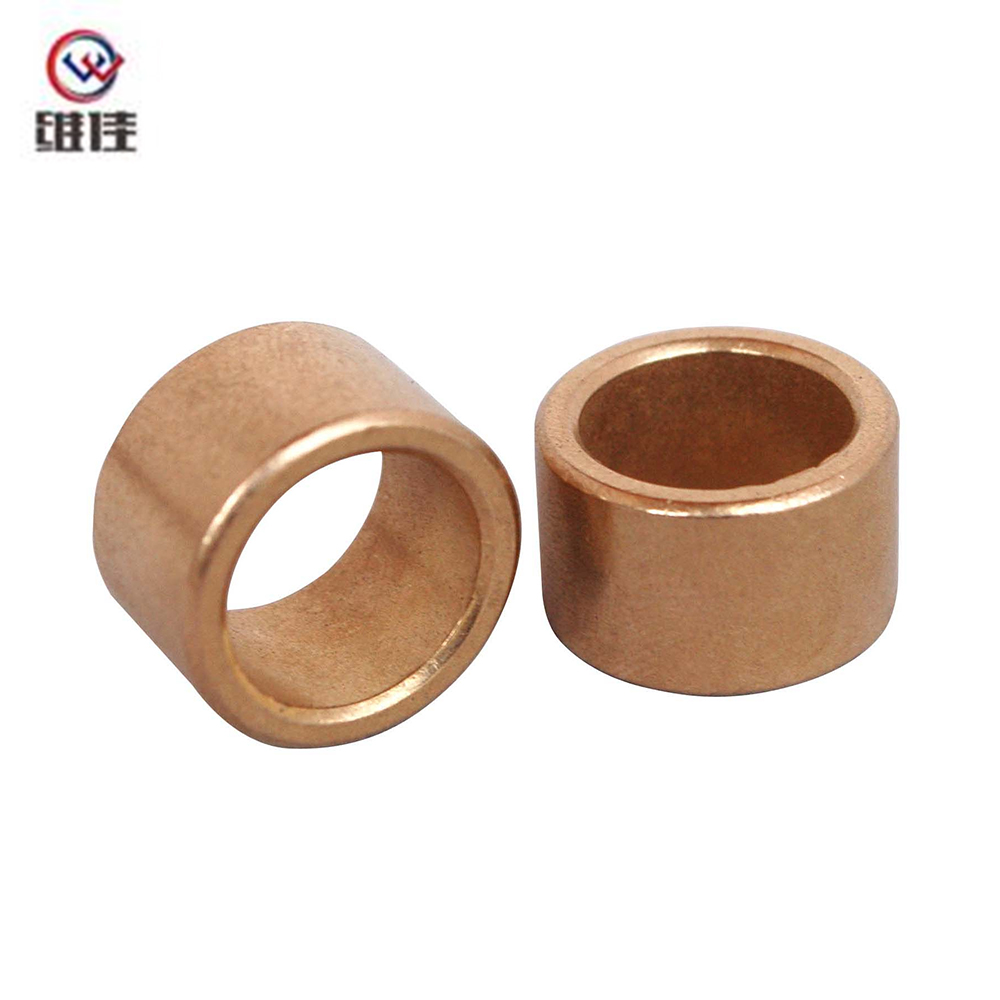
This copper-based powder metallurgy bushing is manufactured through an integrated process of compaction, sintering, sizing, and oil impregnation. It features excellent wear resistance and self-lubrica...
See Details -
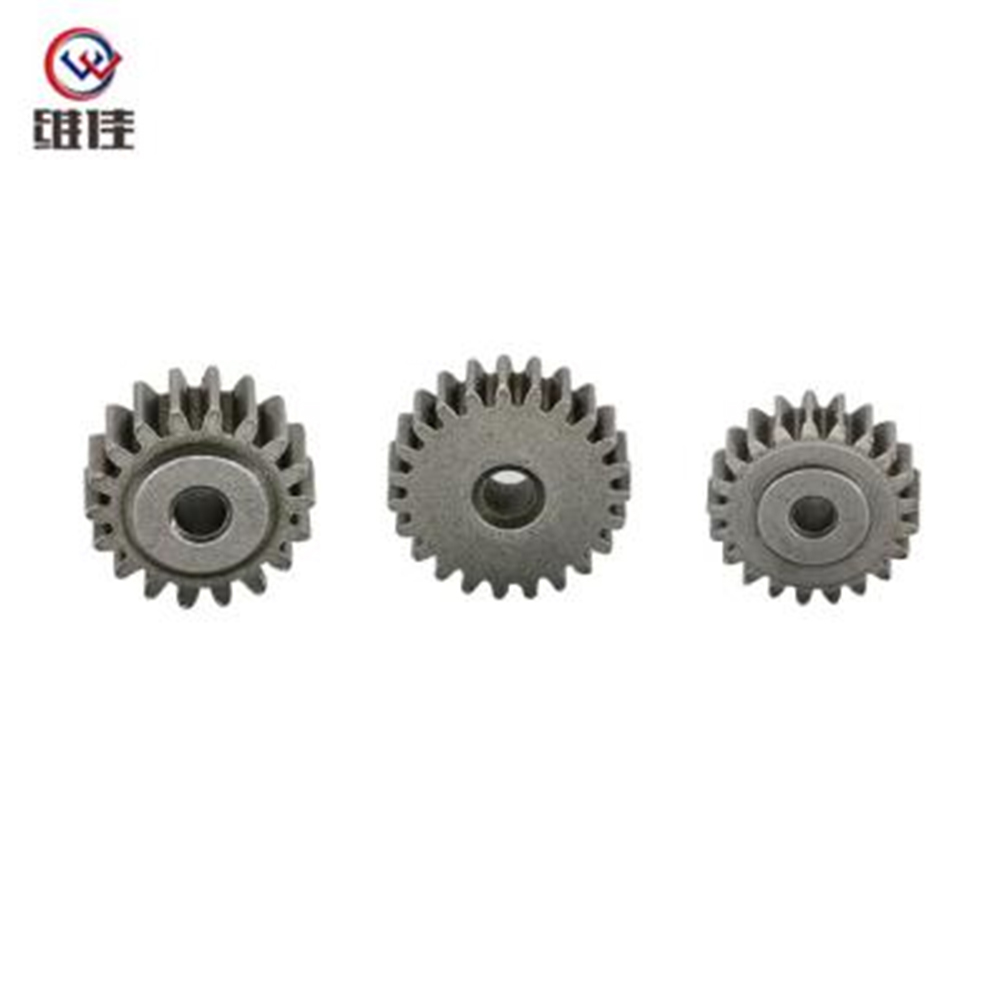
Description: Custom powder metallurgy planetary gear with high precision, wear resistance for automotive, industrial machinery & home appliances. OEM/ODM supported.
See Details
Copyright © Jiande Welfine Technology Co., Ltd. All Rights Reserved. Custom Self-lubricating Sintered Bushing Manufacturers
