E-mail us: [email protected]
Tel: +86-15239857375
 English
 中文简体
中文简体

 Home / Author / Luo Qian — Product Sales Supervisor / Sintered Stainless Steel Self-Lubricating Bushings for Reliable Corrosion-Resistant Motion
 Sintered Stainless Steel Self-Lubricating Bushings for Reliable Corrosion-Resistant Motion
 2026.06.14
 Luo Qian — Product Sales Supervisor
Content
- 1 Product Overview
- 2 How the Self-Lubricating Mechanism Works
- 3 Key Product Advantages
- 4 Advantages over Conventional Bearing Solutions
- 5 Application Value in Food Processing Equipment
- 6 Application Value in Medical and Laboratory Equipment
- 7 Application Value in Marine Equipment
- 8 Advanced Powder Metallurgy Manufacturing
- 9 Manufacturing Strengths of Jiande Welfine Technology Co., Ltd.
- 10 Precision Process Control and Quality Assurance
- 11 Design Considerations for Optimal Performance
- 12 Typical Applications
- 13 Why Customization Matters
- 14 Life-Cycle Cost Benefits
- 15 Q&A Section
- 15.1 What is a sintered stainless steel self-lubricating bushing?
- 15.2 Why is stainless steel used for these bushings?
- 15.3 How does the bushing lubricate itself?
- 15.4 What are the main advantages over carbon steel bushings?
- 15.5 Are these bushings suitable for food processing equipment?
- 15.6 Can they be used in marine environments?
- 15.7 Do self-lubricating bushings require any maintenance?
- 15.8 Can the dimensions be customized?
- 15.9 What manufacturing certifications support product quality?
- 15.10 What information should be provided when requesting a custom bushing?
- 16 Conclusion
- 17 References
- 18 Product: Sintered Stainless Steel Self-lubricating Bushings
Sintered stainless steel self-lubricating bushings are precision-engineered bearing components designed for demanding motion applications where corrosion resistance, stable sliding performance, long service life, and reduced maintenance are essential. In industries such as food processing, medical equipment, marine machinery, chemical processing, packaging systems, and industrial automation, bushings often operate in wet, humid, chemically exposed, or lubrication-restricted environments. Under these conditions, conventional carbon steel bushings or externally lubricated bearings may suffer from corrosion, lubricant loss, contamination risks, frequent servicing, and premature wear. Sintered stainless steel self-lubricating bushings solve these challenges by combining the durability of stainless steel with the functional advantages of powder metallurgy and internally stored lubrication.
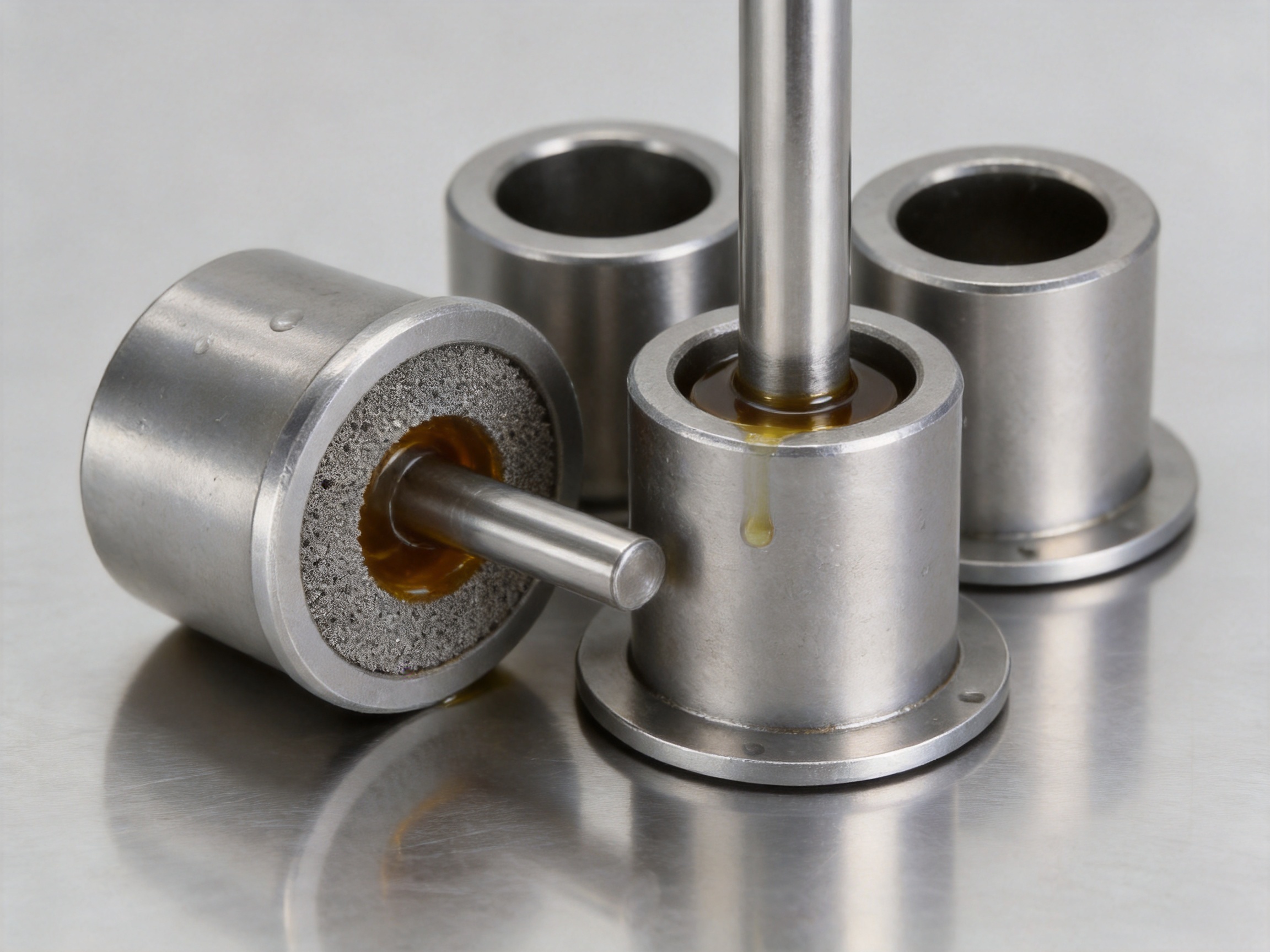
The core value of this product lies in its porous sintered structure. During the powder metallurgy process, stainless steel powder is compacted and sintered to form a controlled network of interconnected pores. These pores can be impregnated with lubricating oil, allowing the bushing to release lubricant gradually during operation. When the shaft rotates or slides against the bearing surface, frictional heat and capillary action help draw oil to the contact zone, forming a thin lubricating film. When the equipment stops, part of the oil can be reabsorbed into the porous matrix. This self-lubricating cycle reduces friction, lowers wear, and helps maintain reliable performance over an extended period.
Compared with traditional bushings that rely heavily on external greasing, sintered stainless steel self-lubricating bushings are especially valuable in applications where lubrication is difficult, inconvenient, undesirable, or restricted by cleanliness requirements. They support smoother operation, reduce downtime, and help simplify equipment design by eliminating or minimizing grease fittings, oil lines, or frequent manual lubrication schedules. For equipment manufacturers and maintenance teams, this translates into lower life-cycle cost, improved equipment availability, and greater reliability in harsh service environments.
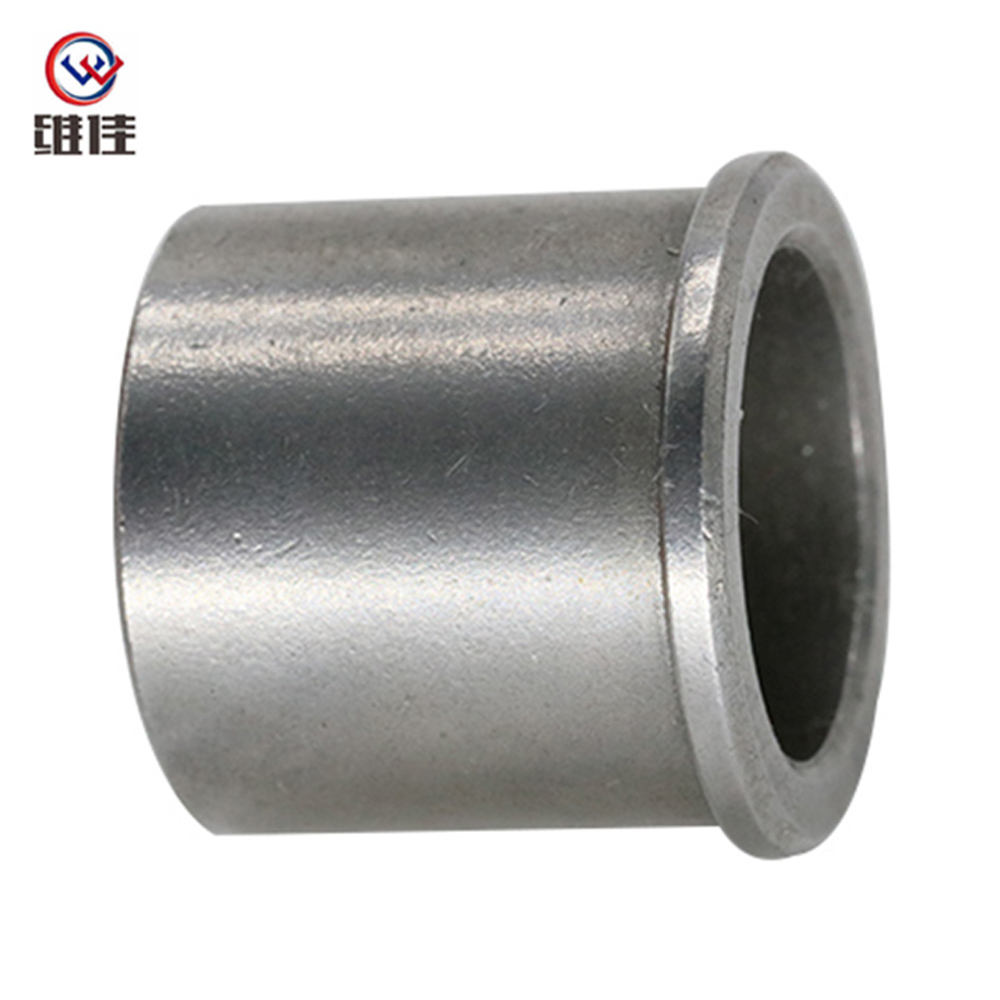
Sintered Stainless Steel Self-lubricating Bushings
Product Overview
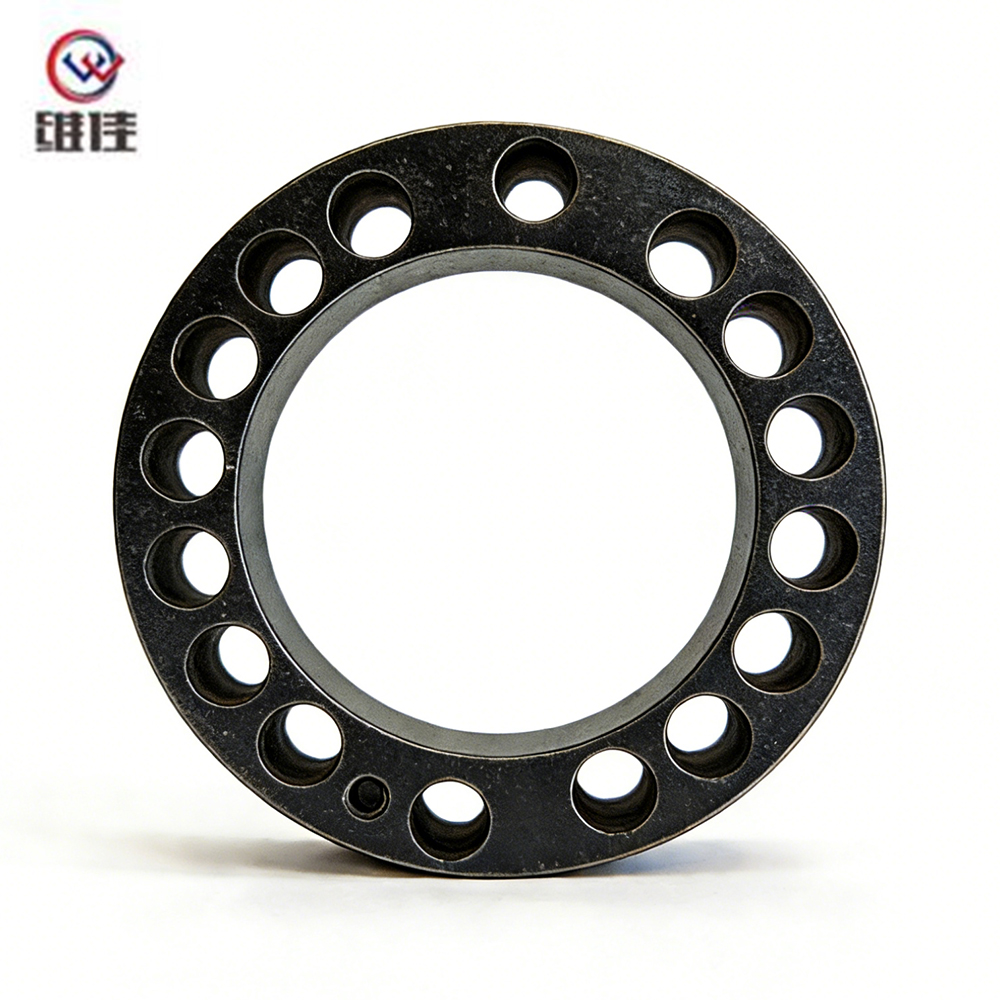
A sintered stainless steel self-lubricating bushing is a cylindrical or flanged bearing component manufactured through powder metallurgy. It is designed to support shafts, guide motion, reduce friction, absorb load, and provide long-term sliding performance without continuous external lubrication. The stainless steel base material provides excellent resistance to rust, oxidation, moisture, and many corrosive media, while the oil-impregnated porous structure delivers internal lubrication during operation.
This product is suitable for applications involving moisture, steam, cleaning agents, seawater exposure, chemical vapors, and environments where ordinary steel components may deteriorate quickly. It also performs well in equipment where access for routine maintenance is limited. Because the lubricant is stored inside the material, the bushing can maintain stable sliding characteristics even when external relubrication is not practical.
The combination of corrosion resistance and self-lubrication makes this bushing particularly effective in food processing machinery, medical devices, marine equipment, water treatment systems, pumps, packaging machinery, laboratory instruments, textile equipment, automation systems, and chemical processing machinery. It is also suitable for use in equipment where cleanliness and reduced lubricant leakage are important considerations.
In addition to corrosion protection, sintered stainless steel bushings offer dimensional stability, good load distribution, wear resistance, and quiet operation. The uniform structure produced by powder metallurgy allows consistent mechanical properties across batches, while secondary machining can provide close dimensional tolerances for custom applications. For manufacturers requiring OEM or ODM components, the bushing can be produced according to drawings, samples, load requirements, dimensional constraints, surface finish needs, and working environment conditions.
How the Self-Lubricating Mechanism Works
The self-lubricating performance of this bushing begins with its microstructure. Unlike fully dense metal components, sintered bushings contain carefully controlled porosity. This porosity is not a defect; it is a functional feature designed into the product. During production, metal powder particles are pressed into shape and then sintered at elevated temperatures. Sintering bonds the particles together while preserving a network of microscopic pores inside the material.
After sintering, the bushing is impregnated with oil under controlled conditions. Vacuum impregnation or pressure-assisted impregnation allows lubricant to penetrate the pores deeply and uniformly. The bushing then becomes a miniature oil reservoir. During operation, as the shaft moves against the bearing surface, temperature and pressure changes draw lubricant from the pores to the sliding interface. This oil film separates the metal surfaces, reduces direct contact, and lowers friction.
The lubrication process is dynamic. When the component heats during operation, the oil expands slightly and migrates toward the surface. When the machine stops and the bushing cools, capillary action helps pull oil back into the pores. This cycle allows the bushing to provide repeated lubrication without constant manual oiling. The result is lower wear, quieter movement, reduced risk of seizure, and more predictable performance.
This mechanism is one of the most important advantages over conventional solid bushings. A solid carbon steel bushing may require regular grease or oil to prevent dry sliding. If lubrication is missed, the surface may heat, wear, gall, or seize. A sintered stainless steel self-lubricating bushing, by contrast, has a built-in lubrication reserve. While correct application design remains important, the internal oil storage significantly improves reliability in environments where maintenance intervals are long or lubrication access is limited.
Key Product Advantages
The first major advantage is corrosion resistance. Stainless steel provides stronger resistance to moisture, water, cleaning chemicals, salt spray, and corrosive atmospheres than ordinary carbon steel. This is particularly important in food plants, marine equipment, outdoor machinery, and chemical processing environments. Reduced corrosion helps preserve bearing geometry, prevents rough surface formation, and extends service life.
The second advantage is maintenance reduction. Because the bushing contains oil inside its porous body, it can operate for long periods with little or no external lubrication. This reduces the need for manual greasing, minimizes downtime, lowers maintenance labor, and helps prevent failures caused by forgotten lubrication schedules. In high-volume equipment or machines installed in hard-to-reach positions, this advantage can be significant.
The third advantage is cleaner operation. Traditional externally lubricated bearings may leak grease or oil, attracting dust or creating contamination risks. In food processing and medical-related equipment, excessive lubricant discharge is undesirable. Self-lubricating bushings reduce reliance on external lubricants and can help support cleaner machine design.
The fourth advantage is wear resistance. The oil film formed at the sliding interface reduces metal-to-metal contact. Lower friction means less heat generation and slower wear progression. When properly selected for load, speed, shaft hardness, alignment, and temperature, sintered stainless steel self-lubricating bushings can deliver long-term stable operation.
The fifth advantage is design flexibility. Powder metallurgy allows efficient production of complex shapes, precise geometries, and material structures that are difficult or costly to achieve by conventional machining alone. Bushings can be produced in straight cylindrical form, flanged form, custom length, special bore size, customized outer diameter, and tailored porosity depending on the application.
The sixth advantage is suitability for harsh environments. These bushings are designed for conditions involving humidity, corrosive liquids or gases, temperature changes, and limited lubrication availability. In certain applications, they can also operate in low-load and high-sliding-speed conditions, depending on design parameters and lubricant selection.
Advantages over Conventional Bearing Solutions
Many competing bearing solutions perform well in standard environments but become less reliable when exposed to corrosion, moisture, cleaning operations, or lubrication restrictions. Carbon steel bushings are economical but may rust quickly. Bronze bushings offer good sliding properties but may require external lubrication and may not provide the same corrosion resistance as stainless steel in aggressive environments. Plastic bushings can resist some chemicals and run without oil, but they may have limitations in load capacity, temperature resistance, creep resistance, and dimensional stability. Rolling bearings provide low friction but may be vulnerable to contamination, seal failure, corrosion, or lubricant washout.
Sintered stainless steel self-lubricating bushings occupy a balanced position among these options. They provide metallic strength, good wear performance, corrosion resistance, internal lubrication, and stable operation in compact designs. For applications where a rolling bearing may be too sensitive to contamination or where a plastic bushing may not support the required load or temperature, sintered stainless steel bushings offer a practical and durable alternative.
Another competitive advantage is the ability to customize material composition, density, porosity, dimensions, and post-processing. Powder metallurgy makes it possible to engineer the bushing according to performance requirements rather than relying only on standard stock shapes. For customers developing specialized equipment, this customization capability can improve fit, function, and overall product reliability.
| Comparison Item | Sintered Stainless Steel Self-Lubricating Bushing | Conventional Carbon Steel Bushing | Plastic Bushing | Rolling Bearing |
| Corrosion Resistance | Excellent in humid and corrosive environments | Limited unless coated or plated | Good for selected chemicals, material dependent | Varies, often requires seals or stainless materials |
| Lubrication Requirement | Internal oil reservoir, reduced external lubrication | Usually requires regular external lubrication | Often dry-running, depending on material | Requires grease or oil inside bearing system |
| Load Capacity | Good for many sliding bearing applications | Good but maintenance dependent | Moderate, may creep under sustained load | High in suitable rolling applications |
| Maintenance Frequency | Low | Medium to high | Low to medium | Medium, depending on seals and lubrication |
| Cleanliness | Reduced lubricant leakage compared with external greasing | Grease leakage may occur | Clean but may generate polymer wear particles | Seal leakage or grease contamination may occur |
| Temperature Stability | Strong metallic stability, lubricant dependent | Good if lubricated and protected from corrosion | Limited by polymer grade | Good within lubricant and seal limits |
| Suitability for Wet Environments | Excellent | Poor to moderate | Good for selected materials | Requires corrosion-resistant design |
| Customization Potential | High through powder metallurgy and machining | Moderate | High for molded parts | Limited to standard bearing series unless specially designed |
Application Value in Food Processing Equipment
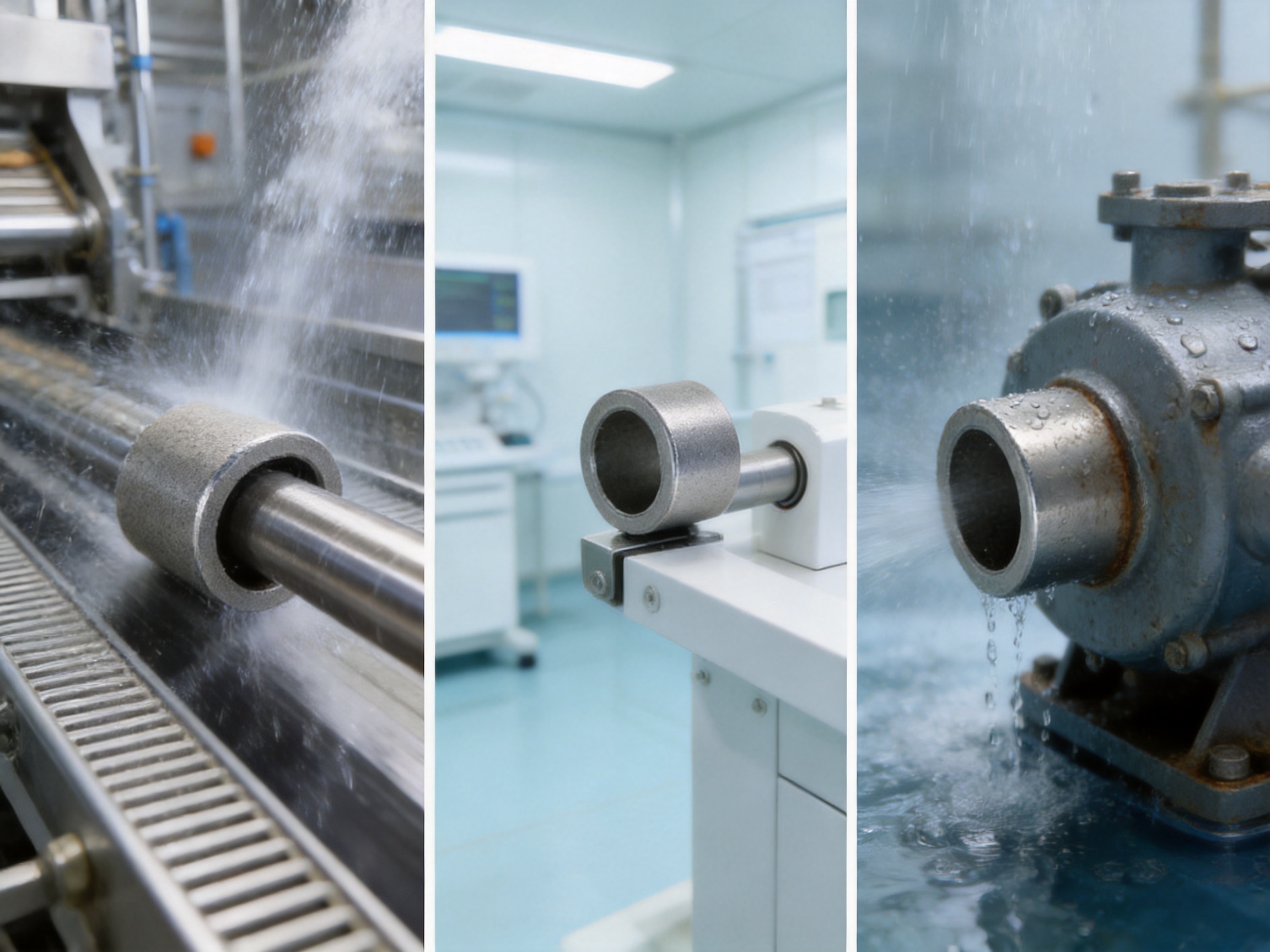
Food processing machinery is exposed to frequent washdowns, steam, detergents, disinfectants, humidity, and strict cleanliness expectations. Bearings and bushings used in mixers, conveyors, filling machines, packaging systems, slicing equipment, bottling lines, and handling mechanisms must resist corrosion while operating reliably. When a bearing corrodes, the resulting surface roughness can accelerate wear, generate debris, increase friction, and shorten machine life.
Sintered stainless steel self-lubricating bushings are well suited for these conditions because stainless steel resists rust formation better than carbon steel, while the internal oil reservoir reduces the need for external greasing. This is especially useful in areas where excess grease could attract food particles or cleaning residues. By minimizing external lubricant application, the bushing helps support a cleaner equipment structure.
Another benefit in food processing equipment is reduced downtime. Production lines often operate on tight schedules, and maintenance stoppages can affect output. A self-lubricating bushing helps extend service intervals and reduces the risk of failure caused by missed lubrication. In conveyor pivots, guide rollers, packaging linkages, indexing systems, and small motion mechanisms, this can improve operational continuity.
Stainless steel self-lubricating bushings also provide good performance in humid environments. Many food factories combine water, temperature variation, and cleaning chemicals. Ordinary bushings may rust after repeated exposure, while stainless steel sintered bushings maintain more stable performance. For machine builders, this supports longer equipment life and stronger customer satisfaction.
Application Value in Medical and Laboratory Equipment
Medical and laboratory equipment requires precision, cleanliness, smooth motion, quiet operation, and dependable performance. Components may be exposed to sterilization procedures, cleaning agents, humidity, and repeated motion cycles. In diagnostic devices, hospital automation equipment, laboratory instruments, sample handling systems, and specialized medical machinery, bushings must deliver consistent movement without frequent maintenance.
Sintered stainless steel self-lubricating bushings help meet these needs by combining dimensional stability with low-friction sliding performance. The internal oil supply supports smooth operation, while stainless steel improves resistance to corrosion in controlled or sterilized environments. In applications where equipment access is restricted or maintenance interruptions are undesirable, long-life bushings help improve reliability.
Quiet movement is another benefit. Lubricated sliding contact reduces noise compared with dry metal-to-metal motion. For medical and laboratory environments, quieter operation supports user comfort and equipment quality perception. Precision machining after sintering can also help meet dimensional requirements for shaft fit, alignment, and motion stability.
Because medical equipment often requires customized components, the ability to manufacture according to drawings or samples is important. Powder metallurgy production combined with secondary machining allows bushings to be adapted to specific device designs. Custom bore sizes, wall thicknesses, flange configurations, tolerances, and material choices can be developed according to application requirements.
Application Value in Marine Equipment
Marine equipment operates in one of the most challenging environments for mechanical components. Saltwater, humidity, rain, temperature fluctuation, and corrosive atmosphere can rapidly damage ordinary steel parts. Bearings used in marine pumps, deck equipment, navigation mechanisms, hinges, auxiliary machinery, water-handling systems, and outdoor assemblies must resist corrosion while maintaining motion reliability.
Sintered stainless steel self-lubricating bushings provide strong value in this field. Stainless steel helps protect against rust and saltwater-related corrosion, while self-lubrication reduces dependence on maintenance in locations that may be difficult to access. Marine operators often prefer components that can withstand long service intervals because maintenance at sea or in outdoor environments can be costly and inconvenient.
The ability to operate in humid and wet conditions also improves safety and reliability. Corroded bushings can seize, create vibration, or cause irregular movement. A corrosion-resistant self-lubricating bushing helps maintain smoother operation in pumps, mechanical linkages, control systems, and deck mechanisms. For marine equipment manufacturers, this can improve product durability and reduce warranty concerns.
Advanced Powder Metallurgy Manufacturing
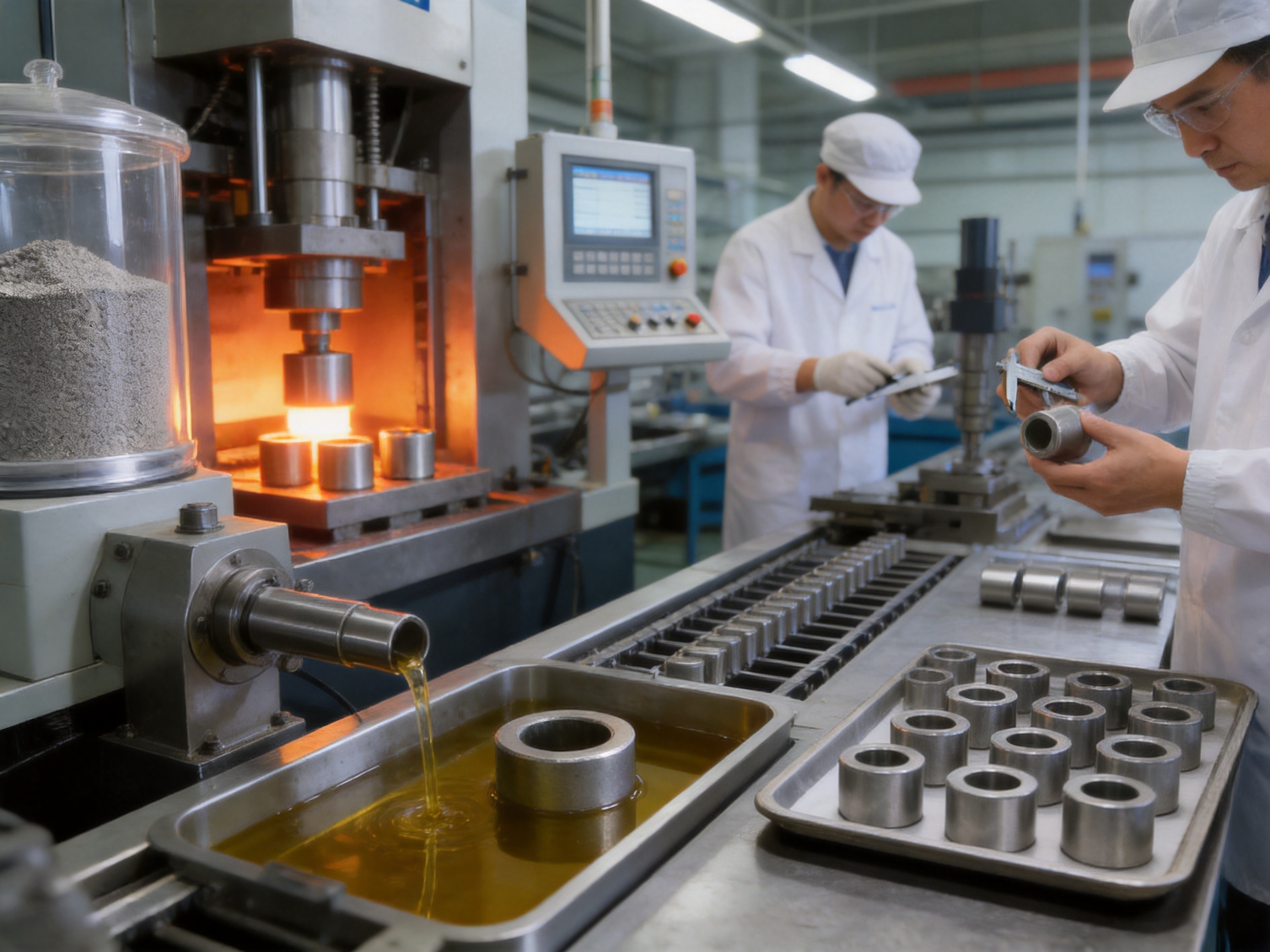
The performance of a sintered stainless steel self-lubricating bushing depends heavily on manufacturing quality. Powder metallurgy is not simply a forming method; it is a controlled engineering process that determines density, porosity, mechanical strength, lubrication capacity, dimensional accuracy, and consistency. Each step must be managed carefully to produce bushings that perform reliably in demanding applications.
The process begins with metal powder selection. Stainless steel powder must meet requirements for particle size, shape, composition, flowability, and purity. Powder characteristics affect compaction behavior, sintering response, pore distribution, and final mechanical properties. Proper powder preparation is essential for stable production quality.
The next stage is mixing. Depending on the design, powders may be blended with lubricants or additives to improve compaction and performance. Uniform mixing helps maintain consistent material properties throughout the batch. In powder metallurgy, small variations in powder distribution can affect density and porosity, so process control is critical.
Compaction follows mixing. The powder is pressed into a die under high pressure to form a green compact. Tooling design, pressing force, powder fill control, and part geometry all influence dimensional accuracy. The compact must have sufficient strength for handling while retaining the intended pore structure after sintering.
Sintering is the thermal bonding stage. The compact is heated in a controlled furnace atmosphere at a temperature below the melting point of the main metal. During sintering, powder particles bond together, strength increases, and the final porous metallic structure is created. Temperature, time, atmosphere, and furnace stability are critical. Too little sintering may reduce strength, while excessive densification can reduce oil storage capacity. The correct balance is essential for self-lubricating performance.
After sintering, sizing or calibration may be performed to improve dimensional precision. The part can be pressed again in precision tooling to correct minor distortion and achieve tighter tolerance. Secondary machining may include turning, boring, chamfering, grooving, facing, or surface finishing according to the customer’s drawing.
Oil impregnation is a defining step for self-lubricating bushings. The porous sintered structure is filled with lubricant under controlled conditions. Proper impregnation ensures that oil penetrates deeply and uniformly. The type of lubricant can be selected according to temperature, speed, load, and environmental requirements. For special applications, different oils or impregnation media may be considered.
Final inspection verifies dimensions, appearance, density, hardness, oil content, surface finish, and other required characteristics. Reliable manufacturers use advanced testing and quality control methods to ensure consistency from batch to batch. For custom parts, inspection can be aligned with drawings, customer specifications, and application standards.
Manufacturing Strengths of Jiande Welfine Technology Co., Ltd.
Jiande Welfine Technology Co., Ltd. was established in 2001 and has developed into a high-tech enterprise integrating research and development, production, and sales. The company focuses on powder metallurgy sintering and related precision machining, with product coverage including powder metallurgy bushings, self-lubricating bushings, sintered metal components, and various precision parts for industrial applications.
The company operates a modern production base covering 13,039 square meters. This manufacturing environment supports stable production planning, efficient workflow, and consistent product quality. Advanced production and testing equipment, including efficient presses, high-temperature sintering furnaces, precision forming machines, and inspection systems, provides the technical foundation for producing reliable sintered components.
With more than 20 years of industry experience and over 150 skilled employees, the company is able to support customers from product development through mass production. Experience is especially important in powder metallurgy because material selection, tooling design, sintering control, porosity management, and machining strategy directly affect final performance. A mature production team can identify potential design risks early and recommend practical solutions.
The company provides OEM and ODM customized bushing solutions based on customer drawings or samples. This capability is valuable for equipment manufacturers who need non-standard dimensions, special structures, unique materials, or application-specific performance. Customization may include inner diameter, outer diameter, length, flange shape, wall thickness, tolerance grade, oil content, surface treatment, and packaging requirements.
Quality management is another major strength. The company strictly implements quality management systems and has passed ISO 9001:2015 and IATF 16949:2016 certifications. These certifications reflect structured quality control, process management, traceability, and continuous improvement. For customers in automotive, industrial, medical-related, food machinery, and equipment manufacturing fields, certified quality systems provide confidence in consistent supply and reliable performance.
The company’s philosophy emphasizes technology leadership, quality priority, stable manufacturing, continuous innovation, and long-term cooperation with global customers. This approach aligns well with the requirements of sintered stainless steel self-lubricating bushings, where the customer is not simply buying a metal sleeve but a precision motion component that must perform reliably in real-world operating conditions.
Precision Process Control and Quality Assurance
For sintered stainless steel self-lubricating bushings, quality assurance must begin before production starts. Engineering review is required to confirm that the bushing design matches the operating conditions. Important parameters include radial load, sliding speed, shaft material, shaft hardness, shaft surface finish, operating temperature, duty cycle, lubrication restrictions, corrosion exposure, alignment, vibration, and installation method. A bushing that performs perfectly in one application may require modification for another.
Tooling accuracy is also critical. Powder compaction tooling determines the initial shape of the part and affects density distribution. Poor tooling can lead to uneven porosity, dimensional variation, or weak areas. Precision tooling and controlled pressing help ensure repeatability.
During sintering, furnace atmosphere and temperature uniformity are essential. Stainless steel powders require controlled conditions to achieve proper bonding and corrosion-resistant properties. Stable furnace operation helps avoid inconsistent shrinkage, oxidation, or insufficient strength. Production monitoring allows manufacturers to maintain repeatable results over multiple batches.
Dimensional control continues after sintering. Because powder metal parts may shrink during sintering, experienced process engineers must account for material behavior when designing tooling. Sizing and machining help achieve final tolerances. For bushings, bore accuracy is especially important because clearance between shaft and bushing strongly affects friction, wear, noise, and service life.
Oil content control is another quality factor. Too little oil can reduce lubrication life, while inappropriate lubricant selection can affect temperature performance or compatibility. Proper impregnation ensures that the bushing contains sufficient lubricant for its intended application. Inspection methods can verify impregnation quality and part consistency.
Surface quality also matters. A smooth and properly finished bore supports stable oil film formation and reduces initial wear. Chamfers can improve assembly and prevent edge damage. Depending on application requirements, additional finishing or cleaning may be used to meet customer standards.
Design Considerations for Optimal Performance
To achieve the best results from sintered stainless steel self-lubricating bushings, the application should be designed with correct bearing principles. Shaft compatibility is one of the first considerations. The shaft should generally have suitable hardness, surface finish, roundness, and corrosion resistance. A rough or soft shaft can accelerate wear, while poor alignment can create edge loading.
Clearance is another important factor. Insufficient clearance may cause excessive friction, heat buildup, or seizure, especially as temperature changes. Excessive clearance may cause vibration, noise, reduced positioning accuracy, or uneven load distribution. Correct clearance depends on shaft diameter, operating temperature, load, speed, lubricant, and installation conditions.
Load and speed must be evaluated together. Sliding bearings are often assessed using pressure-velocity conditions. Higher loads and higher speeds increase heat generation and wear risk. Self-lubricating bushings can perform well when used within proper limits, but extreme conditions require engineering review. For high-temperature, high-load, or high-speed environments, material composition, porosity, lubricant type, and clearance may need special adjustment.
Housing design influences performance as well. The bushing should be installed in a properly sized housing bore with appropriate interference fit. If the housing is too tight, the bushing bore may compress and reduce clearance. If the housing fit is too loose, the bushing may rotate, shift, or lose support. Installation tools should apply force evenly to avoid deformation.
Environmental conditions must be considered. In corrosive, wet, marine, or chemical environments, stainless steel is a strong choice, but the exact material grade and lubricant should match the exposure. In food processing and medical-related equipment, lubricant cleanliness and compatibility may be important. In outdoor or marine systems, saltwater resistance and drainage should be considered.
Maintenance planning should reflect the bushing’s self-lubricating nature. Although the component reduces or eliminates frequent lubrication, it should still be inspected periodically as part of equipment maintenance. Inspection may include checking shaft play, noise, temperature, wear, corrosion, and contamination. Proper monitoring helps prevent unexpected failures and confirms that the application remains within design conditions.
Typical Applications
Sintered stainless steel self-lubricating bushings can be used in a wide range of industrial and precision equipment. In food processing machinery, they are suitable for conveyors, mixers, filling machines, packaging lines, guide rollers, cutting mechanisms, and washing-area equipment. Their corrosion resistance and reduced external lubrication help support stable operation in wet and sanitary environments.
In medical and laboratory equipment, they can support smooth motion in diagnostic machines, automation modules, sample handling devices, adjustable mechanisms, pumps, compact motion assemblies, and laboratory instruments. Low maintenance and quiet operation are valuable in these environments.
In marine applications, they can be used in pumps, deck equipment, hinge mechanisms, navigation support systems, water-handling machinery, outdoor linkages, and auxiliary mechanical assemblies. Stainless steel construction helps resist saltwater-related corrosion, while internal lubrication reduces maintenance demands.
In chemical and petrochemical equipment, these bushings can support motion in valves, pumps, metering equipment, control linkages, processing machinery, and handling systems where corrosion resistance is important. Material and lubricant selection should be matched to the specific chemical exposure.
In industrial automation and packaging equipment, they can be used in rotating shafts, oscillating joints, indexing systems, guide mechanisms, robotic fixtures, small gear assemblies, and precision linkages. The ability to operate with reduced maintenance helps improve uptime in continuous production environments.
Why Customization Matters
Standard bushings are useful for general applications, but many modern machines require custom components. Equipment designers often face limited installation space, special shaft sizes, unusual load directions, specific corrosion conditions, or strict tolerance requirements. A customized sintered stainless steel self-lubricating bushing can solve these problems more effectively than a generic part.
Customization may begin with dimensional design. Inner diameter, outer diameter, length, flange thickness, chamfer, groove, and wall thickness can be adapted to the machine structure. For compact assemblies, a precisely designed bushing can save space while maintaining load capacity. For heavy-duty assemblies, dimensions can be optimized for support and wear life.
Material customization is also important. Stainless steel powder composition, density, and porosity can be selected according to corrosion requirements, strength requirements, and oil storage capacity. Lubricant selection can be adjusted for temperature range, speed, compatibility, and cleanliness needs. In some cases, special impregnation media may be considered for unusual environments.
Manufacturing customization includes secondary machining, sizing, finishing, cleaning, and inspection requirements. Customers may require strict tolerances, specific surface roughness, special packaging, batch traceability, or inspection reports. A manufacturer with powder metallurgy expertise and precision machining capability can provide a complete solution instead of only a basic component.
For OEM and ODM projects, early technical communication is valuable. Drawings, samples, working conditions, assembly method, expected life, and industry standards should be reviewed before production. This helps ensure that the bushing design is practical, manufacturable, and suitable for the operating environment.
Life-Cycle Cost Benefits
The purchase price of a bushing is only one part of its economic value. A low-cost component that requires frequent replacement, causes downtime, or damages shafts can become expensive over time. Sintered stainless steel self-lubricating bushings are designed to reduce life-cycle cost by improving durability, decreasing maintenance frequency, and extending service intervals.
Maintenance savings can be substantial. In large production facilities, manual lubrication consumes labor and creates scheduling complexity. If a lubrication point is missed, equipment may fail unexpectedly. Self-lubricating bushings reduce this risk by providing an internal oil supply. This does not eliminate the need for responsible maintenance planning, but it greatly reduces dependence on frequent manual lubrication.
Downtime reduction is another major cost benefit. When a machine stops, the cost may include lost production, maintenance labor, replacement parts, product waste, and delayed delivery. Longer-life bushings help improve equipment availability. In food processing, packaging, medical equipment, and marine systems, reliability can be more valuable than the initial component cost.
Corrosion resistance also contributes to cost savings. Corroded bushings may damage shafts, increase friction, generate debris, or seize. Replacing both the bushing and shaft is more expensive than using a corrosion-resistant bushing from the beginning. Stainless steel construction helps protect the assembly and maintain performance in wet or aggressive environments.
Cleaner operation can also reduce indirect costs. Less external grease means less contamination, less cleanup, and fewer problems caused by lubricant attracting dust or residues. In applications with cleanliness requirements, this can improve process quality and simplify equipment maintenance.
Q&A Section
What is a sintered stainless steel self-lubricating bushing?
It is a porous stainless steel bearing component produced by powder metallurgy and impregnated with lubricating oil. The pores store oil internally and release it during operation, helping reduce friction and wear without frequent external lubrication.
Why is stainless steel used for these bushings?
Stainless steel provides excellent resistance to moisture, rust, cleaning agents, saltwater exposure, and corrosive atmospheres. This makes it suitable for food processing, medical equipment, marine machinery, chemical equipment, and outdoor applications.
How does the bushing lubricate itself?
The sintered structure contains interconnected microscopic pores filled with oil. During motion, heat and capillary action bring oil to the sliding surface, creating a lubricating film. When the bushing cools, some oil can return to the pores, supporting repeated lubrication cycles.
What are the main advantages over carbon steel bushings?
Compared with carbon steel bushings, sintered stainless steel self-lubricating bushings offer stronger corrosion resistance, reduced external lubrication requirements, lower maintenance frequency, cleaner operation, and longer service life in wet or harsh environments.
Are these bushings suitable for food processing equipment?
Yes. They are well suited for food processing machinery because they resist corrosion from moisture and cleaning processes while reducing the need for external grease. This helps support equipment reliability and cleaner machine operation.
Can they be used in marine environments?
Yes. Their stainless steel structure and self-lubricating performance make them suitable for marine pumps, deck equipment, water-handling systems, outdoor mechanisms, and auxiliary marine assemblies exposed to humidity or saltwater atmosphere.
Do self-lubricating bushings require any maintenance?
They require much less maintenance than externally lubricated bushings, but periodic inspection is still recommended. Operators should check for abnormal noise, excessive play, overheating, contamination, shaft wear, or installation issues.
Can the dimensions be customized?
Yes. Jiande Welfine Technology Co., Ltd. provides OEM and ODM customization based on drawings or samples. Inner diameter, outer diameter, length, flange design, wall thickness, tolerance, material, and lubricant options can be adapted to project requirements.
What manufacturing certifications support product quality?
The company has passed ISO 9001:2015 and IATF 16949:2016 certifications, supporting systematic quality management, process control, traceability, and continuous improvement for precision powder metallurgy components.
What information should be provided when requesting a custom bushing?
Useful information includes drawings or samples, shaft diameter, housing size, load, speed, temperature, operating environment, corrosion exposure, required service life, tolerance requirements, lubricant restrictions, and annual demand. These details help engineers recommend the appropriate design.
Conclusion
Sintered stainless steel self-lubricating bushings provide a strong solution for equipment requiring reliable sliding motion in harsh, wet, corrosive, or maintenance-limited environments. Their value comes from the combination of stainless steel corrosion resistance, powder metallurgy precision, controlled porosity, and oil-impregnated self-lubrication. This combination helps reduce friction, extend service life, minimize maintenance, improve cleanliness, and support stable performance in demanding applications.
Compared with conventional carbon steel bushings, plastic bushings, and some rolling bearing systems, sintered stainless steel self-lubricating bushings offer a balanced set of advantages: metallic strength, corrosion resistance, internal lubrication, compact design, and customization potential. These advantages make them especially suitable for food processing equipment, medical and laboratory devices, marine machinery, chemical processing systems, packaging equipment, and industrial automation.
Manufacturing quality is essential to performance. Jiande Welfine Technology Co., Ltd., established in 2001, supports this product with more than 20 years of powder metallurgy experience, a 13,039-square-meter production base, advanced presses, high-temperature sintering furnaces, precision forming equipment, testing capability, over 150 skilled employees, and certified quality systems. Its OEM and ODM capabilities allow customers to obtain custom bushings designed for specific dimensions, operating conditions, and performance requirements.
For equipment manufacturers and maintenance teams seeking corrosion-resistant, low-maintenance, and long-life sliding bearing components, sintered stainless steel self-lubricating bushings are a practical and technically advanced choice. When properly designed, manufactured, installed, and applied, they can improve equipment reliability, reduce operating costs, and provide dependable motion performance across a wide range of industrial environments.
References
German, R. M. Powder Metallurgy and Particulate Materials Processing. Metal Powder Industries Federation.
ASM International. ASM Handbook, Volume 7: Powder Metal Technologies and Applications.
ISO 5755. Sintered Metal Materials, Specifications.
ISO 9001:2015. Quality Management Systems Requirements.
IATF 16949:2016. Quality Management System Requirements for Automotive Production and Relevant Service Parts Organizations.
Schatt, W., Wieters, K. P., and Kieback, B. Powder Metallurgy: Processing and Materials. European Powder Metallurgy Association.
Neale, M. J. The Tribology Handbook. Butterworth-Heinemann.
Stachowiak, G. W., and Batchelor, A. W. Engineering Tribology. Butterworth-Heinemann.
Product: Sintered Stainless Steel Self-lubricating Bushings

Related products
-
-
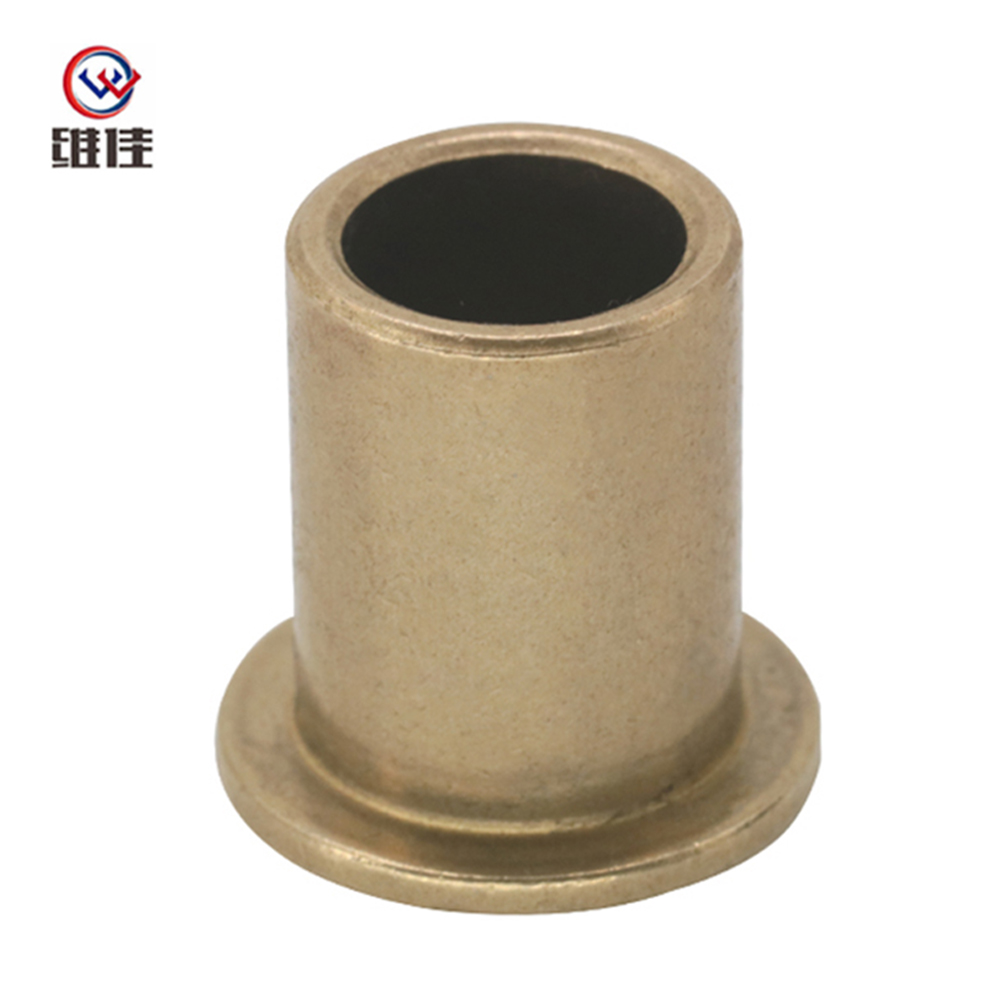
Our sintered bronze self-lubricating bearings are engineered for demanding industrial applications where traditional lubrication is impractical. Designed with advanced powder metallurgy technology, th...
See Details
Copyright © Jiande Welfine Technology Co., Ltd. All Rights Reserved. Custom Self-lubricating Sintered Bushing Manufacturers
