E-mail us: [email protected]
Tel: +86-15239857375
 English
 中文简体
中文简体

 Home / Author / Gao Manli — Overseas Sales Manager / Self-Lubricating Tin Bronze Flanged Bushings for Reliable Pump Performance
 Self-Lubricating Tin Bronze Flanged Bushings for Reliable Pump Performance
 2026.07.16
 Gao Manli — Overseas Sales Manager
Content
- 1 Product Overview: What Makes This Flanged Bushing Different?
- 2 Why Pump Manufacturers Need Better Bushing Solutions
- 3 Core Advantages Over Conventional Competitor Products
- 4 How the Self-Lubricating Mechanism Works
- 5 Advanced Powder Metallurgy Manufacturing Process
- 6 Technical Parameters and Performance Reference
- 7 Application Value in Pump Systems
- 8 How the Product Improves Pump Reliability
- 9 Comparison With Conventional Bushing Solutions
- 10 Design Considerations for Pump Engineers
- 11 Company Manufacturing Strengths
- 12 Customization Capabilities
- 13 Packaging, Storage, and After-Sales Support
- 14 Why This Bushing Is a Strong Choice for Pump Manufacturers
- 15 Q&A Section
- 15.1 What is a powder metallurgy self-lubricating tin bronze flanged bushing?
- 15.2 Why is this bushing suitable for pump manufacturers?
- 15.3 How does the self-lubricating function work?
- 15.4 What advantages does it have over conventional bronze bushings?
- 15.5 Can the bushing be customized?
- 15.6 What materials are commonly used?
- 15.7 What dimensional accuracy can be achieved?
- 15.8 What applications can use this type of bushing besides pumps?
- 15.9 Does the bushing require any external lubrication?
- 15.10 Why is powder metallurgy important for this product?
- 15.11 What quality certifications support production reliability?
- 15.12 How should engineers select the correct bushing?
- 16 Conclusion
- 17 References
- 18 Product: Powder Metallurgy Self-lubricating Tin Bronze Flanged Bushing
In pump systems, bearing performance directly affects reliability, service life, energy consumption, and maintenance cost. A small bushing may appear to be a simple component, but it controls shaft guidance, friction stability, axial positioning, vibration reduction, and wear resistance. When the operating environment involves continuous rotation, intermittent start-stop cycles, moisture, chemical media, dust, or limited access for maintenance, the choice of bushing becomes even more important. The powder metallurgy self-lubricating tin bronze flanged bushing is designed specifically to address these challenges by combining a porous bronze structure, internal oil storage, a one-piece flange, and precision sintered manufacturing.
This product belongs to bronze-based oil-impregnated bearings and is widely used in pumps, motors, reducers, textile machinery, construction equipment, automotive mechanisms, hydraulic devices, and general industrial transmission assemblies. For pump manufacturers, the bushing offers a practical balance between performance and cost. It reduces dependence on frequent external lubrication, improves shaft protection, stabilizes operation, and supports customized dimensions for different pump designs.
Compared with conventional machined bronze bushings, ordinary sleeve bearings, and low-cost substitute components, a powder metallurgy self-lubricating tin bronze flanged bushing offers a significant advantage: the lubrication function is built into the material itself. During operation, oil stored in the interconnected pores migrates to the friction surface and forms a protective film between the shaft and the bearing bore. When the system cools down, part of the oil is reabsorbed into the porous matrix. This repeated lubrication cycle helps reduce friction, wear, heat generation, seizure risk, and maintenance frequency.
Jiande Welfine Technology Co., Ltd. specializes in powder metallurgy sintering and precision machining. Established in 2001, the company has developed long-term manufacturing experience in powder metallurgy bushings, self-lubricating bushings, sintered metal parts, and customized precision components. With a 13,039-square-meter production base, advanced presses, high-temperature sintering furnaces, precision forming equipment, testing instruments, and more than 150 skilled employees, the company provides OEM and ODM solutions for customers requiring stable quality, reliable delivery, and engineering support.
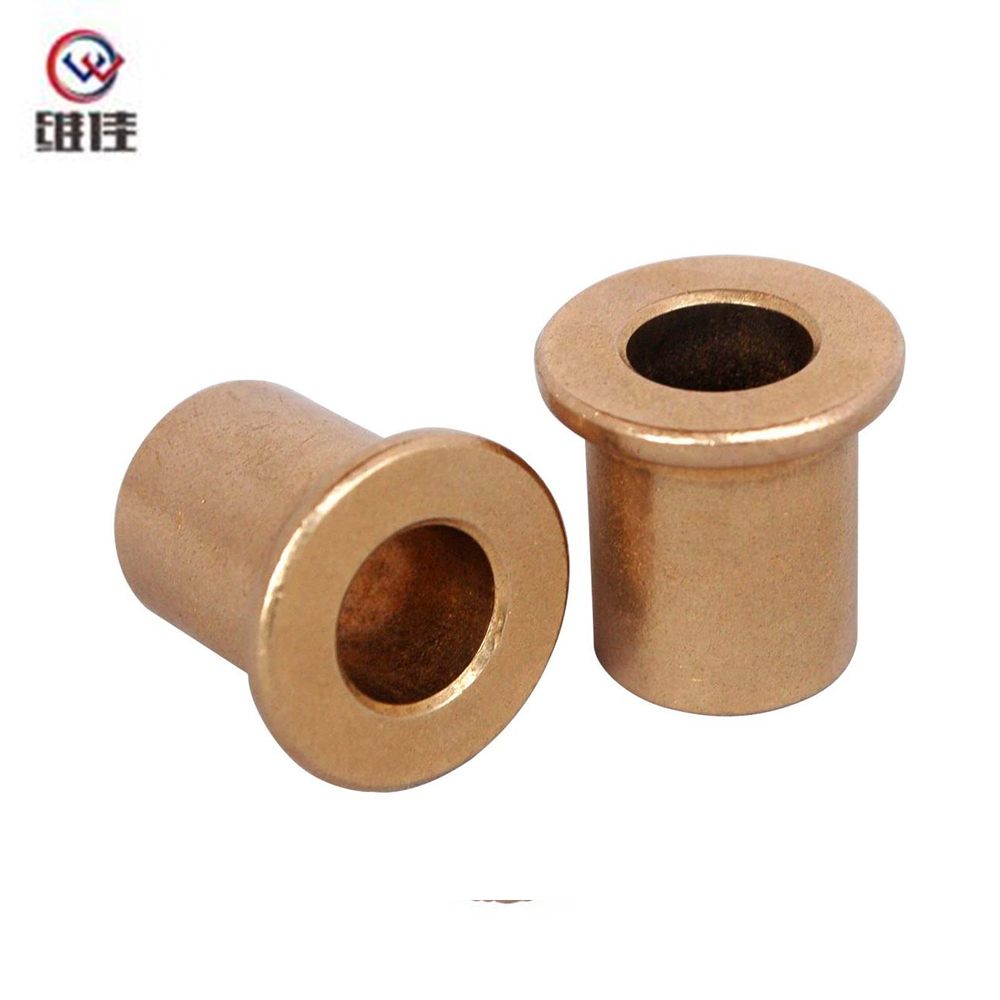
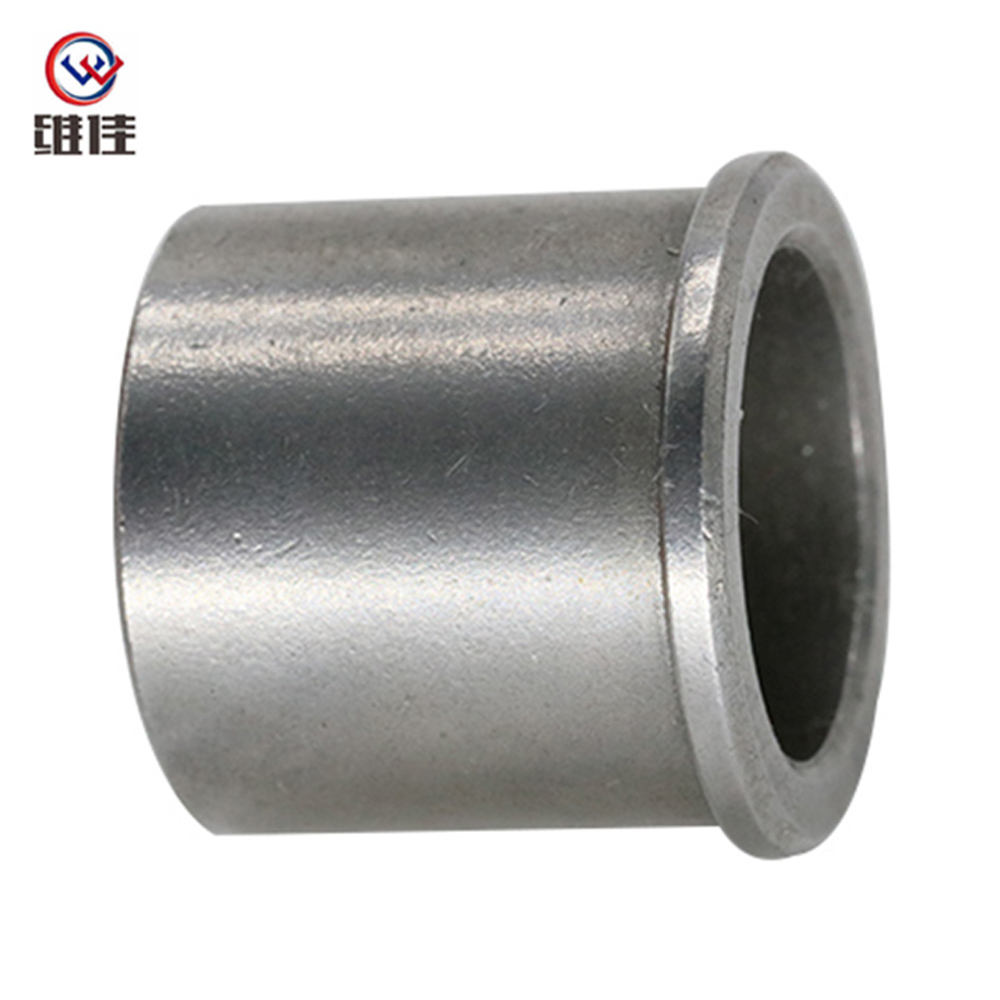
Powder Metallurgy Self-lubricating Tin Bronze Flanged Bushing
Product Overview: What Makes This Flanged Bushing Different?
The powder metallurgy self-lubricating tin bronze flanged bushing is manufactured from tin bronze powder, such as CuSn6 or CuSn8 grades depending on application requirements. Through powder compaction, high-temperature sintering, sizing, and oil impregnation, the material develops a controlled porous structure capable of storing lubricating oil. The resulting bushing combines mechanical strength, wear resistance, dimensional accuracy, and self-lubricating performance.
The flange is integrated into the bushing body, forming a one-piece component that improves axial positioning during assembly. In pump applications, this design is especially useful because it helps prevent unwanted axial movement, supports thrust loads within the design range, improves alignment, and simplifies installation. Instead of requiring additional washers, spacers, or complicated locating features, the flange provides a built-in positioning surface.
The product can be customized according to customer drawings, samples, application conditions, and assembly requirements. Typical parameters include an inner diameter range from Φ3 mm to Φ100 mm, an outer diameter range from Φ6 mm to Φ120 mm, a length range from 5 mm to 100 mm, and a flange diameter generally 2 mm to 10 mm larger than the outer diameter. Operating temperature can reach approximately -40℃ to +220℃ depending on lubricant selection and operating environment. The ultimate PV value may reach about 2.5 MPa·m/s without external oil lubrication under reference conditions.
The bushing is suitable for applications where low maintenance, smooth operation, compact structure, and cost-effective production are important. In pumps, it is used to guide rotating shafts, support sliding movement, reduce vibration, and protect mating components. In general machinery, it can be used in motor housings, gear reducers, conveyor assemblies, linkage structures, valve mechanisms, and other bearing locations where a bronze self-lubricating solution is preferred.
Why Pump Manufacturers Need Better Bushing Solutions
Pumps are often expected to operate for long periods with minimal interruption. Whether the pump is used for water circulation, agricultural irrigation, industrial cooling, chemical transfer, marine service, hydraulic systems, or oil handling, downtime can lead to production losses, maintenance costs, safety concerns, and customer dissatisfaction. Many pump failures are linked to friction, misalignment, contamination, insufficient lubrication, or excessive wear in rotating support components.
Traditional bushings can perform well when lubrication is applied correctly and regularly. However, in real operating conditions, lubrication schedules may be missed, grease may become contaminated, oil supply may be insufficient, and maintenance access may be difficult. If the bearing surface operates without proper lubrication, metal-to-metal contact increases. This raises friction, generates heat, accelerates shaft wear, and may eventually cause seizure or pump failure.
A self-lubricating tin bronze flanged bushing reduces these risks because it does not rely entirely on external lubrication. The internal oil reservoir supports continuous lubrication during motion. Even when maintenance intervals are extended, the bearing surface can remain protected under suitable operating conditions. This makes the product highly valuable for pump manufacturers that want to improve reliability without adding complex lubrication systems.
Another issue in pumps is axial control. During operation, shafts and rotating assemblies may experience axial forces caused by hydraulic pressure, impeller movement, vibration, or assembly tolerances. A flanged bushing provides a locating shoulder that helps maintain position and prevents the bushing from shifting within the housing. This contributes to more stable rotation and reduces the chance of uneven wear.
Core Advantages Over Conventional Competitor Products
Built-In Self-Lubrication
The most important advantage of this product is its built-in self-lubricating capability. Conventional solid bronze bushings often require grease grooves, oil holes, or regular manual lubrication. If lubrication is not maintained, friction rises rapidly. In contrast, a porous sintered bronze bushing stores oil throughout its structure. The lubricant is not merely applied to the surface; it is contained inside the material.
During operation, frictional heat and capillary action help bring oil to the contact surface. A stable lubricating film forms between the shaft and bushing. This film reduces direct contact, lowers friction coefficient, and minimizes wear. When the component stops operating, the oil can return into the pores. This automatic oil supply cycle is one of the reasons self-lubricating bushings are commonly selected for pumps and other rotating equipment.
Reduced Maintenance Frequency
Many competitor products depend on scheduled lubrication. In applications where equipment is remote, sealed, difficult to access, or continuously running, lubrication maintenance can be inconvenient and expensive. The self-lubricating tin bronze flanged bushing reduces the need for frequent manual lubrication. This does not mean the entire pump system never requires maintenance, but it does mean the bearing point can remain more stable with less intervention.
Lower maintenance frequency is especially valuable for pump manufacturers selling equipment to customers in agriculture, mining, water treatment, chemical processing, and industrial plants. In these sectors, users often prefer components that reduce routine service requirements and decrease downtime risk.
Excellent Wear and Seizure Resistance
Tin bronze provides a strong combination of toughness, wear resistance, corrosion resistance, and compatibility with steel shafts. Through sintering, the bronze powder particles bond into a stable structure. After sizing, the bushing achieves accurate dimensions and an improved surface condition. After oil impregnation, the pores hold lubricant that protects the sliding surface.
Compared with lower-grade bushings made from inconsistent materials or poorly controlled porosity, this product offers more reliable oil retention and wear behavior. The dense yet porous sintered structure helps resist seizure under demanding start-stop or moderate-load conditions. For pump shafts that experience continuous rotation, this can extend service life and reduce the risk of sudden failure.
One-Piece Flange for Axial Positioning
A standard sleeve bushing provides radial support, but it does not always offer axial positioning. If the housing fit is not ideal or axial forces are present, the sleeve may move or require extra retaining components. The flanged design solves this issue by adding an integrated shoulder. This supports easier assembly, more accurate positioning, and improved stability.
For pump manufacturers, simplified assembly can improve production efficiency. Operators can install the bushing with a clear locating surface, reducing assembly errors and improving consistency from unit to unit. The flange can also help distribute axial loads and protect the housing surface where appropriate.
Precision Customization
Not all pumps use the same shaft size, housing bore, rotation speed, fluid medium, or load profile. A major advantage of powder metallurgy production is its ability to support customized shapes and dimensions with good repeatability. Jiande Welfine Technology Co., Ltd. can produce bushings according to drawings or samples, including custom inner diameter, outer diameter, length, flange diameter, flange thickness, chamfer, tolerance, material grade, oil type, and surface treatment.
This flexibility is an advantage over suppliers that only offer standard catalog sizes. Pump manufacturers developing new products often require prototype batches, small-batch trial production, and later mass production. A supplier with OEM and ODM capability can support the entire development cycle from design verification to stable supply.
Cost Optimization Through Near-Net-Shape Manufacturing
Traditional copper alloy bushings are often produced from bar stock or tube stock, followed by machining. This may generate significant material waste, especially when flanges or special shapes are required. Powder metallurgy is a near-net-shape process. Metal powder is compacted in a die close to the final geometry, sintered, and then sized or machined only where necessary.
This method can reduce machining allowance, lower copper alloy waste, improve production efficiency, and reduce cost compared with fully machined bronze parts. For large-volume pump production, these savings can be substantial while still maintaining reliable performance.
How the Self-Lubricating Mechanism Works
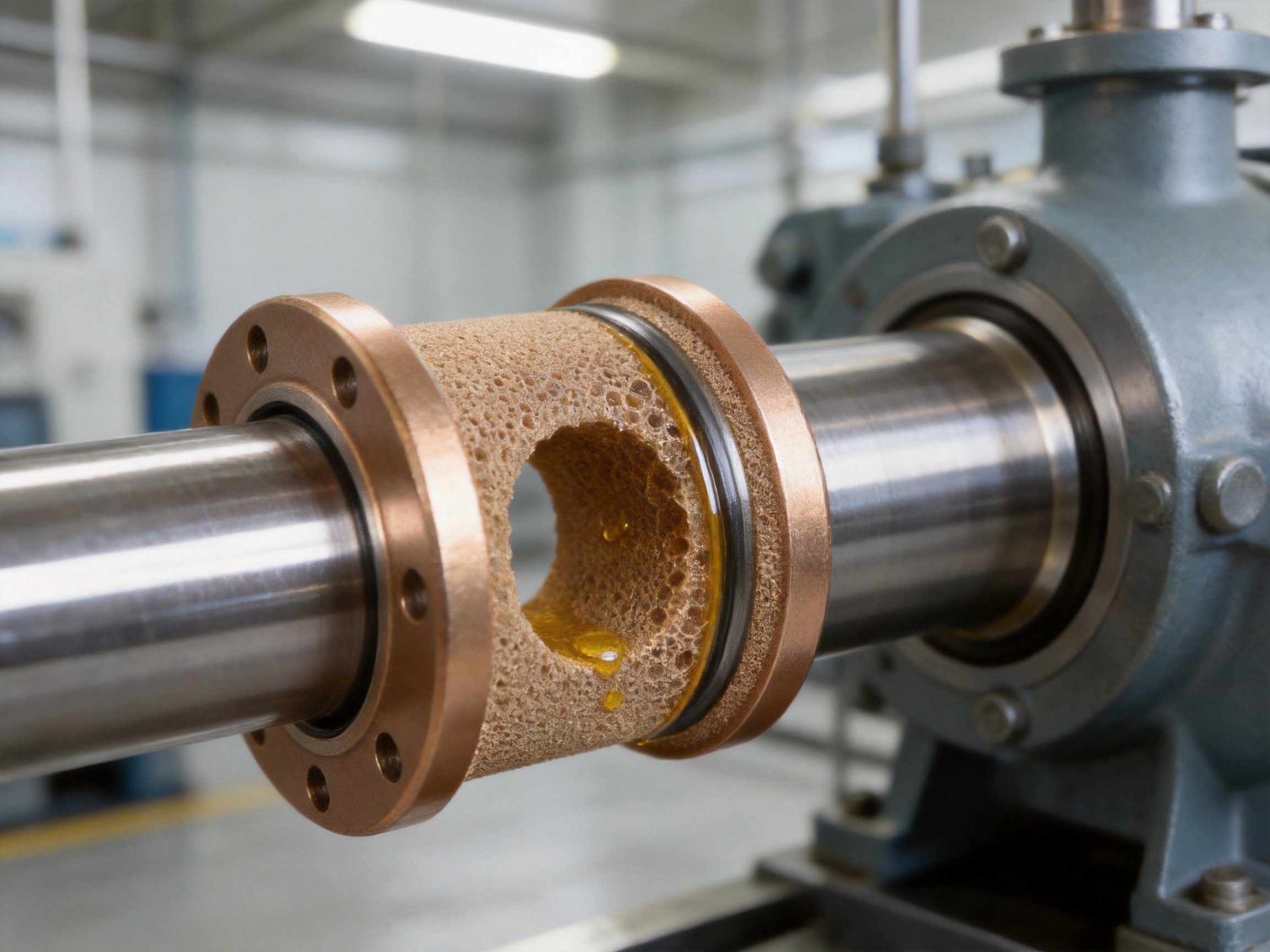
The self-lubricating mechanism begins with the powder metallurgy process. During compaction and sintering, bronze powder particles are bonded while leaving controlled interconnected pores. These microscopic pores are not defects; they are functional oil reservoirs. After sintering and sizing, the bushing is impregnated with lubricating oil, typically under vacuum or controlled conditions so that oil fills the internal pore network.
When the pump shaft rotates inside the bushing, friction generates heat at the contact interface. As the temperature rises, the oil inside the pores becomes more mobile and migrates toward the bearing surface. The shaft movement spreads the oil into a thin film. This film reduces the coefficient of friction, limits direct asperity contact, and carries away some heat from the contact zone.
When operation stops, the temperature decreases. Capillary action and material porosity allow some of the oil to return into the bushing. This cycle repeats throughout the service life of the component. The result is a bearing that can provide lubrication automatically, without relying entirely on external grease or oil supply systems.
In practical pump applications, this mechanism is valuable during start-up, low-speed operation, intermittent running, and locations where grease cannot be easily replenished. It also helps maintain cleaner assemblies because less external grease is exposed to dust, water, or abrasive particles.
Advanced Powder Metallurgy Manufacturing Process
Material Selection and Powder Preparation
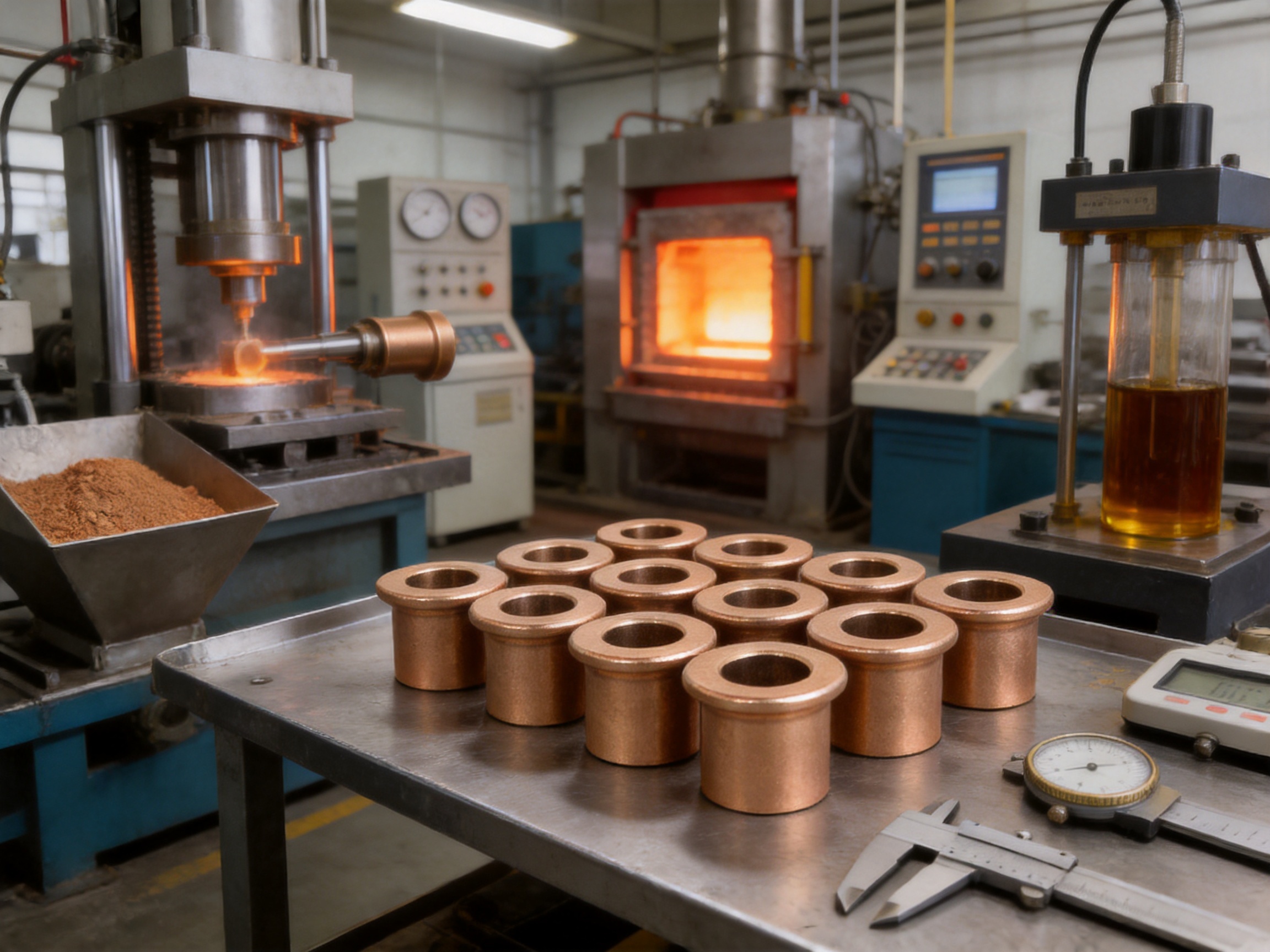
Manufacturing begins with suitable tin bronze powder selection. Common bronze grades such as CuSn6 and CuSn8 are selected according to required strength, wear resistance, porosity, and compatibility with the working environment. Powder characteristics such as particle size distribution, apparent density, flowability, purity, and composition directly influence the final product.
A reliable supplier must control raw material quality carefully. Inconsistent powder can produce unstable porosity, uneven density, poor sintering strength, and variable oil content. Jiande Welfine Technology Co., Ltd. emphasizes material control as part of its manufacturing system, helping ensure that each batch of bushings achieves consistent performance.
Powder Compaction
The prepared bronze powder is filled into a precision die and compacted under high pressure. Compaction forms the green part, which has the shape of the bushing but has not yet reached final metallurgical strength. The die design determines the basic geometry, including the sleeve body and flange. Powder filling consistency, press pressure, tooling condition, and dimensional control are critical at this stage.
Compared with machining from solid material, compaction can create a near-net-shape flanged structure with less waste. For high-volume production, the repeatability of pressing contributes to stable part dimensions and competitive cost.
High-Temperature Sintering
After compaction, the green parts are placed in a high-temperature sintering furnace. During sintering, the bronze particles bond together metallurgically. The process must be carefully controlled in terms of temperature, time, atmosphere, and furnace uniformity. Proper sintering creates strength while preserving the interconnected porosity needed for oil impregnation.
Advanced sintering equipment helps improve product consistency. If sintering temperature is too low, strength may be insufficient. If it is too high or poorly controlled, pores may close excessively or dimensions may distort. Jiande Welfine Technology Co., Ltd. uses high-temperature sintering furnaces and established process knowledge to balance strength, porosity, and dimensional stability.
Sizing and Calibration
After sintering, the bushings are sized or calibrated to achieve accurate final dimensions. Sizing improves roundness, inner diameter precision, outer diameter consistency, and surface quality. For pump applications, dimensional accuracy is essential because the clearance between shaft and bushing affects lubrication film formation, vibration, friction, and wear.
The product can reach dimensional accuracy levels such as IT7 to IT8 depending on part design and process conditions. This precision helps pump manufacturers maintain consistent assembly performance and avoid problems caused by excessive clearance or interference.
Oil Impregnation
Oil impregnation is a key step for self-lubricating performance. The sintered bronze bushing is treated so that lubricant enters the interconnected pore network. The oil content can be at least 18% under suitable product specifications, providing a reservoir for long-term operation. The selected oil must match the expected operating temperature, speed, load, and environment.
Proper impregnation distinguishes high-quality self-lubricating bushings from inferior products. If the oil content is too low or uneven, lubrication performance will be unstable. A controlled impregnation process improves reliability and helps the bushing deliver the performance expected in pump systems.
Optional Surface Treatment
Depending on customer requirements, surface treatments such as natural finish, phosphating, or tin plating may be available. These treatments can improve rust prevention, appearance, surface protection, or wear behavior in specific environments. The choice depends on application conditions, storage requirements, assembly method, and operating medium.
Inspection and Quality Assurance
Quality control includes material verification, dimensional inspection, density testing, oil content testing, appearance checks, and performance-related evaluations. For customized parts, inspection reports may be provided according to customer requirements. Jiande Welfine Technology Co., Ltd. has passed ISO 9001:2015 and IATF 16949:2016 certifications, supporting systematic quality control and continuous improvement.
These certifications are important for customers in automotive, industrial, and pump manufacturing sectors because they indicate that production processes, traceability, corrective action systems, and quality management procedures are formally controlled. Stable manufacturing is not only about equipment; it also depends on trained employees, process discipline, documented standards, and repeatable inspection.
Technical Parameters and Performance Reference
Parameter |
Reference Value or Description |
Benefit for Pump Applications |
Material |
Tin bronze, including grades such as CuSn6 or CuSn8 |
Provides wear resistance, toughness, and shaft compatibility |
Manufacturing Method |
Powder compaction, sintering, sizing, and oil impregnation |
Creates controlled porosity and near-net-shape efficiency |
Oil Content |
Typically at least 18% depending on specification |
Supports continuous self-lubrication during operation |
Density |
Approximately 6.2 to 6.8 g/cm³ |
Balances strength and oil storage capacity |
Inner Diameter Range |
Φ3 mm to Φ100 mm |
Suitable for small, medium, and larger pump shaft designs |
Outer Diameter Range |
Φ6 mm to Φ120 mm |
Supports diverse housing bore requirements |
Length Range |
5 mm to 100 mm |
Allows adjustment for load area and assembly space |
Flange Diameter |
Usually 2 mm to 10 mm larger than outer diameter |
Improves axial positioning and assembly stability |
Operating Temperature |
Approximately -40℃ to +220℃ depending on conditions |
Suitable for many industrial and pump environments |
Dimensional Accuracy |
Can reach IT7 to IT8 depending on design |
Improves fit, clearance control, and running stability |
Ultimate PV Value |
Reference value around 2.5 MPa·m/s without external oil lubrication |
Indicates capability under combined pressure and velocity conditions |
Application Value in Pump Systems
Centrifugal Pumps
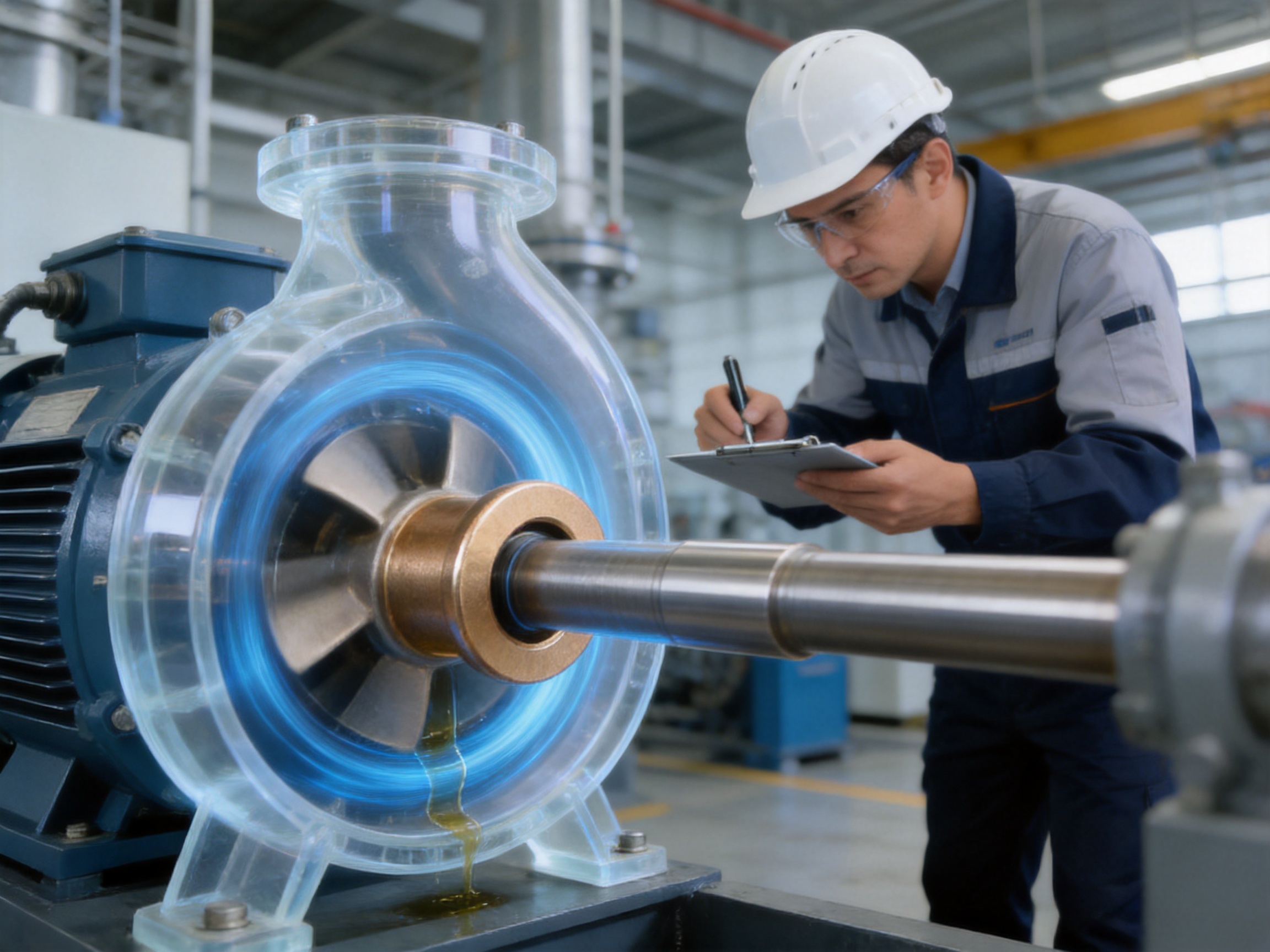
Centrifugal pumps require stable shaft support to maintain impeller alignment and reduce vibration. If shaft guidance is poor, the impeller may experience imbalance, seal wear may increase, and bearing loads may become uneven. A self-lubricating flanged bronze bushing helps support the shaft while reducing friction. The flange assists positioning, making the component practical for compact pump assemblies.
Water Circulation Pumps
Water circulation pumps often operate continuously in HVAC systems, industrial cooling lines, and process water circuits. Long running hours increase the importance of low wear and stable lubrication. Self-lubricating bushings reduce the need for frequent service, helping users maintain consistent water flow and reduce maintenance interruptions.
Chemical Transfer Pumps
Chemical processing environments may involve corrosive atmospheres, contamination, or restricted maintenance access. While material compatibility must always be evaluated for each chemical medium, bronze self-lubricating bushings can offer stable performance in many pump support positions where external grease contamination is undesirable. Optional surface treatment and customized oil selection may further improve suitability.
Agricultural Irrigation Pumps
Agricultural pumps are often used in dusty, wet, or remote environments. Maintenance may be irregular, and equipment may be operated seasonally under demanding conditions. A bushing with internal lubrication reduces dependence on frequent greasing and helps protect the shaft during operation. The flange also supports easy assembly and replacement.
Industrial Cooling Pumps
Cooling pumps are essential for maintaining stable temperatures in production systems. Unexpected failure can affect machines, molds, heat exchangers, and process equipment. Self-lubricating bushings contribute to reliability by reducing friction heat and wear at the shaft support points.
Marine Pump Systems
Marine equipment operates in humid, corrosive, and vibration-prone environments. Bushings must offer reliability and resistance to maintenance delays. Bronze materials are commonly valued in marine-related applications, and self-lubricating properties can improve performance where external lubrication is inconvenient.
Hydraulic and Oil Transfer Pumps
Hydraulic devices and oil transfer systems require stable rotating or sliding support under pressure and load. A precision sintered bronze bushing can provide reliable movement, low friction, and dimensional stability. Customization allows the bushing to match specific shaft materials, housing designs, and operating conditions.
How the Product Improves Pump Reliability
Lower Friction Coefficient
A stable lubricating film reduces friction between shaft and bushing. Lower friction means less power is wasted as heat, less torque is needed to maintain rotation, and the pump can operate more smoothly. In many applications, a self-lubricating bronze bushing may operate with a friction coefficient around 0.05 to 0.15 under appropriate conditions, while conventional bushings may show higher friction if lubrication is inconsistent.
Reduced Vibration and Noise
Excessive bearing wear can cause shaft looseness, vibration, noise, and seal problems. Because the self-lubricating bushing protects the sliding surface and maintains a stable interface, it helps reduce vibration caused by uneven wear or dry contact. Better dimensional accuracy also contributes to smooth rotation.
Protection Against Lubrication Failure
External lubrication systems can fail due to blocked oil passages, dried grease, contamination, incorrect lubricant, or missed maintenance. Internal oil storage reduces the risk of sudden dry running in suitable applications. This is a major reliability advantage, especially for pumps that operate in remote or difficult-to-service locations.
Improved Shaft Life
The shaft is often more expensive and harder to replace than the bushing. A self-lubricating bronze bushing acts as a protective bearing surface. By reducing direct metal-to-metal contact, it helps prevent scoring, galling, and excessive shaft wear. This extends the service life of the entire pump assembly.
Better Thermal Stability
Heat accelerates lubricant degradation, material expansion, and wear. Continuous lubrication helps control frictional heat generation. Lower operating temperatures support longer bearing life, more stable clearance, and reduced risk of thermal seizure.
Comparison With Conventional Bushing Solutions
When comparing bushing solutions, buyers should consider not only the purchase price but also service life, maintenance cost, downtime risk, assembly efficiency, and shaft protection. A cheaper bushing may become more expensive if it requires frequent lubrication, causes shaft damage, or fails prematurely.
Comparison Item |
Self-Lubricating Tin Bronze Flanged Bushing |
Conventional Solid Bronze Bushing |
Low-Cost Generic Bushing |
Lubrication Method |
Oil stored in interconnected pores |
External grease or oil usually required |
Often inconsistent or application-dependent |
Maintenance Demand |
Low under suitable operating conditions |
Regular lubrication required |
May require frequent inspection |
Axial Positioning |
Integrated flange supports positioning |
May require extra components |
Often limited design support |
Wear Resistance |
High due to tin bronze and oil film |
Good if properly lubricated |
Variable depending on material quality |
Risk of Dry Running |
Reduced by internal oil storage |
Higher if maintenance is missed |
Often higher |
Dimensional Consistency |
Controlled by sizing and inspection |
Depends on machining process |
May be inconsistent |
Cost Efficiency |
Near-net-shape process reduces waste |
Higher machining and material waste possible |
Low initial price but higher risk |
Suitability for Pump Manufacturers |
Excellent for reliable and low-maintenance designs |
Good when maintenance is controlled |
Uncertain for demanding applications |
Design Considerations for Pump Engineers
Shaft Material and Surface Finish
The mating shaft should have suitable hardness, roundness, and surface finish. A rough shaft can damage the bushing surface and disrupt the oil film. A shaft that is too soft may wear prematurely. Engineers should define shaft specifications according to load, speed, and service expectations.
Clearance Control
Proper clearance is essential for performance. If clearance is too small, oil film formation may be restricted and seizure risk may increase. If clearance is too large, vibration, noise, and misalignment may occur. Customized production allows the bushing dimensions to match the required operating clearance.
Load and Speed
The PV value, which combines pressure and sliding velocity, is an important reference for bearing selection. Pump designers should consider radial load, axial load, speed, duty cycle, temperature, and lubrication environment. The flanged bushing can provide excellent performance when used within its recommended operating range.
Housing Fit
The bushing must be properly retained in the housing. Interference fit, press-fit method, flange seating, and housing material should be considered. Improper installation can deform the bushing bore, reduce clearance, or cause misalignment. Technical support from an experienced manufacturer can help avoid these issues.
Operating Environment
Temperature, moisture, dust, chemicals, and external contamination all affect bushing performance. For special environments, material grade, oil type, surface treatment, and dimensional design should be confirmed. A custom manufacturer can recommend suitable adjustments based on application details.
Company Manufacturing Strengths
Jiande Welfine Technology Co., Ltd. has focused on powder metallurgy sintering and precision machining since 2001. More than two decades of experience give the company a strong understanding of material behavior, sintering control, tooling design, dimensional calibration, oil impregnation, and customer-specific engineering requirements.
The company operates a modern 13,039-square-meter production base in Jiande City, Zhejiang Province, China. The facility is equipped with advanced production and testing equipment, including efficient presses, high-temperature sintering furnaces, precision forming machines, and inspection instruments. This manufacturing platform supports stable production of powder metallurgy bushings, self-lubricating sintered bushings, and various sintered metal components.
With more than 150 skilled employees, the company can manage standard production, customized product development, process optimization, inspection, packaging, and delivery coordination. Its OEM and ODM services allow customers to submit drawings or samples for tailored bushing solutions. This is especially helpful for pump manufacturers that require unique flange sizes, non-standard tolerances, special materials, or prototype development before mass production.
Quality management is a major strength. The company has passed ISO 9001:2015 and IATF 16949:2016 certifications. These systems support process control, traceability, defect prevention, continuous improvement, and consistent product performance. For industrial customers, this reduces supply risk and helps ensure that each batch meets agreed specifications.
Another strength is rapid development and flexible production. Standard parts may be available from stock, while custom parts can often be delivered in a practical development cycle depending on complexity and order conditions. Small-batch trial production is supported, allowing customers to validate fit and performance before scaling up.
Customization Capabilities
Customization is one of the most important reasons to choose an experienced powder metallurgy manufacturer. Pump designs differ widely, and a bushing that works in one model may not fit another. Jiande Welfine Technology Co., Ltd. can develop parts according to customer drawings, samples, or performance requirements.
Custom options may include inner diameter, outer diameter, length, flange diameter, flange thickness, chamfer dimensions, oil content, density range, material grade, tolerance level, surface treatment, and packaging method. For special applications, engineers can evaluate load conditions, speed, operating temperature, shaft material, housing fit, and lubrication expectations to recommend a practical solution.
This customized approach offers an advantage over catalog-only suppliers. Instead of forcing the pump design to adapt to a standard bushing, the bushing can be designed to fit the pump. This improves assembly efficiency, performance consistency, and long-term reliability.
Packaging, Storage, and After-Sales Support
Self-lubricating bronze bushings should be packaged properly to prevent oxidation, contamination, and physical damage during transportation. Moisture-proof packaging helps protect the surface and preserve product quality before installation. Independent packaging can also reduce collision damage and make inventory management easier.
After-sales support is valuable for customers selecting, installing, and maintaining bushings. Technical guidance may include recommended fitting methods, installation precautions, shaft requirements, clearance considerations, and storage instructions. For qualified non-human-induced damage within the agreed warranty conditions, replacement support may be available according to the supplier’s policy.
For pump manufacturers, supplier support does not end when the product is shipped. A reliable bushing supplier can help solve assembly questions, improve designs, analyze wear patterns, and optimize future production. This long-term cooperation model is especially important for OEM customers seeking stable quality and continuous improvement.
Why This Bushing Is a Strong Choice for Pump Manufacturers
The powder metallurgy self-lubricating tin bronze flanged bushing is a strong choice because it addresses several common pain points at the same time. It reduces lubrication maintenance, improves wear resistance, provides axial positioning, supports precision customization, and lowers cost through near-net-shape manufacturing. These advantages are especially relevant for pump manufacturers that need reliable components for competitive equipment.
In comparison with conventional bronze bushings, the self-lubricating design improves protection against lubrication failure. In comparison with low-cost generic bushings, it provides better material control, oil retention, dimensional stability, and quality assurance. In comparison with complex rolling bearings or external lubrication systems, it can offer a compact, economical, and robust solution for sliding support positions.
The product is not merely a commodity part. Its performance depends on powder quality, porosity control, sintering technology, sizing precision, oil impregnation, inspection, and application engineering. This is why manufacturer capability matters. Jiande Welfine Technology Co., Ltd. combines long industry experience, certified quality systems, advanced equipment, and custom manufacturing ability to provide reliable self-lubricating bushing solutions for global customers.
Q&A Section
What is a powder metallurgy self-lubricating tin bronze flanged bushing?
It is a porous bronze bearing component produced by powder metallurgy. The bushing is made from tin bronze powder, compacted, sintered, sized, and impregnated with lubricating oil. Its internal pores store oil and release it during operation, forming a lubricating film between the shaft and the bushing. The integrated flange provides axial positioning and installation stability.
Why is this bushing suitable for pump manufacturers?
Pumps often require long service life, smooth shaft rotation, low maintenance, and stable operation. This bushing reduces friction, protects the shaft, lowers wear, and minimizes dependence on frequent external lubrication. The flange also helps position the component accurately in the pump housing, improving assembly efficiency and reliability.
How does the self-lubricating function work?
The sintered bronze structure contains interconnected microscopic pores filled with oil. During operation, frictional heat and capillary action bring oil to the bearing surface. The oil forms a thin lubricating film between the shaft and bushing. When the equipment stops and cools, some oil is reabsorbed into the pores. This cycle supports long-term lubrication.
What advantages does it have over conventional bronze bushings?
Conventional bronze bushings usually require regular external grease or oil. If lubrication is missed, wear and seizure risk increase. The self-lubricating tin bronze flanged bushing stores oil internally, reducing maintenance frequency and improving reliability. It also uses a one-piece flange for axial positioning and can be produced by near-net-shape powder metallurgy to reduce machining waste.
Can the bushing be customized?
Yes. Customization can include inner diameter, outer diameter, length, flange diameter, flange thickness, tolerance, material grade, density, oil content, surface treatment, and packaging. Jiande Welfine Technology Co., Ltd. supports OEM and ODM production according to customer drawings, samples, and application requirements.
What materials are commonly used?
Tin bronze grades such as CuSn6 and CuSn8 are commonly available. These materials offer a good balance of strength, wear resistance, toughness, corrosion resistance, and compatibility with steel shafts. The final material choice depends on the working condition and customer specification.
What dimensional accuracy can be achieved?
Depending on product design and manufacturing requirements, dimensional accuracy can reach levels such as IT7 to IT8. Sizing and calibration after sintering help improve bore accuracy, roundness, and consistency, which are important for pump shaft support and clearance control.
What applications can use this type of bushing besides pumps?
In addition to centrifugal pumps, water circulation pumps, chemical transfer pumps, irrigation pumps, cooling pumps, marine pumps, and hydraulic equipment, the bushing can be used in automotive mechanisms, construction machinery, textile machinery, printing equipment, office equipment, motors, reducers, conveyors, and general mechanical transmission systems.
Does the bushing require any external lubrication?
In many suitable applications, the bushing can operate with its internal oil impregnation and requires much less external lubrication than conventional bushings. However, the exact maintenance requirement depends on load, speed, temperature, shaft condition, environment, and duty cycle. Engineers should confirm operating conditions during selection.
Why is powder metallurgy important for this product?
Powder metallurgy creates the controlled porous structure needed for oil storage. It also enables near-net-shape production, material efficiency, repeatable dimensions, and customized geometries such as flanged bushings. Without proper powder metallurgy control, oil retention and long-term performance may be unstable.
What quality certifications support production reliability?
Jiande Welfine Technology Co., Ltd. has passed ISO 9001:2015 and IATF 16949:2016 certifications. These quality management systems support process control, traceability, inspection, corrective action, and consistent manufacturing performance.
How should engineers select the correct bushing?
Engineers should consider shaft diameter, housing bore, required clearance, radial load, axial load, speed, operating temperature, environment, lubricant requirements, installation method, and expected service life. Providing drawings, samples, or working condition data allows the manufacturer to recommend a suitable customized solution.
Conclusion
The powder metallurgy self-lubricating tin bronze flanged bushing is a high-value bearing solution for pump manufacturers and industrial equipment builders. Its porous bronze structure stores lubricating oil, enabling automatic lubrication during operation. Its tin bronze material provides wear resistance and toughness. Its integrated flange improves axial positioning and assembly efficiency. Its powder metallurgy manufacturing process reduces material waste and supports stable, customized production.
For pump systems, these advantages translate into lower friction, reduced wear, less maintenance, improved shaft protection, more stable operation, and longer service life. Compared with conventional bushings and low-cost substitutes, the product offers stronger reliability and better total cost performance when used correctly.
Jiande Welfine Technology Co., Ltd. provides the manufacturing foundation behind this performance. With more than 20 years of powder metallurgy experience, a modern 13,039-square-meter production base, advanced sintering and precision forming equipment, more than 150 skilled employees, OEM and ODM customization, and ISO 9001:2015 and IATF 16949:2016 quality certifications, the company is positioned to support pump manufacturers and industrial customers requiring reliable self-lubricating bushing solutions.
For applications where downtime is costly, maintenance access is limited, and bearing reliability is essential, a self-lubricating tin bronze flanged bushing is not just a component choice. It is a design improvement that supports long-term equipment performance.
References
1. German, R. M. Powder Metallurgy and Particulate Materials Processing. Metal Powder Industries Federation.
2. ASM International. ASM Handbook, Volume 7: Powder Metal Technologies and Applications.
3. Neale, M. J. The Tribology Handbook. Butterworth-Heinemann.
4. Stachowiak, G. W., and Batchelor, A. W. Engineering Tribology. Butterworth-Heinemann.
5. ISO 5755. Sintered Metal Materials: Specifications for Structural Parts.
6. ISO 9001:2015. Quality Management Systems Requirements.
7. IATF 16949:2016. Quality Management System Standard for Automotive Production and Relevant Service Parts Organizations.
Product: Powder Metallurgy Self-lubricating Tin Bronze Flanged Bushing

Related products
-
-
Our sintered bronze self-lubricating bearings are engineered for demanding industrial applications where traditional lubrication is impractical. Designed with advanced powder metallurgy technology, th...
See Details
Copyright © Jiande Welfine Technology Co., Ltd. All Rights Reserved. Custom Self-lubricating Sintered Bushing Manufacturers
