 English
 中文简体
中文简体
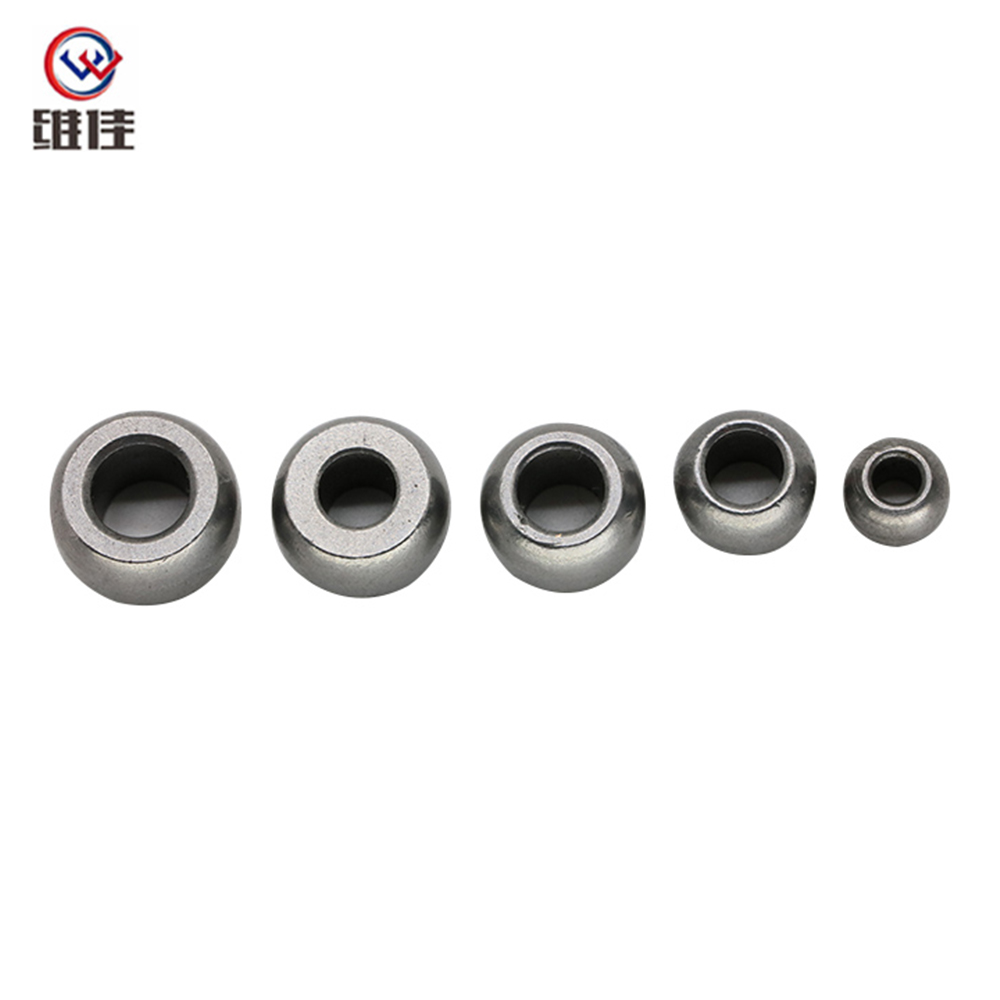
Premium Material: Our flange bushing is crafted from Sint B50 oil-impregnated bronze, featuring an 18% oil content. The high-quality tin bronze material ensures exceptional hardness, wear resistance, ...
See DetailsE-mail us: [email protected]
Tel: +86-15239857375


 Home / Author / Gao Manli — Overseas Sales Manager / Oil-Impregnated Bronze Flange Bushings for Reliable Self-Lubricating Motion
 Oil-Impregnated Bronze Flange Bushings for Reliable Self-Lubricating Motion
 2026.06.26
 Gao Manli — Overseas Sales Manager
Content
- 1 Understanding the Role of a Flange Bushing in Mechanical Systems
- 2 Material Advantage: Oil-Impregnated Sintered Bronze
- 3 Powder Metallurgy: Why the Manufacturing Method Matters
- 4 Core Product Features of the Sint B50 Bronze Flange Bushing
- 5 Comparison with Conventional Bearing and Bushing Solutions
- 6 Why the Flange Design Increases Assembly Efficiency
- 7 Self-Lubricating Behavior and Maintenance Reduction
- 8 Application Areas Across Industries
- 9 Quality Factors That Determine Bushing Performance
- 10 Manufacturing Strengths of Jiande Welfine Technology Co., Ltd.
- 11 Advantages Over Competitors
- 12 Design Considerations for Successful Application
- 13 Lifecycle Cost Benefits
- 14 Environmental and Operational Cleanliness Benefits
- 15 Precision Manufacturing and Consistency in Mass Production
- 16 Q&A Section
- 16.1 What is the Sint B50 Powdered Metallurgy Oil-Impregnated Bronze Flange Bushing?
- 16.2 Does this bushing require regular lubrication?
- 16.3 Why is oil impregnation important?
- 16.4 What advantage does the flange provide?
- 16.5 How does this bushing compare with a solid bronze bushing?
- 16.6 Can it be used in automotive applications?
- 16.7 Is customization available?
- 16.8 What factors affect the service life of the bushing?
- 16.9 Why is powder metallurgy suitable for self-lubricating bushings?
- 16.10 What certifications support the manufacturer’s quality capability?
- 17 Conclusion
- 18 References
- 19 Product: Sint B50 Powdered Metallurgy Oil-Impregnated Bronze Flange Bushing
In modern mechanical design, small components often determine whether a machine operates smoothly for years or requires frequent downtime and costly maintenance. Among these components, the oil-impregnated bronze flange bushing plays a particularly important role because it supports shafts, reduces friction, stabilizes motion, and helps protect surrounding mechanical assemblies from wear. The Sint B50 Powdered Metallurgy Oil-Impregnated Bronze Flange Bushing is designed for applications where reliability, compact structure, low maintenance, and long service life are essential.
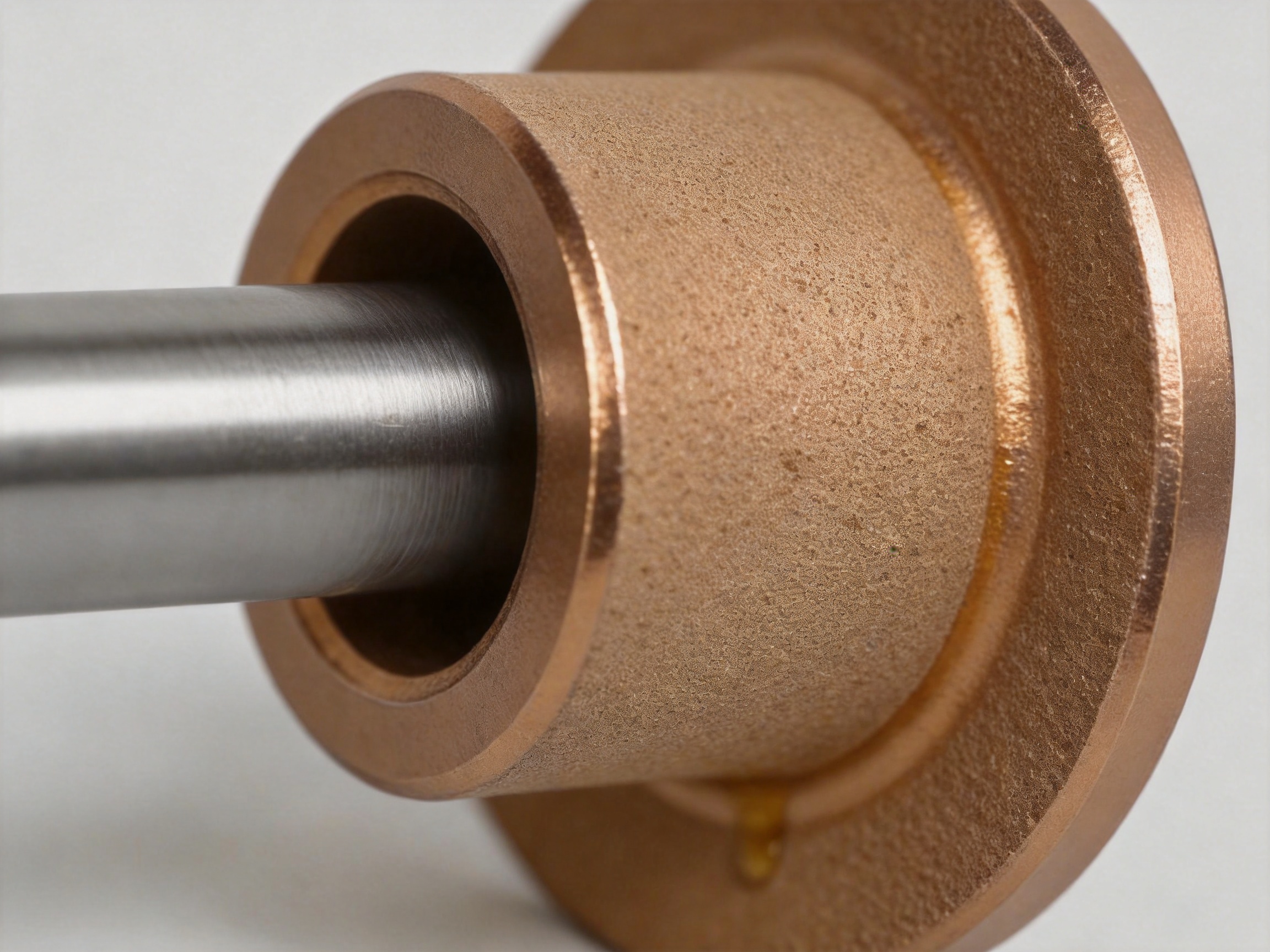
Manufactured from high-quality oil-impregnated sintered bronze with approximately 18% oil content, this flange bushing combines the strength of bronze with the lubrication-retaining capability of powder metallurgy. Instead of depending entirely on external grease or oil, the bushing stores lubricant inside a network of microscopic pores formed during the sintering process. During operation, the lubricant is gradually released to the bearing surface, creating a protective oil film between the shaft and the bushing. When operation stops, part of the lubricant is reabsorbed into the porous structure, allowing a continuous self-lubricating cycle.
This product is suitable for industries such as automotive systems, industrial machinery, agricultural equipment, hydraulic assemblies, household appliances, power tools, textile machinery, packaging equipment, office devices, and automation systems. Its flange design provides positioning support and helps accommodate certain axial loads, making it more functional than a simple straight cylindrical sleeve in many assemblies. For manufacturers seeking a compact, durable, and cost-effective bearing solution, the Sint B50 oil-impregnated bronze flange bushing offers strong practical value.
Jiande Welfine Technology Co., Ltd. specializes in powder metallurgy sintering and related precision machining. Established in 2001, the company has developed into a high-tech manufacturer integrating research and development, production, and sales. With a 13,039-square-meter production base, advanced pressing equipment, high-temperature sintering furnaces, precision forming machines, inspection instruments, and more than 20 years of manufacturing experience, the company provides customized OEM and ODM solutions for self-lubricating bushings and sintered precision components. Its ISO 9001:2015 and IATF 16949:2016 certifications further support stable quality control for demanding global applications.
Sint B50 Powdered Metallurgy Oil-Impregnated Bronze Flange Bushing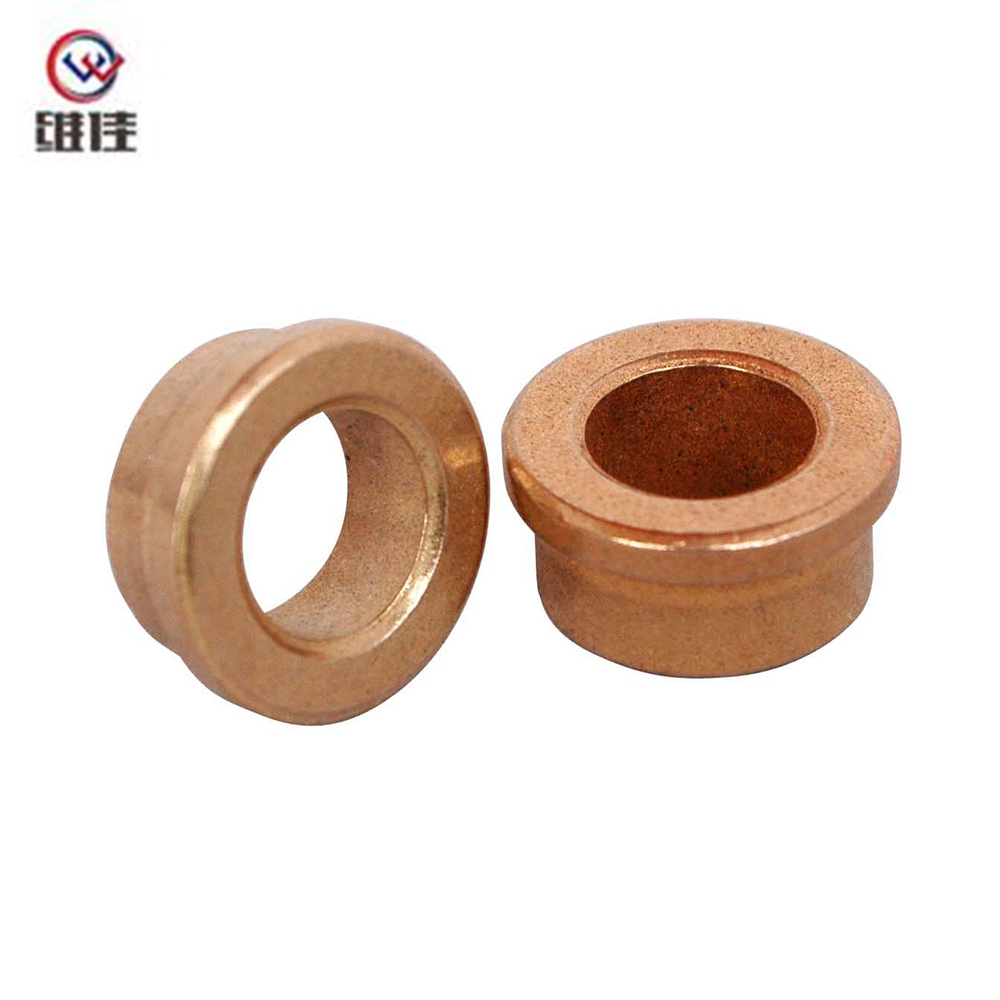
Understanding the Role of a Flange Bushing in Mechanical Systems
A bushing is a plain bearing that supports sliding or rotating motion between two mechanical parts. Unlike rolling bearings, which use balls or rollers, bushings rely on a sliding surface and proper lubrication to reduce friction. This simple structure offers many advantages, including compact size, low noise, shock resistance, ease of installation, and cost efficiency. In applications where space is limited or where quiet operation is required, bushings are often preferred over more complex bearing systems.
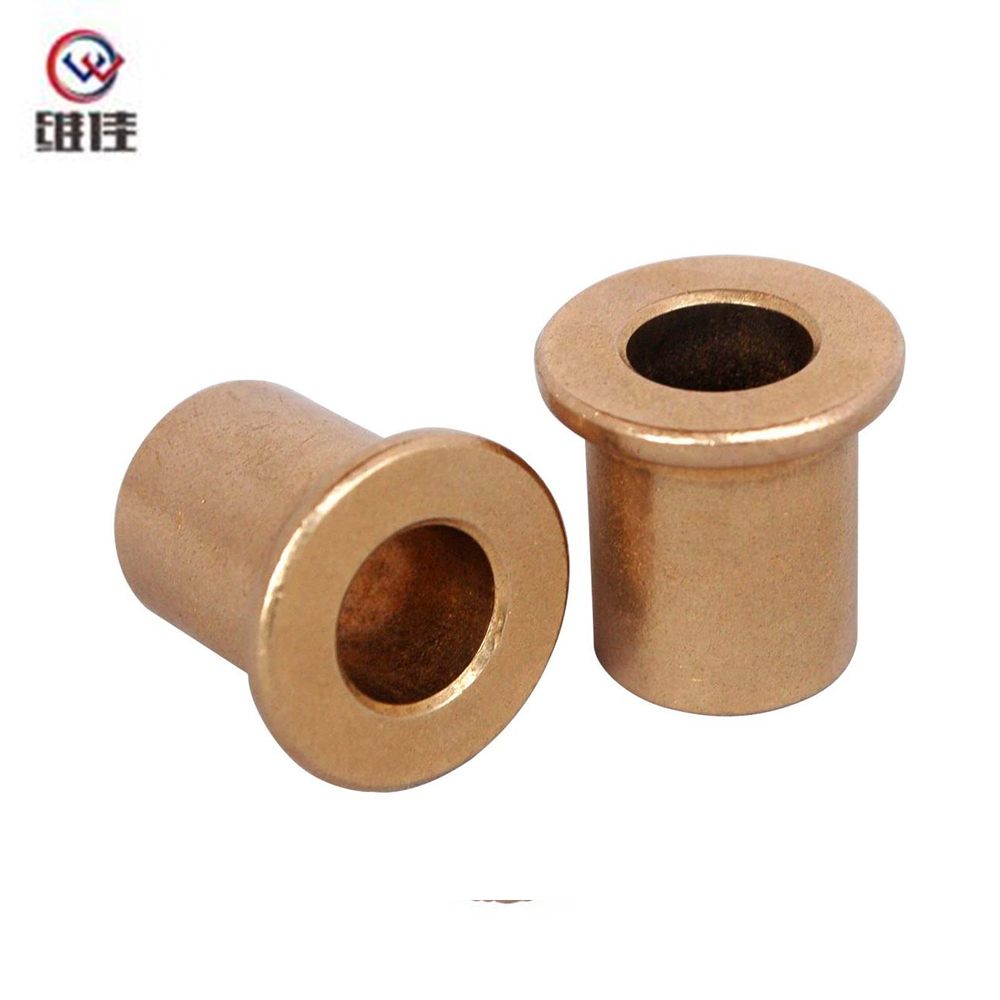
The flange bushing is a specialized variation of the plain bushing. It has a cylindrical body and an integrated flange at one end. The cylindrical portion supports radial loads, while the flange can help locate the component axially and bear certain thrust loads. This combination reduces the need for additional washers, collars, or retaining components. As a result, the overall assembly can be simpler, lighter, and easier to maintain.
In many machines, shafts do not only rotate under radial force. They may also experience side movement or axial pressure caused by vibration, misalignment, shifting loads, or external mechanical interaction. A flange bushing helps manage these forces by providing a stable shoulder surface. This feature is especially useful in compact assemblies such as motor housings, linkages, actuators, hinges, wiper mechanisms, small gearboxes, seat adjustment structures, conveyor rollers, and hydraulic control components.
The Sint B50 Powdered Metallurgy Oil-Impregnated Bronze Flange Bushing is designed to deliver this multifunctional support while reducing lubrication maintenance. It is particularly valuable in assemblies where lubrication points are difficult to reach, where grease may attract dust or contaminants, or where customers want to reduce maintenance frequency throughout the service life of the equipment.
Material Advantage: Oil-Impregnated Sintered Bronze
The performance of any bushing begins with its material. Bronze has long been valued in bearing applications because it offers a favorable balance of strength, corrosion resistance, conformability, and compatibility with steel shafts. Tin bronze, in particular, provides good hardness and wear resistance, making it suitable for sliding components exposed to repeated movement and moderate to demanding loads.
The Sint B50 oil-impregnated bronze flange bushing is produced by powder metallurgy rather than traditional casting and machining alone. In powder metallurgy, metal powders are compacted into a desired shape under pressure and then sintered at high temperature. During sintering, particles bond together metallurgically while maintaining a controlled porous structure. This porosity is central to the bushing’s self-lubricating capability.
The approximately 18% oil content provides a strong lubrication reserve. Instead of applying lubricant only to the surface, the manufacturing process allows oil to penetrate deeply into the porous network. This internal oil reservoir is one of the main differences between sintered self-lubricating bushings and ordinary solid bronze bushings. A conventional machined bronze sleeve usually needs external lubrication channels, grease grooves, or periodic relubrication. By contrast, the Sint B50 bushing carries lubricant within its own structure.
This material structure helps reduce direct metal-to-metal contact. During shaft rotation or sliding motion, frictional heat and capillary action encourage oil to migrate to the working surface. The oil film lowers friction, reduces wear, minimizes noise, and supports smoother operation. When the equipment cools or stops, the lubricant can be drawn back into the pores. This cycle makes the product highly suitable for long-term applications where routine lubrication is inconvenient or undesirable.
Powder Metallurgy: Why the Manufacturing Method Matters
Powder metallurgy is not simply an alternative way of forming metal components; it is a manufacturing technology that enables properties difficult to achieve through conventional machining. For oil-impregnated bushings, powder metallurgy is especially important because it creates the controlled porosity needed for lubricant storage.
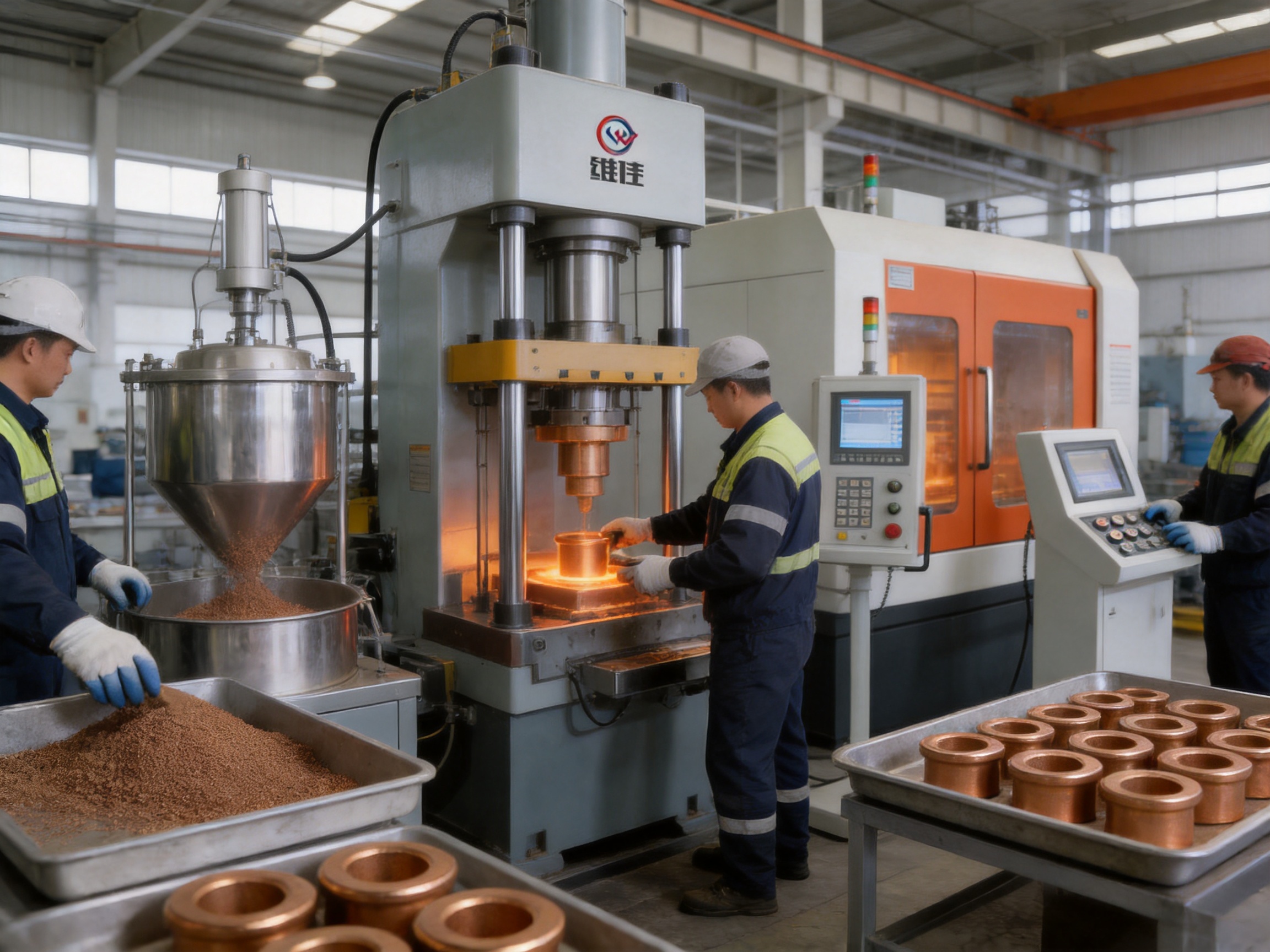
The process typically begins with the selection and preparation of metal powders. Copper-based alloy powders are carefully blended to achieve the required composition, flow characteristics, and final material performance. The powder mixture is then filled into a precision die and compacted under high pressure. This step determines the initial density, shape, and dimensional foundation of the bushing.
After compaction, the green compact is sintered in a high-temperature furnace under a controlled atmosphere. During sintering, the particles bond together while the component develops strength and structural integrity. The sintering temperature, furnace atmosphere, heating curve, and holding time all influence the final pore distribution, mechanical strength, and dimensional stability. A properly controlled sintering process allows the bushing to have enough porosity for oil retention without sacrificing necessary load-bearing capacity.
Following sintering, additional sizing, calibration, machining, deburring, cleaning, and vacuum oil impregnation may be performed. Sizing improves dimensional accuracy and surface consistency. Vacuum oil impregnation removes air from the pore structure and allows lubricant to penetrate deeply and evenly. The result is a self-lubricating bushing with reliable oil storage and predictable operating behavior.
Jiande Welfine Technology Co., Ltd. has built its manufacturing capability around this type of process control. The company uses advanced presses, high-temperature sintering furnaces, precision forming equipment, and inspection systems to support consistent production. Its experience in powder metallurgy bushings and self-lubricating components enables it to adjust material formulation, density, porosity, dimensions, and post-processing according to customer requirements.
Core Product Features of the Sint B50 Bronze Flange Bushing
The Sint B50 Powdered Metallurgy Oil-Impregnated Bronze Flange Bushing offers a combination of features that make it suitable for both standard and customized applications. Its value lies not in one single characteristic, but in the interaction of material, structure, manufacturing precision, and self-lubricating performance.
High Oil Content for Long-Term Lubrication
With approximately 18% oil content, the bushing stores lubricant throughout its porous bronze body. This oil reserve supports long-term self-lubrication and reduces the need for frequent manual maintenance. In many operating conditions, no additional lubrication is required after installation.
Reliable Wear Resistance
The tin bronze base material provides strong wear resistance under sliding and rotating conditions. When combined with an oil film generated by the self-lubricating structure, the bushing helps protect both itself and the mating shaft from excessive wear.
Flange Design for Positioning and Axial Support
The integrated flange improves installation stability and can help support axial loads. This design reduces component count and simplifies assembly, especially in equipment where space and alignment are important.
Low Noise and Smooth Operation
The steady release of lubricant reduces friction and vibration. This helps improve motion smoothness and can lower operating noise, which is important for household appliances, office equipment, automotive cabin components, and precision devices.
Dimensional Precision
Powder metallurgy and precision sizing allow good dimensional repeatability. Consistent tolerances are important for automated assembly lines and high-volume production where every component must fit correctly.
Cost-Effective Production
Compared with fully machined solid bronze components, powder metallurgy can improve material utilization and reduce machining waste. For large-volume production, this method provides attractive cost efficiency without compromising essential performance.
Comparison with Conventional Bearing and Bushing Solutions
When selecting a bearing component, engineers often compare oil-impregnated bronze flange bushings with solid bronze bushings, plastic bushings, rolling bearings, and composite bearings. Each solution has suitable application areas, but the Sint B50 sintered bronze flange bushing has several competitive advantages in conditions requiring compact design, durability, and reduced lubrication maintenance.
| Solution Type | Main Strengths | Common Limitations | Advantages of Sint B50 Oil-Impregnated Bronze Flange Bushing |
|---|---|---|---|
| Solid machined bronze bushing | Good strength, traditional bearing material, suitable for heavy-duty use with lubrication | Usually requires regular lubrication, higher machining waste, may need grooves or lubrication holes | Stores oil internally, reduces maintenance, offers powder metallurgy cost efficiency |
| Plastic bushing | Lightweight, corrosion resistant, quiet in some applications | May deform under heat or load, lower thermal conductivity, limited high-load capability | Better heat resistance and dimensional stability, stronger bronze structure |
| Rolling bearing | Low friction at high speed, precise rotation | More complex, sensitive to contamination and shock, larger installation space in some designs | Simpler structure, compact, shock tolerant, suitable for oscillating and low-speed sliding motion |
| Composite bearing | Low friction surfaces, good performance in selected dry-running conditions | Layer damage may affect performance, application-specific limitations | Uniform porous metal structure with internal oil reserve and robust bronze body |
| Standard straight sintered bushing | Self-lubricating, compact, economical | Limited axial positioning support | Integrated flange adds positioning function and helps manage axial forces |
This comparison shows why the Sint B50 product is often selected for applications where a simple sleeve is not enough, but a complex rolling bearing is unnecessary. It provides a practical balance between strength, lubrication, compactness, and cost.
Why the Flange Design Increases Assembly Efficiency
The flange is more than an added rim; it is a functional design element that can improve assembly reliability. In mechanical systems, components must be positioned accurately to prevent unwanted movement, uneven loading, noise, and premature wear. A straight cylindrical bushing may require additional hardware to prevent axial displacement. A flange bushing can provide this positioning function directly.
By integrating a flange into the bushing, designers can reduce the number of separate parts. This helps simplify purchasing, inventory management, assembly procedures, and maintenance operations. Fewer components also mean fewer opportunities for installation errors. In high-volume manufacturing, even a small reduction in assembly steps can produce meaningful productivity improvements.
The flange surface can act as a thrust face in applications with limited axial load. For example, a linkage mechanism may move side to side during operation, or a rotating shaft may experience axial force caused by gear engagement or actuator movement. The flange helps control this movement and maintain alignment.
In compact equipment, every millimeter matters. Replacing a separate washer and sleeve combination with one flange bushing can reduce space requirements. This is beneficial in automotive interior mechanisms, small electric motors, appliances, power tools, compact pumps, and automation devices. The Sint B50 bushing therefore supports not only bearing performance but also efficient mechanical design.
Self-Lubricating Behavior and Maintenance Reduction
Lubrication is one of the most important factors affecting bearing life. Without a proper lubricant film, sliding contact can cause rapid wear, high friction, noise, heat generation, and even seizure. Traditional bushings often rely on scheduled maintenance to replenish grease or oil. However, in real operating environments, maintenance may be delayed, overlooked, or difficult to perform.
The self-lubricating mechanism of the Sint B50 oil-impregnated bronze flange bushing directly addresses this issue. Its porous structure acts as an internal lubricant storage system. During movement, oil is released to the contact surface. This helps reduce friction between the bushing and shaft. As a result, the product can operate with lower maintenance requirements than many conventional metal bushings.
Reduced maintenance has economic and operational benefits. Equipment downtime can be expensive, especially in automated production lines, agricultural machinery during peak season, or industrial systems operating continuously. If a bushing can reduce relubrication needs, operators save labor time and avoid unnecessary interruptions. In applications where bushings are enclosed or difficult to reach, self-lubrication becomes even more valuable.
The oil-impregnated design also helps prevent over-lubrication. Excess external grease can attract dust, dirt, fibers, or abrasive particles, especially in agricultural, textile, woodworking, or packaging environments. Contaminated grease may accelerate wear. A self-contained lubrication reserve can reduce exposed lubricant and contribute to cleaner operation.
Application Areas Across Industries
The Sint B50 Powdered Metallurgy Oil-Impregnated Bronze Flange Bushing is used in a wide range of industries because its core functions—supporting shafts, reducing friction, controlling wear, and lowering maintenance—are universal mechanical needs.
Automotive Systems
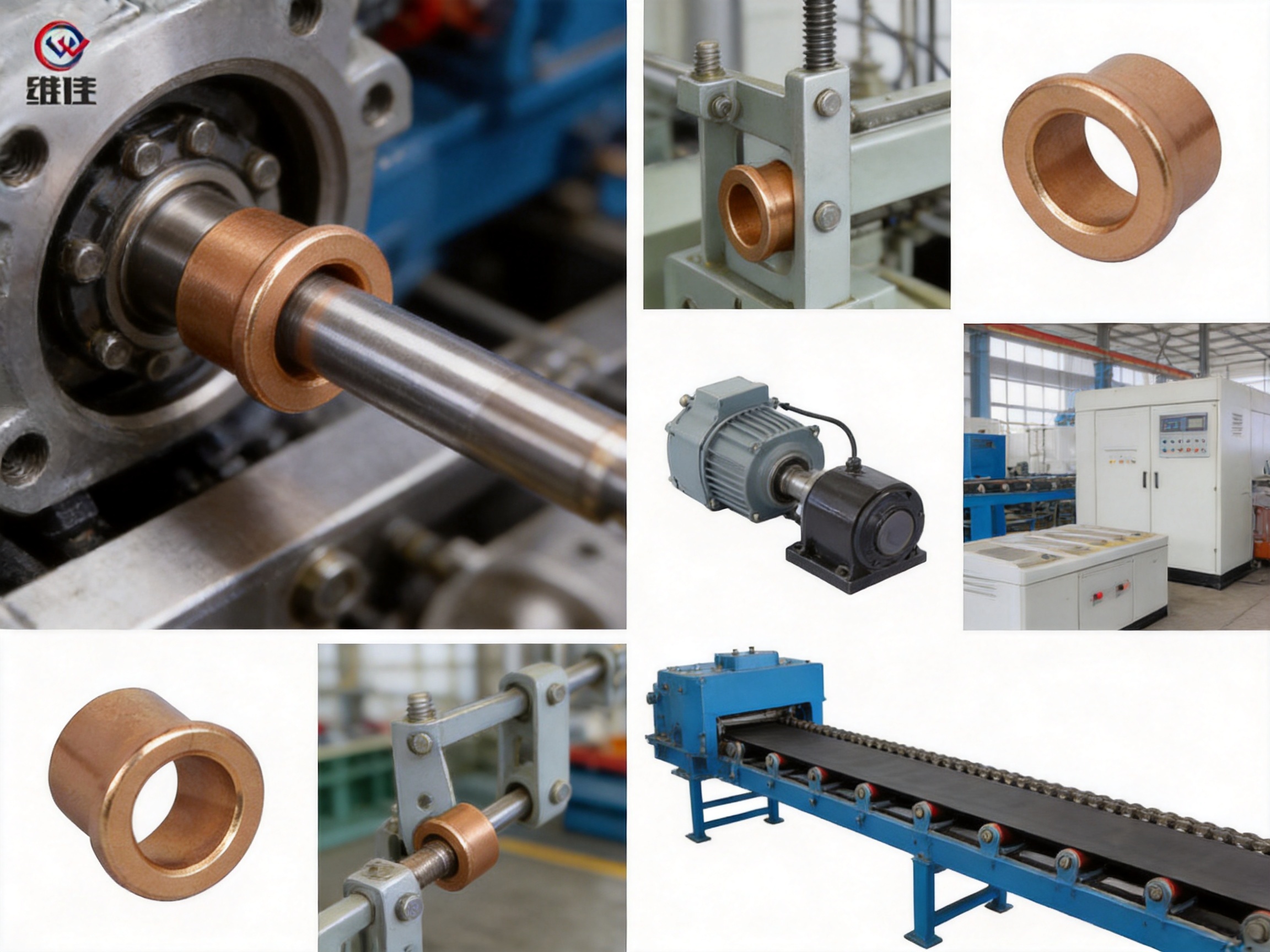
Automotive applications require reliable components that can perform consistently under vibration, temperature variation, repeated movement, and limited maintenance access. Oil-impregnated bronze flange bushings may be used in seat adjustment mechanisms, windshield wiper systems, sunroof assemblies, cooling fan motors, steering column accessories, pedal systems, hinges, and small actuators. Their low-maintenance design is especially useful because many automotive bushings are not easily serviced after assembly.
Industrial Machinery
Industrial equipment often runs for long periods under repetitive motion. Conveyor systems, packaging machines, printing equipment, textile machinery, pumps, small gear drives, and material handling equipment can benefit from self-lubricating bushings. The flange design supports stable positioning, while the oil-impregnated bronze structure helps reduce wear during continuous operation.
Agricultural Equipment
Agricultural machinery is frequently exposed to dust, vibration, impact, and irregular maintenance schedules. Bushings used in linkages, adjustment systems, rotating shafts, and control mechanisms must be robust and practical. Bronze self-lubricating bushings offer good resistance to mechanical stress and can reduce dependence on frequent lubrication.
Hydraulic Systems
Hydraulic equipment often includes pivot points, control rods, valve mechanisms, and actuator supports that require smooth movement and dependable bearing surfaces. A flange bushing can improve alignment while providing radial and limited axial support. Oil-impregnated bronze is suitable for many moderate-speed, moderate-load sliding applications in hydraulic assemblies.
Household Appliances and Office Equipment
Noise reduction and maintenance-free performance are important in appliances and office devices. Washing machines, air-conditioning fans, vacuum cleaners, printers, scanners, and small motors may use sintered bronze bushings to achieve quiet and smooth operation. The self-lubricating feature helps maintain performance without user maintenance.
Automation and Robotics
Automation equipment requires consistent motion and predictable service life. Compact actuators, robotic joints, linear motion supports, small gearboxes, and precision positioning systems can benefit from sintered bronze flange bushings. Their dimensional consistency supports repeatable assembly, while their lubrication reserve helps improve uptime.
Quality Factors That Determine Bushing Performance
Not all oil-impregnated bronze bushings perform equally. The final quality depends on raw material selection, powder blending, compaction, sintering, sizing, oil impregnation, machining, inspection, and packaging. A weakness in any step can affect service life, noise, friction, dimensional fit, or load capability.
Raw Material Control
High-quality copper-based alloy powders are essential for stable performance. Powder particle size, shape, purity, and composition influence compaction behavior and sintered structure. If the powder blend is inconsistent, the final bushing may show uneven density, poor porosity distribution, or variable strength.
Porosity Balance
Porosity must be controlled carefully. Too little porosity reduces oil storage capacity and weakens self-lubricating performance. Too much porosity can reduce mechanical strength and load-bearing capacity. The ideal bushing balances lubricant storage with structural integrity.
Sintering Precision
Sintering conditions determine particle bonding, pore structure, dimensional change, and mechanical properties. Temperature control, furnace atmosphere, and process timing are critical. Advanced sintering equipment and experienced process engineers help achieve consistent results.
Dimensional Accuracy
A bushing must fit properly with the housing and shaft. If the inner diameter, outer diameter, flange thickness, length, or roundness is outside tolerance, the assembly may experience excessive clearance, tight rotation, misalignment, noise, or early failure. Precision forming and sizing are therefore essential.
Oil Impregnation Quality
Vacuum oil impregnation must fill the porous network effectively. Incomplete impregnation can reduce lubrication life. Proper cleaning before oil impregnation is also important because residue or contamination may block pores.
Inspection and Certification
A reliable manufacturer must verify product dimensions, material characteristics, appearance, hardness, density, oil content, and performance requirements according to customer specifications. Quality management systems such as ISO 9001:2015 and IATF 16949:2016 support disciplined process control and traceability.
Manufacturing Strengths of Jiande Welfine Technology Co., Ltd.
Jiande Welfine Technology Co., Ltd. has focused on powder metallurgy sintering and precision machining since its establishment in 2001. Over more than two decades, the company has accumulated production knowledge, process experience, and application understanding in self-lubricating bushings and sintered metal components.
The company operates a modern production base covering 13,039 square meters. This facility is equipped with advanced production and testing equipment, including high-efficiency presses, high-temperature sintering furnaces, precision forming machines, and inspection systems. These resources allow the company to manage the full manufacturing process from powder preparation and compaction to sintering, finishing, oil impregnation, and final inspection.
With more than 150 skilled employees, the company can support stable mass production while also responding to customized requirements. Its engineering and technical teams can produce OEM and ODM bushings based on customer drawings, samples, working conditions, and performance expectations. This is important because bearing applications are often highly specific. Load, speed, temperature, shaft material, housing design, lubrication requirements, installation method, and environmental contamination all influence product selection.
The company’s ISO 9001:2015 certification demonstrates its commitment to systematic quality management. Its IATF 16949:2016 certification is particularly valuable for automotive-related customers because it reflects stricter process control, defect prevention, traceability, and continuous improvement requirements. These certifications help customers reduce supplier risk and improve confidence in product consistency.
Another strength is the company’s ability to combine powder metallurgy with related precision machining. While powder metallurgy can form near-net-shape components efficiently, certain applications require additional machining, sizing, or finishing to meet exact dimensional and surface requirements. By integrating these capabilities, the company can provide bushings that fit demanding assembly conditions.
Advantages Over Competitors
The market for sintered bronze bushings includes many suppliers, but meaningful differences exist in material consistency, porosity control, oil impregnation quality, dimensional precision, customization capability, and quality management. The Sint B50 oil-impregnated bronze flange bushing supplied by Jiande Welfine Technology Co., Ltd. offers competitive advantages in several areas.
Integrated Production Capability
Some suppliers may rely heavily on outsourced steps, which can increase variability and reduce process control. Welfine’s integrated manufacturing approach allows better coordination of pressing, sintering, finishing, impregnation, and inspection. This supports consistent product performance and faster response to quality feedback.
Experience in Powder Metallurgy
More than 20 years of industry experience gives the company practical knowledge of material behavior, tooling design, dimensional compensation, pore control, and application-specific requirements. This experience helps prevent common problems such as unstable dimensions, insufficient oil content, brittle structure, or poor surface finish.
Customization for Real Operating Conditions
Standard catalog bushings are not always ideal for specialized equipment. The company can provide OEM and ODM solutions according to drawings or samples, enabling customers to specify dimensions, flange geometry, tolerances, oil type, material characteristics, and performance needs. This ability is a significant advantage for machinery manufacturers developing unique assemblies.
Certified Quality Systems
ISO 9001:2015 and IATF 16949:2016 certifications help differentiate the company from suppliers with less formal quality control. For customers in automotive, industrial automation, and international equipment manufacturing, certification provides assurance that production processes are managed through documented procedures and continuous improvement principles.
Balanced Performance and Cost
The powder metallurgy process supports efficient material utilization and repeatable production. This allows the company to provide cost-effective solutions while maintaining the performance benefits of oil-impregnated bronze. Customers can achieve lower lifecycle costs through reduced maintenance, longer service life, and simplified assembly.
Design Considerations for Successful Application
To achieve the best results with an oil-impregnated bronze flange bushing, engineers should consider load, speed, shaft hardness, surface finish, alignment, operating temperature, installation method, and environmental conditions. Even a high-quality bushing must be applied correctly to deliver optimal service life.
The shaft should have an appropriate surface finish. A surface that is too rough may damage the oil film and accelerate wear. A shaft that is too soft may wear or transfer material. Proper hardness and finish help the bushing operate smoothly. Alignment is also important because edge loading can concentrate stress and reduce service life.
Housing fit must be controlled carefully. Press-fitting a bushing into a housing can reduce the inner diameter slightly, so design allowances are necessary. The flange must seat properly against the mounting surface without distortion. If the flange is used as a thrust face, the mating surface should be suitable for sliding contact.
Operating conditions should remain within the recommended load and speed range for the selected bushing design. While oil-impregnated bronze bushings are durable, excessive load, extreme speed, high temperature, abrasive contamination, or severe misalignment can shorten life. For demanding applications, consultation with the manufacturer is recommended.
Lubricant compatibility should also be considered. Although the bushing is oil-impregnated, some applications may involve contact with other oils, chemicals, cleaning agents, or fluids. The selected impregnation oil should match the operating environment whenever possible.
Lifecycle Cost Benefits
Initial purchase price is only one part of component cost. A low-cost bushing that requires frequent lubrication, causes downtime, wears quickly, or damages shafts can become expensive over the full lifecycle of a machine. The Sint B50 oil-impregnated bronze flange bushing is designed to reduce lifecycle cost by improving reliability and reducing maintenance demand.
Maintenance labor is a major cost in many facilities. Every lubrication task requires time, scheduling, tools, and access. In large equipment fleets or production lines with many bearing points, these tasks accumulate quickly. Self-lubricating bushings reduce the number of service points and simplify maintenance planning.
Downtime is often even more expensive than maintenance labor. If a machine stops unexpectedly due to bearing wear or seizure, production losses can exceed the cost of the component many times over. A durable, self-lubricating bushing can help improve uptime and reduce unexpected interruptions.
Assembly cost is another factor. Because the flange design combines radial support and positioning support in one part, it may reduce the need for extra washers, collars, or retainers. Fewer parts mean faster assembly, simpler inventory, and less risk of incorrect installation.
Finally, product reputation matters. Equipment manufacturers want their machines to operate reliably for customers. Using high-quality self-lubricating bushings can improve end-user satisfaction by reducing noise, wear, maintenance, and failure risk.
Environmental and Operational Cleanliness Benefits
Reducing external lubrication can also support cleaner equipment operation. In many environments, excess grease can collect dust, metal particles, fibers, soil, and other contaminants. This accumulation can create abrasive paste that increases wear. It can also stain surrounding parts, attract debris, or require cleaning.
Oil-impregnated sintered bronze bushings provide lubrication from within the material. Although a thin oil film is present at the working surface, the system generally avoids the heavy exposed grease deposits associated with some traditional bearing points. This is useful in appliances, office equipment, packaging machinery, textile machinery, and other settings where cleanliness matters.
Lower friction can also contribute to energy efficiency. While a single bushing may represent a small friction point, many machines contain numerous rotating and sliding interfaces. Reducing friction across these interfaces can improve mechanical efficiency, lower heat generation, and contribute to smoother operation.
In addition, longer service life means fewer replacement parts and less waste. Durable powder metallurgy bushings can help reduce material consumption over time, particularly in applications where maintenance access is difficult and premature replacement would require disassembly of larger systems.
Precision Manufacturing and Consistency in Mass Production
One of the important advantages of powder metallurgy is repeatability. Once tooling and process parameters are optimized, large quantities of bushings can be produced with consistent shape, density, and dimensions. This is valuable for manufacturers running automated assembly lines because component variation can disrupt production efficiency.
Dimensional consistency is especially important for flange bushings. The outer diameter must fit the housing, the inner diameter must provide proper running clearance with the shaft, the flange thickness must match assembly requirements, and the flange diameter must provide adequate support without interfering with surrounding parts. Consistent geometry helps ensure predictable installation and operation.
Jiande Welfine Technology Co., Ltd. supports this need through controlled production systems and inspection procedures. Its manufacturing experience enables it to manage powder flow, pressing force, tooling wear, sintering shrinkage, sizing effects, and final calibration. This level of control is essential for customers who require repeat orders and long-term supply stability.
For customized projects, engineering communication is also important. Customers may provide drawings, samples, operating parameters, or performance targets. The manufacturer can then recommend suitable dimensions, tolerances, material options, and production methods. This collaborative approach helps avoid overdesign, underdesign, and unnecessary cost.
Q&A Section
What is the Sint B50 Powdered Metallurgy Oil-Impregnated Bronze Flange Bushing?
It is a self-lubricating bronze plain bearing manufactured through powder metallurgy. It has a cylindrical body for radial support and an integrated flange for positioning and limited axial support. Its porous sintered bronze structure is impregnated with oil, allowing it to release lubricant during operation.
Does this bushing require regular lubrication?
Under normal operating conditions, it generally does not require frequent additional lubrication. The lubricant stored inside the porous bronze structure provides self-lubricating performance. However, suitability depends on load, speed, temperature, contamination, and application design.
Why is oil impregnation important?
Oil impregnation fills the microscopic pores of the sintered bronze with lubricant. During operation, the oil migrates to the sliding surface and forms a lubricating film. This reduces friction, wear, noise, and maintenance requirements.
What advantage does the flange provide?
The flange helps position the bushing in the assembly and can support certain axial loads. It may reduce the need for separate washers, collars, or retaining components, making the mechanical design simpler and more compact.
How does this bushing compare with a solid bronze bushing?
A solid bronze bushing can be strong, but it usually requires external lubrication. The Sint B50 oil-impregnated bronze bushing stores lubricant internally, reducing maintenance needs. Powder metallurgy also supports efficient mass production and controlled porosity.
Can it be used in automotive applications?
Yes. It is suitable for many automotive mechanisms, including seat adjustment systems, wiper assemblies, sunroof mechanisms, fan motors, hinges, and small actuators, depending on the specific operating conditions.
Is customization available?
Yes. Jiande Welfine Technology Co., Ltd. provides OEM and ODM customization based on drawings, samples, dimensions, materials, tolerances, and application requirements.
What factors affect the service life of the bushing?
Service life is influenced by load, speed, shaft hardness, shaft surface finish, alignment, operating temperature, contamination, housing fit, lubrication conditions, and the quality of the bushing’s material and manufacturing process.
Why is powder metallurgy suitable for self-lubricating bushings?
Powder metallurgy creates a controlled porous metal structure. These pores act as lubricant reservoirs, allowing the bushing to provide self-lubrication. Conventional fully dense machining methods cannot easily create the same uniform internal oil storage structure.
What certifications support the manufacturer’s quality capability?
Jiande Welfine Technology Co., Ltd. has passed ISO 9001:2015 and IATF 16949:2016 certifications, supporting systematic quality management, process control, traceability, and continuous improvement.
Conclusion
The Sint B50 Powdered Metallurgy Oil-Impregnated Bronze Flange Bushing is a practical and high-value solution for modern machinery requiring dependable sliding support, reduced lubrication maintenance, compact assembly, and long service life. Its sintered bronze structure provides strength and wear resistance, while its approximately 18% oil content supports continuous self-lubrication. The flange design adds positioning capability and helps manage certain axial forces, making the product more versatile than standard straight bushings in many applications.
Compared with conventional solid bronze bushings, plastic bushings, and more complex bearing arrangements, this product offers an effective balance of durability, simplicity, cost efficiency, and maintenance reduction. It is suitable for automotive systems, industrial machinery, agricultural equipment, hydraulic assemblies, appliances, office equipment, automation devices, and other mechanical systems requiring reliable low-maintenance motion.
Jiande Welfine Technology Co., Ltd. strengthens the value of this product through advanced powder metallurgy manufacturing, precision machining capability, experienced engineering support, modern production equipment, and certified quality management systems. With more than 20 years of experience, a 13,039-square-meter production base, more than 150 skilled employees, and OEM/ODM customization capability, the company can provide stable and tailored bushing solutions for global customers.
For equipment manufacturers and end users seeking to reduce downtime, simplify assembly, improve motion reliability, and lower lifecycle costs, the Sint B50 oil-impregnated bronze flange bushing represents a proven and efficient self-lubricating bearing solution.
References
1. German, R. M. Powder Metallurgy Science. Metal Powder Industries Federation.
2. ASM International. ASM Handbook, Volume 7: Powder Metal Technologies and Applications.
3. Neale, M. J. The Tribology Handbook. Butterworth-Heinemann.
4. Bhushan, B. Introduction to Tribology. John Wiley & Sons.
5. ISO 5755. Sintered Metal Materials: Specifications.
6. ISO 9001:2015. Quality Management Systems: Requirements.
7. IATF 16949:2016. Quality Management System Requirements for Automotive Production and Relevant Service Parts Organizations.
Product: Sint B50 Powdered Metallurgy Oil-Impregnated Bronze Flange Bushing
Related products
-
-
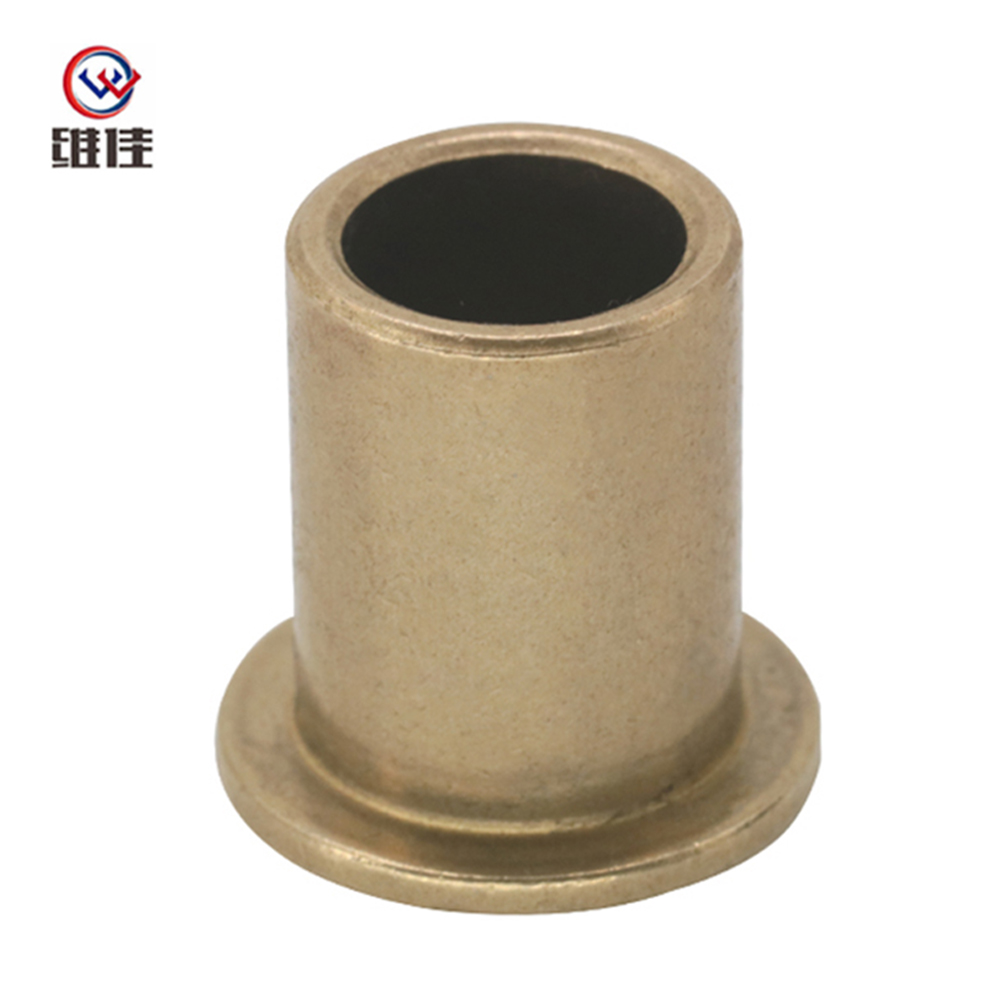
Our sintered bronze self-lubricating bearings are engineered for demanding industrial applications where traditional lubrication is impractical. Designed with advanced powder metallurgy technology, th...
See Details -
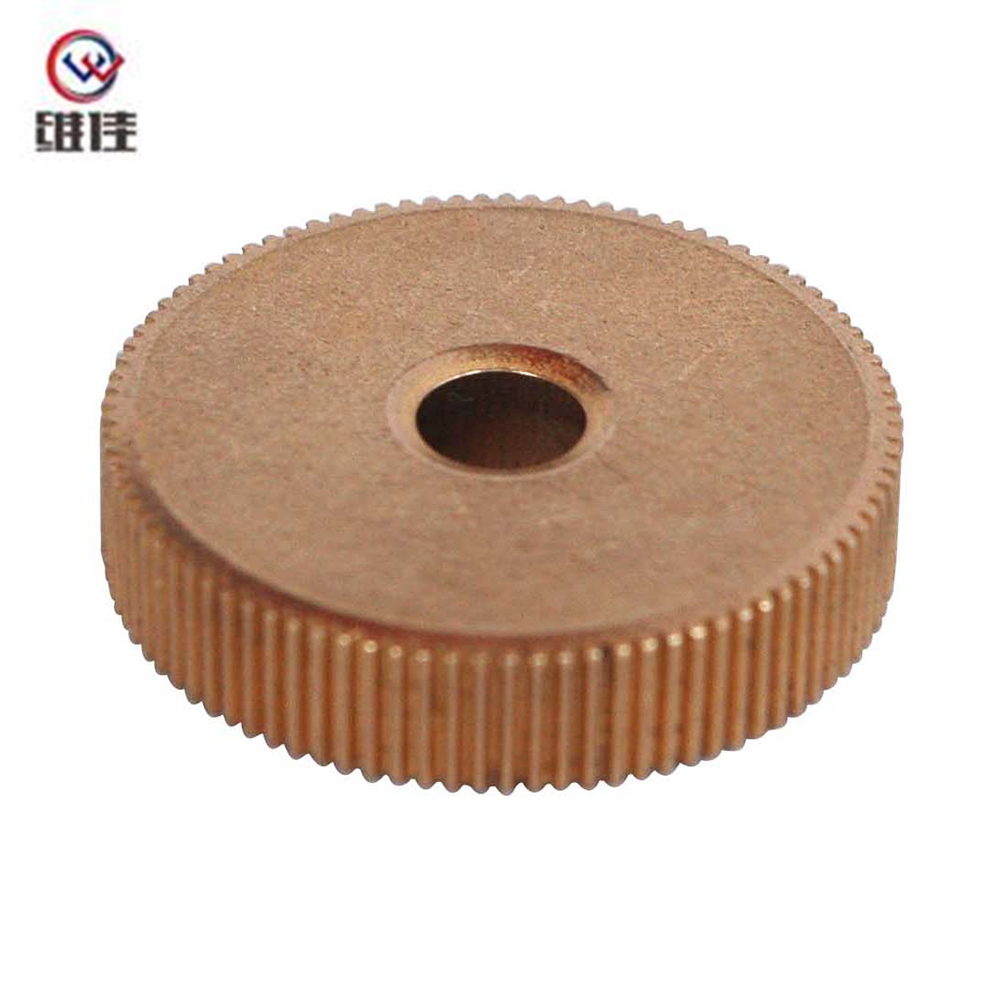
This 4×11.5×5.2mm powder metallurgy gear is manufactured through a precise press-sinter-through hole-oil impregnation process, with strict control of press density (6.7–6.8g/cm³) and sintering tempera...
See Details
Copyright © Jiande Welfine Technology Co., Ltd. All Rights Reserved. Custom Self-lubricating Sintered Bushing Manufacturers
