 English
 中文简体
中文简体
Description: Custom powder metallurgy planetary gear with high precision, wear resistance for automotive, industrial machinery & home appliances. OEM/ODM supported.
See DetailsE-mail us: [email protected]
Tel: +86-15239857375


 Home / Author / Shen Yiruo — Senior After-Sales Service Manager / Powder Metallurgy Planetary Gears for Precision, Durability, and Efficient Motion
 Powder Metallurgy Planetary Gears for Precision, Durability, and Efficient Motion
 2026.07.12
 Shen Yiruo — Senior After-Sales Service Manager
Content
- 1 Product Overview: Custom Sintered Planetary Gear for Compact Power Transmission
- 2 Why Powder Metallurgy Is Well Suited to Planetary Gears
- 3 Advantages Over Conventional Machined or Forged Steel Gears
- 4 High-Precision Meshing and Low Transmission Noise
- 5 Wear Resistance and Contact Fatigue Performance
- 6 The Synergy of Green Density and Sintering Temperature
- 7 Advanced Manufacturing Process
- 8 Company Strengths Supporting Reliable Gear Production
- 9 Application Scenarios
- 10 Design Considerations for Custom Planetary Gears
- 11 Quality Assurance and Batch Traceability
- 12 Cost Efficiency Without Compromising Functional Value
- 13 Q&A: Common Questions About Powder Metallurgy Planetary Gears
- 13.1 What makes a powder metallurgy planetary gear different from a machined steel gear?
- 13.2 Can a sintered planetary gear provide enough strength for automotive applications?
- 13.3 What accuracy can be achieved?
- 13.4 Why is oil impregnation useful?
- 13.5 How do green density and sintering temperature affect performance?
- 13.6 Is powder metallurgy suitable for high-speed EV motor systems?
- 13.7 What information should be provided for a custom quote?
- 13.8 Can the gear be customized for corrosion resistance?
- 13.9 How does the company ensure consistent quality in batch production?
- 14 Conclusion
- 15 References
- 16 Product: Powder Metallurgy Planetary Gear
Planetary gear systems are essential wherever compact size, high torque density, smooth transmission, and reliable long-term motion are required. From automotive seat adjusters and electric vehicle auxiliary drive systems to industrial reducers, robot joints, washing machine drive gearboxes, and precision appliance mechanisms, planetary gears must combine accurate tooth geometry with wear resistance, stable dimensions, low noise, and competitive production cost. A custom powder metallurgy planetary gear is designed to meet these requirements through a manufacturing route that forms the gear close to its final shape, controls material density, and allows functional features to be integrated directly into the part.
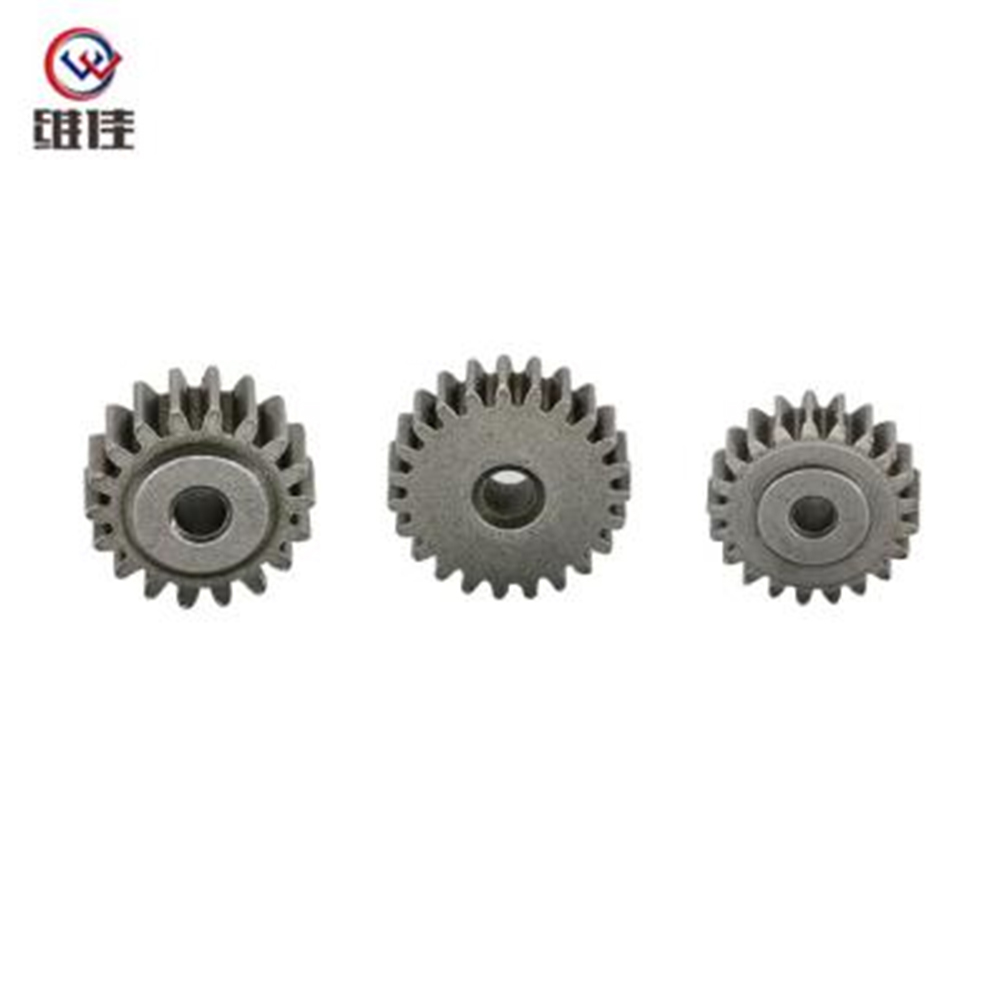
The powder metallurgy planetary gear supplied by Jiande Welfine Technology Co., Ltd. is a high-precision sintered metal component manufactured for OEM and ODM applications. It can be produced with customizable iron-based or alloy powder formulations, adjustable hardness, optional oil impregnation, zinc plating, phosphatization, steam treatment, or other surface processes, and gear accuracy generally in the Grade 7 to Grade 9 range depending on drawing requirements. Compared with many conventional machined gears, this product offers a strong combination of repeatability, material efficiency, self-lubricating capability, mass production economy, and design flexibility.
The value of a powder metallurgy planetary gear is not limited to the gear shape itself. Its performance depends on the entire manufacturing system: powder selection, blending, compaction pressure, tooling precision, green density uniformity, sintering atmosphere, sintering temperature, sizing, finishing, inspection, and traceability. Jiande Welfine Technology Co., Ltd., established in 2001, has developed powder metallurgy production capabilities supported by advanced presses, high-temperature sintering furnaces, precision forming equipment, and quality systems certified to ISO 9001:2015 and IATF 16949:2016. This combination enables the company to provide stable custom sintered gears for demanding industrial and automotive uses.
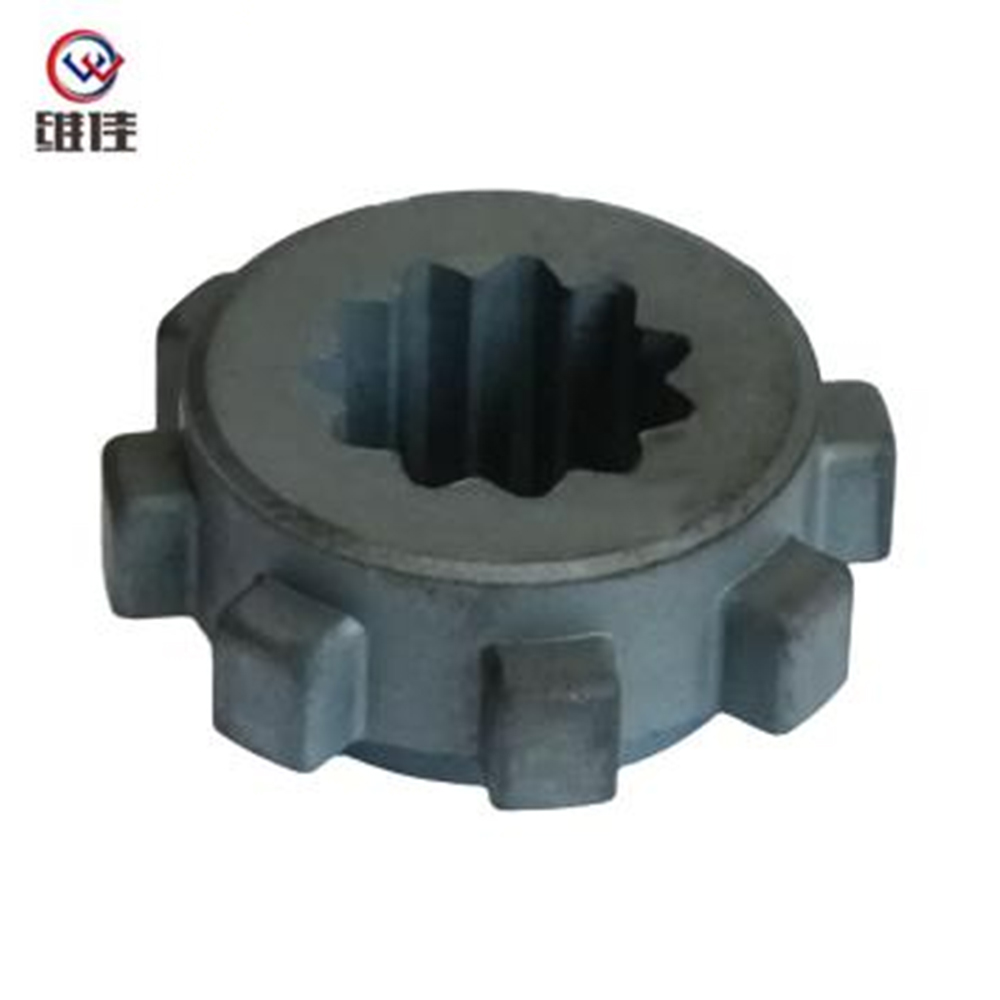
Powder Metallurgy Planetary Gear
Product Overview: Custom Sintered Planetary Gear for Compact Power Transmission
A planetary gear is a gear element used inside a planetary gear set, typically meshing with a central sun gear and an outer ring gear. Because several planetary gears share the load at the same time, planetary gear sets can transmit relatively high torque in a compact envelope. However, this advantage can only be realized when every planetary gear has stable tooth form, controlled runout, consistent tooth spacing, suitable hardness, and a material structure capable of resisting contact fatigue and wear.
The custom powder metallurgy planetary gear is designed for applications that require precise meshing, reliable wear performance, and cost-efficient serial production. The product can be manufactured according to customer drawings, samples, or application requirements. Typical materials include reduced iron powder, Fe-Cu alloy, Fe-Ni alloy, and other iron-based powder systems selected according to torque, speed, lubrication conditions, and required service life. The density is commonly controlled at or above 6.8 g/cm³ after sintering, with higher-density solutions available for more demanding load conditions.
The gear can be supplied with oil impregnation for self-lubricating behavior, zinc plating for corrosion protection, phosphatization for surface stability and running-in support, or other surface treatments according to the working environment. For applications with higher fatigue and wear requirements, post-sintering options such as sizing, steam treatment, carburizing, carbonitriding, or secondary finishing may be considered. This makes the product suitable for both standard mechanical assemblies and customized high-performance transmission systems.
| Item | Typical Specification | Customization Possibility |
|---|---|---|
| Product Name | Powder Metallurgy Planetary Gear | Designed according to drawing, sample, or application target |
| Material | Reduced iron powder, Fe-Cu alloy, Fe-Ni alloy | Powder formula can be adjusted for strength, wear resistance, or cost |
| Gear Accuracy | Grade 7 to Grade 9 | Higher precision can be evaluated according to size and finishing process |
| Hardness | HRB 60 to 90 | Adjustable through alloy selection, sintering, and heat treatment |
| Sintered Density | Generally ≥6.8 g/cm³ | Higher density available for stronger fatigue performance |
| Surface Treatment | Oil impregnation, zinc plating, phosphatization | Steam treatment, sealing, carburizing, or carbonitriding may be evaluated |
| Quality System | ISO 9001:2015 and IATF 16949:2016 | Process control, inspection records, and batch traceability supported |
Why Powder Metallurgy Is Well Suited to Planetary Gears
Powder metallurgy is a near-net-shape manufacturing process in which metal powders are blended, compacted in a precision die, sintered at high temperature, and then finished to achieve the required geometry and properties. For planetary gears, this process offers several important advantages. First, the teeth, bore, hub, recesses, weight-reduction features, and lubrication-related geometry can often be formed directly during compaction. This reduces or eliminates extensive cutting operations, which are usually required for forged or machined gears.
Second, powder metallurgy enables excellent repeatability in mass production. Once the tooling and process parameters are validated, thousands or millions of gears can be produced with consistent dimensions. This is especially valuable in automotive and appliance industries, where stable assembly behavior and predictable transmission noise are critical. A gear that varies from batch to batch can increase backlash variation, uneven load distribution, and warranty risk. A controlled sintered gear can reduce these concerns by maintaining consistent tooth geometry and material structure.
Third, powder metallurgy makes it possible to tune density and porosity. In some applications, very high density is preferred for maximum fatigue strength. In other applications, controlled residual porosity is beneficial because it can retain lubricant and provide internal damping. Oil-impregnated powder metallurgy gears can reduce friction and support smoother running, especially in compact mechanisms where external lubrication is limited. This self-lubricating advantage is one reason sintered gears are widely used in seat adjustment gearboxes, mirror adjustment systems, appliance transmissions, and small reducers.
Fourth, the material utilization of powder metallurgy is high. Conventional gear machining often removes a significant amount of material from bar stock, forging blanks, or cast blanks. In contrast, PM compaction forms the gear close to final shape. Lower waste, fewer machining operations, and efficient production cycles help reduce unit cost in mass production. For OEM customers, this can mean lower total cost without sacrificing functional performance.
Advantages Over Conventional Machined or Forged Steel Gears
When comparing powder metallurgy planetary gears with conventional forged or machined steel gears, the best choice depends on load level, accuracy requirement, speed, lubrication condition, cost target, and production volume. Forged steel gears can achieve very high ultimate strength and are often chosen for extremely high-load powertrain gears. However, in many compact and medium-load applications, a well-designed sintered planetary gear provides a more attractive balance of performance, weight, noise behavior, and manufacturing economy.
One major advantage is cost-efficient mass production. Machined gears require cutting, hobbing, broaching, drilling, deburring, heat treatment, and often grinding or shaving if high accuracy is needed. These operations increase cycle time, tool wear, labor, and scrap risk. Powder metallurgy can form the teeth and central bore in one pressing step, followed by sintering and sizing. This near-net-shape route can significantly reduce secondary machining. For high-volume production, unit costs may be reduced while maintaining stable performance.
Another advantage is self-lubrication. Conventional forged gears are dense and do not naturally store oil inside the material structure. In contrast, sintered gears can be oil impregnated so that lubricant is retained in micro-pores and released during operation. This can reduce friction, improve wear resistance, and support quieter meshing. In compact assemblies where grease or oil replenishment is difficult, this feature can be especially important.
A third advantage is lower mass and improved damping. PM gears generally have a slightly lower effective density than fully wrought steel because of controlled porosity. This can reduce rotating inertia, which is useful in high-speed electric motor systems and small drive units where acceleration response matters. The porous structure can also provide internal damping that helps absorb high-frequency vibration energy generated at the mesh. This damping behavior can contribute to lower gear whine and smoother acoustic performance.
A fourth advantage is design integration. PM tooling can include geometries that would be more expensive to machine after forging, such as pockets, recesses, grooves, oil passages, hubs, or lightweight features. Integrating these features directly into the compacted part can simplify the gear assembly and reduce downstream manufacturing steps. For OEM designers, this can open opportunities to reduce part count, save space, and optimize weight.
Finally, powder metallurgy supports stable dimensional repeatability when process parameters are carefully controlled. Green density, tooling alignment, powder filling, compaction pressure, sintering temperature, and sizing all influence the finished gear. With proper control, PM planetary gears can achieve consistent tooth profile, bore size, and pitch accuracy suitable for many automotive, industrial, and appliance mechanisms.
High-Precision Meshing and Low Transmission Noise
The quality of a planetary gear is often judged by how smoothly it meshes with the sun gear and ring gear. Poor tooth geometry can cause uneven contact, high transmission error, noise, vibration, heat generation, and accelerated wear. In a planetary gear set, these issues can be amplified because several planet gears operate simultaneously. Therefore, the precision of each gear must be maintained within tight limits.
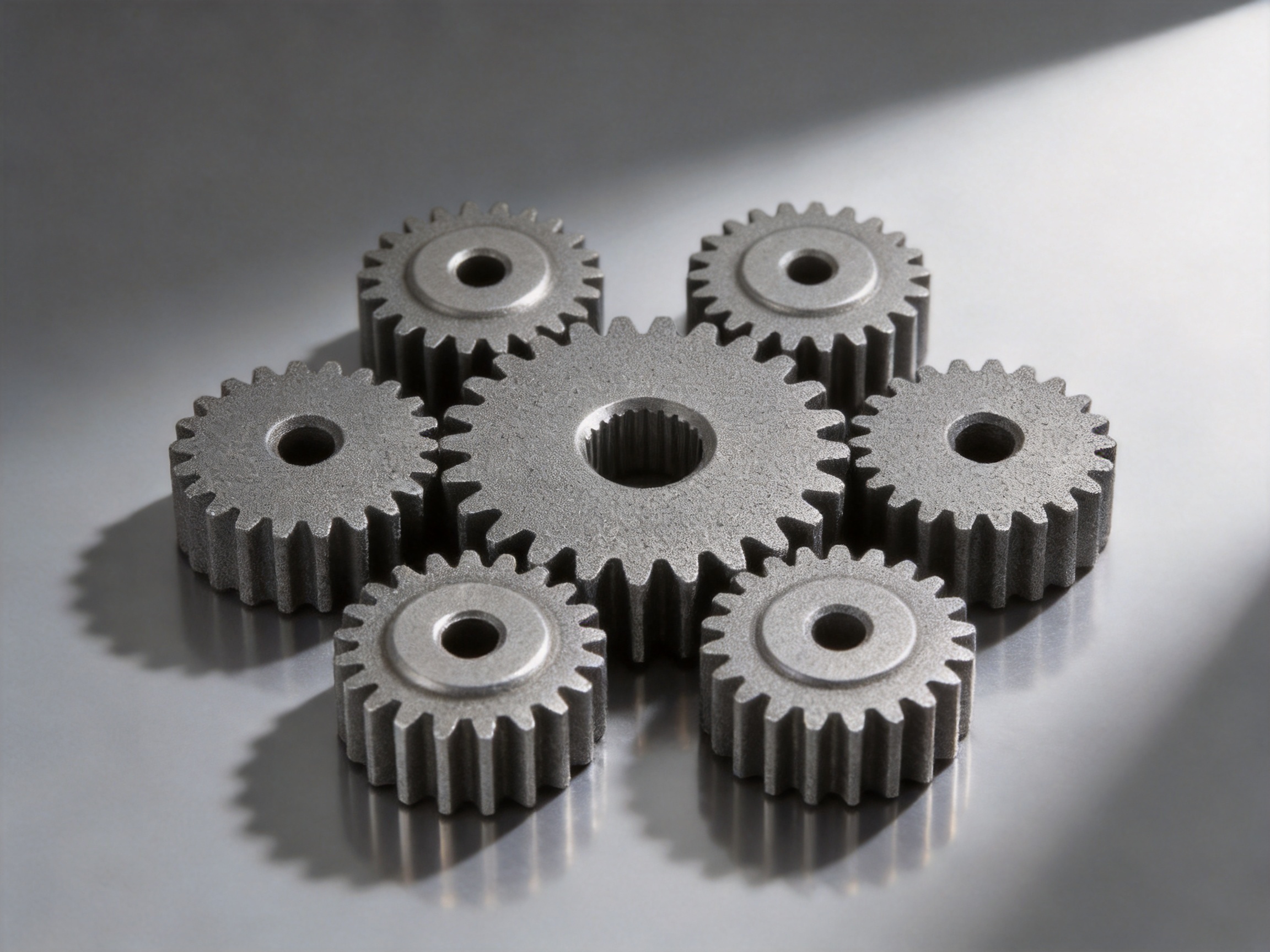
The powder metallurgy planetary gear is produced with precision mold forming and controlled finishing so that the tooth profile, tooth spacing, and bore relationship can remain stable. Tooth profile tolerance can be controlled according to the drawing and application requirements, and precision sizing after sintering can improve the tooth form and inner hole accuracy. For many applications, gear accuracy in Grade 7 to Grade 9 is suitable, with further optimization possible depending on module, diameter, material, and post-processing method.
Noise reduction is achieved through several mechanisms. The first is accurate geometry. When the gear teeth have consistent profile and spacing, the load is transferred smoothly from one tooth pair to the next. This reduces transmission error, which is a major source of gear whine. The second is the damping effect of the sintered structure. Controlled porosity can absorb part of the vibration energy generated during meshing. The third is lubrication. Oil impregnation or suitable surface treatment can reduce micro-impact and sliding friction at the tooth surface, especially during startup or intermittent operation.
For applications such as automotive seat adjustment systems, side mirror adjustment gearboxes, air conditioner swing motors, washing machine pulsator gearboxes, servo reducers, and robot joint mechanisms, low noise is not merely a comfort feature. It is often part of product quality perception. A quiet transmission suggests precision and reliability, while a noisy gear set may be considered defective even if it still transmits torque. By combining tooth accuracy, material damping, and lubrication options, the sintered planetary gear provides an effective solution for noise-sensitive assemblies.
Wear Resistance and Contact Fatigue Performance
Planetary gears are subjected to repeated contact stress at the tooth flanks. Over time, insufficient material strength or poor lubrication can lead to pitting, spalling, abrasive wear, or tooth profile degradation. The wear resistance of a powder metallurgy gear depends on material composition, sintered density, pore distribution, hardness, surface condition, and lubrication strategy. Jiande Welfine Technology Co., Ltd. controls these factors through material selection, compaction, sintering, and optional post-treatments.
Higher density generally improves fatigue strength because it reduces large interconnected pores that act as stress concentrators. A sintered density of 6.8 g/cm³ or above is suitable for many general-duty gears, while higher-density solutions can be used for higher load applications. Material systems such as Fe-Cu or Fe-Ni can improve strength compared with plain iron powder, and carbon or alloy additions may be selected according to required hardness and toughness. The hardness range of HRB 60 to 90 can be adjusted by the sintering process and material design.
Oil impregnation improves wear resistance by reducing direct metal-to-metal contact. During operation, heat and capillary action can help lubricant migrate from internal pores to the surface. This self-lubricating effect is valuable in gearboxes where lubricant quantity is limited. Compared with a dry conventional gear, an oil-impregnated sintered gear can reduce friction and improve service life. The product information indicates friction reduction compared with traditional gears and an extended service life due to high-density sintered material and self-lubricating design.
For higher performance applications, surface treatments can further improve wear behavior. Phosphatization can improve corrosion resistance and running-in characteristics. Zinc plating may be selected for corrosion protection. Steam treatment can form a magnetite layer on iron-based PM components, improving surface hardness and sealing some surface porosity. Carburizing or carbonitriding may be evaluated where higher surface hardness is required. The final process should always be chosen based on load, speed, lubrication, environmental exposure, and cost target.
The Synergy of Green Density and Sintering Temperature
In powder metallurgy gear manufacturing, green density and sintering temperature are two of the most important process variables. Green density refers to the density of the compacted gear before sintering. It is influenced by powder type, particle size distribution, lubricant content, die filling, compaction pressure, and tooling design. Sintering temperature determines the degree of metallurgical bonding between powder particles, diffusion of alloying elements, pore shape evolution, shrinkage, and final mechanical strength.
High green density reduces residual porosity and increases the contact area between powder particles. Under tooth contact stress, fewer pores and better particle bonding help distribute load more evenly across the tooth flank. If green density is too low, the sintered gear may contain interconnected pores that become initiation points for fatigue cracks. In planetary gears, where repeated cyclic contact occurs during every rotation, this can lead to premature pitting or spalling.
Sintering temperature must be high enough to promote diffusion bonding and neck growth between particles. For iron-based alloy systems, optimized sintering is often performed in a controlled atmosphere and within a temperature range selected for the powder formulation and desired final properties. Higher temperatures can improve strength, but excessive temperature may cause grain growth, distortion, or dimensional instability. Therefore, the best result is not achieved by simply maximizing temperature; it is achieved by matching green density, alloy composition, furnace atmosphere, and shrinkage control.
Dimensional accuracy is also affected by density and sintering. If green density varies across the gear, different zones may shrink by different amounts during sintering. Tooth root, tooth tip, hub, and bore areas may respond differently if powder filling or compaction is not uniform. This can create profile errors, runout, or bore distortion. Precision tooling, controlled pressing, and sizing are used to reduce these effects. Stable furnace temperature and atmosphere help ensure uniform sintering and repeatable dimensions from batch to batch.
For precision planetary gears, an optimized density and sintering window can improve both contact fatigue strength and transmission accuracy. Higher density supports higher load capacity, while controlled sintering and sizing support consistent tooth geometry. Jiande Welfine Technology Co., Ltd. uses production and testing capabilities to manage these relationships, enabling custom gears to be matched to specific torque, speed, noise, and service life requirements.
Advanced Manufacturing Process
The manufacturing process begins with technical evaluation. Customer drawings, samples, torque requirements, operating speed, lubrication condition, assembly space, mating gear material, accuracy target, and environmental requirements are reviewed. This stage determines whether the gear should use a standard iron-based powder, an Fe-Cu alloy, an Fe-Ni alloy, or another material system. It also determines whether the gear requires oil impregnation, plating, phosphatization, heat treatment, sizing, or additional machining.
The next step is powder mixing. The selected metal powders and additives are blended to achieve uniform composition. Powder consistency is essential because variations in alloy content, lubricant distribution, or particle size can affect flowability, compaction behavior, density, and sintered properties. A stable powder mixture helps ensure that each pressed gear begins with the same material condition.
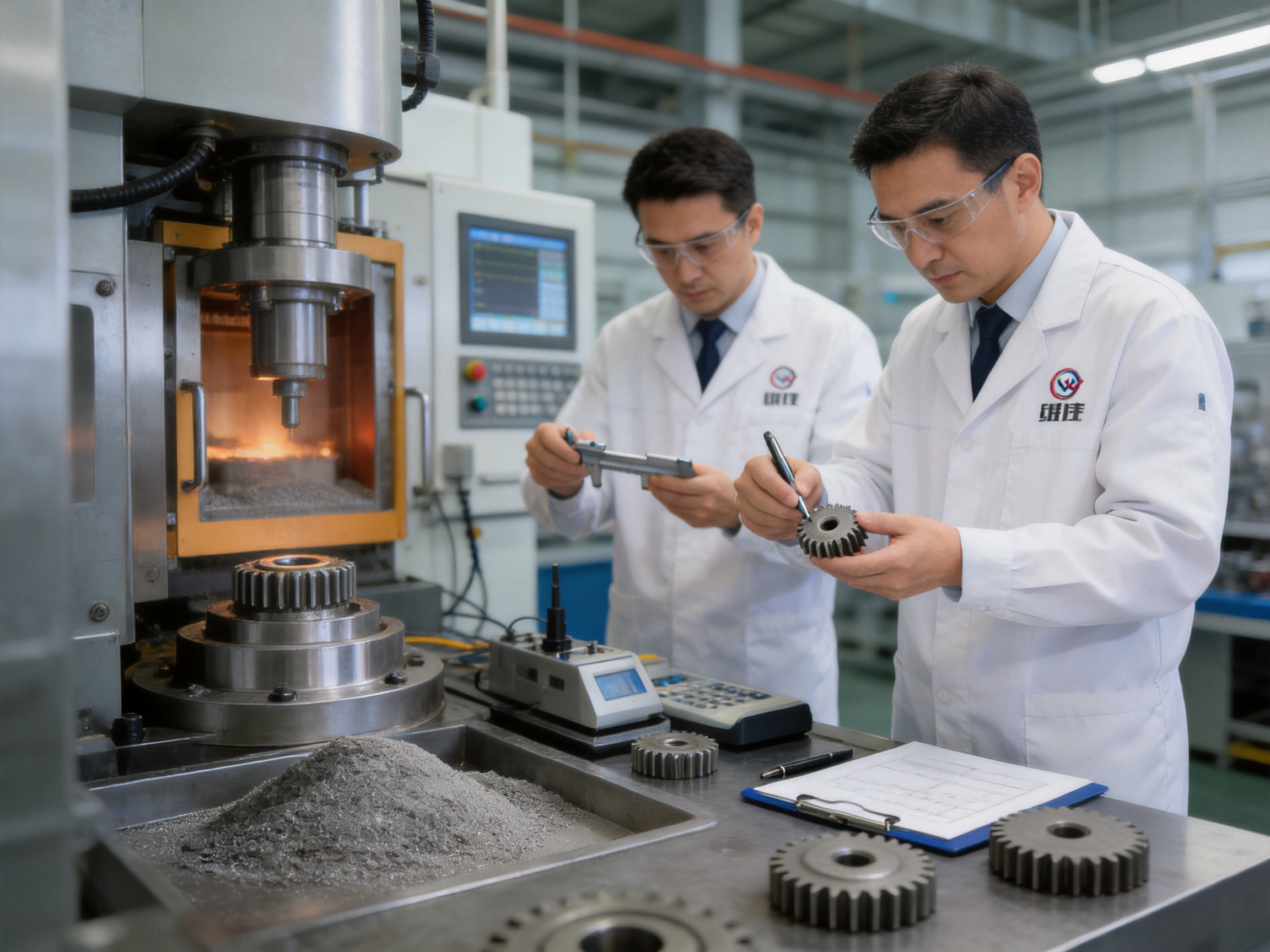
Precision pressing follows. The powder is filled into a die and compacted under high pressure, often in the range of hundreds of MPa depending on part geometry and density target. The compaction tool forms the gear teeth, bore, and other geometric features. Tooling precision is especially important for gears because small tooth errors can influence noise and load distribution. Press selection, die design, powder fill control, and ejection management all contribute to green part quality.
After pressing, the green gear is sintered in a protective atmosphere at high temperature. Sintering bonds the powder particles and develops the mechanical strength of the part. Atmosphere control helps prevent oxidation and supports consistent carbon or alloy behavior where applicable. Temperature uniformity across the furnace is important because uneven heating can cause uneven shrinkage and variation in final dimensions.
Sizing and finishing are then used to improve dimensional precision. Sizing can correct tooth profile, bore diameter, outer diameter, and other critical features. Depending on application requirements, secondary operations may include deburring, machining, surface treatment, impregnation, heat treatment, or inspection preparation. The objective is to deliver a gear that meets drawing requirements and performs reliably in the customer assembly.
Final inspection confirms dimensional, mechanical, and visual quality. Gear measuring instruments, hardness testers, density meters, metallographic analysis, and other inspection tools can be used to verify process results. Batch traceability allows production conditions and inspection records to be connected to each lot. For OEM customers, this traceability is an important part of risk control and long-term supply stability.
Company Strengths Supporting Reliable Gear Production
Jiande Welfine Technology Co., Ltd. is a high-tech enterprise integrating research, development, production, and sales with a focus on powder metallurgy sintering and related precision machining. Since its establishment in 2001, the company has accumulated more than two decades of experience in powder metallurgy bushings, self-lubricating components, sintered metal parts, and precision structural parts. This background is highly relevant to sintered planetary gears because gear performance depends on the same core competencies: powder control, compaction, sintering, dimensional finishing, lubrication behavior, and quality management.
The company operates a modern production base of approximately 13,039 square meters and employs more than 150 skilled personnel. Its manufacturing equipment includes efficient presses, high-temperature sintering furnaces, precision forming machines, and testing equipment. This production foundation allows the company to support both standard production and custom OEM/ODM projects based on drawings or samples.
Certification to ISO 9001:2015 and IATF 16949:2016 demonstrates a commitment to systematic quality management. For automotive-related customers, IATF 16949 is especially important because it emphasizes process control, defect prevention, traceability, continuous improvement, and supply chain reliability. Planetary gears used in automotive mechanisms must meet not only dimensional and mechanical requirements, but also long-term stability and documentation expectations. A certified manufacturing system helps support these requirements.
The company’s experience in self-lubricating bushings and oil-impregnated powder metallurgy parts is also an advantage. Lubrication behavior is critical for sintered planetary gears, particularly in compact mechanisms and intermittent drive systems. Knowledge of porosity, oil retention, surface treatment, and wear behavior can be applied directly to gear design and production. This enables the company to provide practical recommendations rather than simply producing a shape from a drawing.
Another strength is customization. Different customers may require different gear modules, tooth counts, bore shapes, hub structures, densities, hardness ranges, surface treatments, or packaging standards. Jiande Welfine Technology Co., Ltd. supports OEM and ODM customization, allowing the gear to be optimized for the actual application rather than forcing customers to accept a generic part. This is valuable for industries such as automotive, industrial machinery, electric drives, appliances, and robotics, where each mechanism may have unique load and assembly conditions.
Application Scenarios
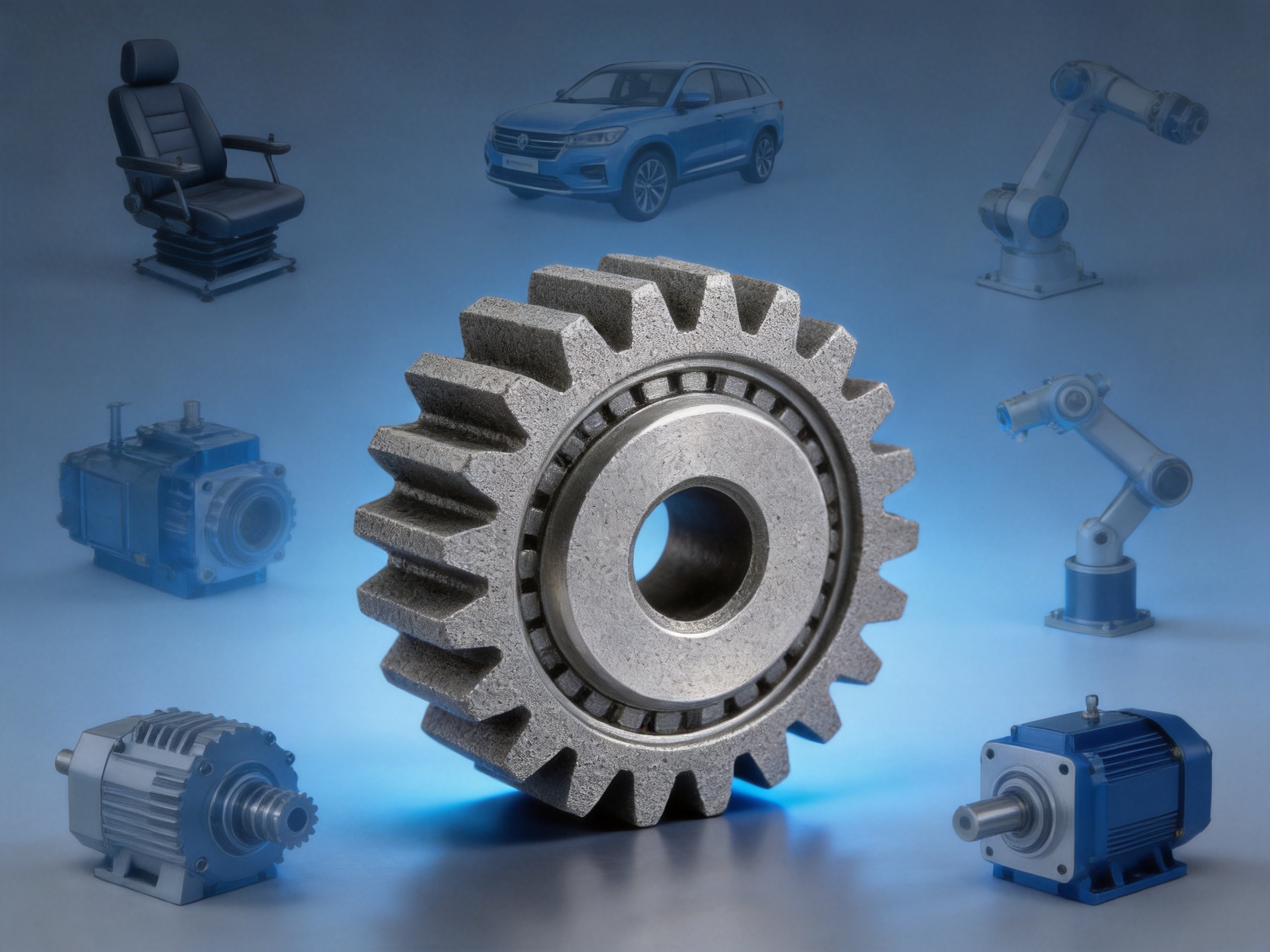
In the automotive industry, powder metallurgy planetary gears can be used in automatic transmission auxiliary mechanisms, seat adjustment gearboxes, side mirror adjustment systems, sunroof drives, electric parking brake assemblies, steering column adjustment systems, and EV motor-related mechanisms. These applications value compactness, stable torque transmission, low noise, and repeatable production quality. For high-volume automotive supply, near-net-shape manufacturing can also provide strong cost advantages.
In electric vehicle motor systems, sintered gears may provide benefits related to lower mass, damping, and design integration. High-speed electric drive systems are sensitive to noise, vibration, and rotational inertia. A PM gear with controlled density can be lighter than a comparable fully dense forged steel gear, and the internal material damping can help reduce high-frequency mesh noise. While extremely high-load main drive gears may still require wrought steel in some designs, many auxiliary and medium-load EV gear applications can benefit from optimized powder metallurgy solutions.
In industrial machinery, planetary gears are used in servo motor reducers, CNC machine tool feed mechanisms, automation equipment, and compact transmission modules. These systems require dimensional consistency and long service life. Sintered gears can be engineered for the required torque range and may reduce production cost for repeated assemblies. With suitable sizing and quality control, they can provide smooth movement and reliable meshing.
In robotics, planetary gears can support joint transmission systems, compact reducers, grippers, and actuator modules. Robot applications often demand low backlash, stable accuracy, lightweight design, and predictable wear behavior. A custom PM planetary gear can incorporate weight-reduction features and material properties tailored to the operating duty cycle. When combined with inspection and traceability, it can support the reliability expectations of automation equipment.
In home appliances, powder metallurgy planetary gears are used in washing machine pulsator drive gearboxes, refrigerator compressor gear systems, air conditioner swing motor gears, food processing equipment, and other compact drive mechanisms. Appliances require quiet operation, long service life, and economical production at scale. Oil-impregnated sintered gears are particularly useful where maintenance is difficult and low-noise operation is important to end users.
Design Considerations for Custom Planetary Gears
Successful custom gear development begins with accurate application data. Customers should provide gear drawings whenever possible, including module, tooth count, pressure angle, bore size, hub geometry, thickness, tolerance requirements, heat treatment requirements, surface finish requirements, and inspection standards. If a drawing is not available, a physical sample and application description can be used for evaluation.
Torque and speed are key design inputs. A gear used in a low-speed seat adjuster has very different requirements from a gear used in a high-speed EV auxiliary drive or an industrial servo reducer. Higher torque requires higher tooth bending strength and contact fatigue resistance. Higher speed increases the importance of balance, runout, lubrication, noise, and heat generation. The powder formulation, density, hardness, and surface treatment should be selected accordingly.
Lubrication condition should also be defined early. If the gear operates in grease, oil, dry conditions, or a sealed gearbox, the best material and surface treatment may differ. Oil impregnation is suitable for many sintered gears, but some applications may require sealed pores, plating, phosphatization, steam treatment, or compatibility with transmission fluid. The target service temperature and chemical exposure should be reviewed as well.
Accuracy requirements should be realistic and connected to function. Very high gear accuracy may require additional finishing, which increases cost. Many PM gears can meet Grade 7 to Grade 9 requirements depending on geometry and process route. For extremely low-noise or low-backlash systems, precision sizing or additional finishing may be recommended. The best design balances performance target and economic production.
The bore and assembly interface are especially important. Planetary gears often rotate on pins or bearings, or they may be assembled with shafts, hubs, or carriers. Bore roundness, diameter tolerance, surface condition, and alignment relative to the tooth pitch circle influence load sharing and wear. Powder metallurgy can produce accurate bores, and sizing can further improve fit. If a bushing, pin, or bearing is used, the mating component should be considered during design review.
Quality Assurance and Batch Traceability
Quality assurance for sintered planetary gears is not a single final inspection step. It begins with raw material control and continues through powder mixing, pressing, sintering, sizing, surface treatment, and final verification. Each stage affects the next. A defect introduced during powder filling or compaction may not be fully correctable later, so process monitoring is essential.
During pressing, operators and quality personnel may monitor part weight, green density, visual condition, and critical dimensions. Stable part weight can indicate consistent powder filling, while density checks help confirm that compaction targets are being met. Tool wear, die alignment, and ejection behavior must be controlled because they can influence tooth quality and dimensional consistency.
During sintering, furnace temperature, atmosphere, belt speed or cycle time, and loading arrangement must be controlled. Sintering transforms the compacted gear into a metallurgically bonded part, so variation in this stage can affect hardness, density, strength, and dimensions. A well-controlled furnace system reduces batch-to-batch variation and supports predictable performance.
After sintering and sizing, inspection may include gear measurement, bore measurement, hardness testing, density testing, visual inspection, and surface treatment verification. Gear measuring instruments can evaluate tooth profile, pitch variation, runout, and other geometry parameters. Hardness testers confirm that material processing achieved the required range. Density meters and metallographic checks can help verify internal structure when required.
Batch traceability provides confidence for OEM supply. Each batch can be connected to production parameters, inspection records, material lots, and processing history. If a customer reports an issue, traceability allows faster analysis and corrective action. For automotive and industrial customers, this capability is often as important as the part itself because it supports long-term quality management.
Cost Efficiency Without Compromising Functional Value
One of the strongest reasons to choose a powder metallurgy planetary gear is the ability to reduce total manufacturing cost while preserving functional value. The near-net-shape process reduces material waste and machining time. In many cases, the tooth form, bore, hub, and other features are created directly in the compaction tool. When production volumes are significant, the initial tooling investment is spread across many parts, creating strong unit cost advantages.
Cost efficiency also comes from repeatability. If gears are produced consistently, assembly adjustments, rework, noise sorting, and warranty risk can be reduced. A cheaper part that creates assembly problems is not truly economical. A well-engineered PM gear aims to reduce total cost across the supply chain, including manufacturing, assembly, lubrication, inspection, and field performance.
Another economic advantage is process flexibility. Customers can choose a material and treatment level appropriate to the application. A light-load appliance gear may not need the same density or surface treatment as a high-load industrial reducer gear. By customizing density, alloy content, hardness, and finishing, the product can avoid over-engineering while still meeting performance needs. This application-specific approach is often more economical than using a forged steel gear designed for loads far beyond the real requirement.
For mass production programs, delivery stability is also part of cost. Jiande Welfine Technology Co., Ltd. has production capacity, skilled employees, and established quality systems to support repeat orders. Stable supply reduces purchasing risk and helps customers maintain production schedules. When combined with technical support for material and process selection, this makes the company a valuable partner for custom sintered gear programs.
Q&A: Common Questions About Powder Metallurgy Planetary Gears
What makes a powder metallurgy planetary gear different from a machined steel gear?
A powder metallurgy planetary gear is made by compacting metal powder in a precision die and sintering it to create a bonded metal component. A machined steel gear is typically cut from wrought or forged stock. PM gears can be produced close to final shape, often reducing machining, material waste, and cost. They can also include controlled porosity for oil impregnation and damping, which can improve lubrication and noise behavior in many compact mechanisms.
Can a sintered planetary gear provide enough strength for automotive applications?
Yes, many automotive mechanisms are suitable for sintered planetary gears, especially seat adjusters, mirror adjusters, auxiliary drives, and compact transmission systems. Strength depends on material, density, tooth design, hardness, and surface treatment. For higher-load applications, higher-density powder metallurgy, alloyed powders, sizing, heat treatment, or surface densification may be considered. Application review is recommended before final material selection.
What accuracy can be achieved?
The product is commonly designed for Grade 7 to Grade 9 gear accuracy, depending on module, diameter, tooth geometry, material, and finishing route. Precision compaction and sizing can improve tooth profile, bore accuracy, and runout. For very low-noise or low-backlash applications, the drawing and inspection standard should be reviewed so that the proper process plan can be selected.
Why is oil impregnation useful?
Oil impregnation allows lubricant to be stored inside the controlled pores of the sintered gear. During operation, lubricant can migrate to the working surface and reduce friction between meshing teeth. This supports smoother running, lower wear, and quieter operation, especially in compact mechanisms where continuous external lubrication is limited.
How do green density and sintering temperature affect performance?
Green density influences the amount and distribution of porosity before sintering. Higher and more uniform green density generally improves strength and dimensional stability. Sintering temperature controls particle bonding, diffusion, shrinkage, and final properties. When green density and sintering temperature are optimized together, the gear can achieve better contact fatigue strength, more stable tooth geometry, and improved transmission accuracy.
Is powder metallurgy suitable for high-speed EV motor systems?
Powder metallurgy gears can be suitable for many EV motor-related applications, particularly auxiliary gears, idler gears, oil pump gears, and medium-load reduction elements where lower mass, damping, and cost-efficient production are valuable. For extremely high-load main drive gears, a detailed engineering review is required. The choice depends on torque, speed, lubrication, noise target, safety factor, and fatigue requirement.
What information should be provided for a custom quote?
Customers should provide a drawing or sample, material requirements if known, gear module, tooth count, bore and hub dimensions, tolerance requirements, hardness target, surface treatment preference, operating torque, speed, lubrication condition, annual quantity, and application environment. With this information, Jiande Welfine Technology Co., Ltd. can evaluate material, tooling, process route, and inspection requirements.
Can the gear be customized for corrosion resistance?
Yes. Depending on the operating environment, surface options may include zinc plating, phosphatization, steam treatment, sealing, or other protective processes. The correct choice depends on humidity, oil exposure, chemical contact, temperature, and expected service life. Corrosion protection should be considered early because it may influence dimensions and surface behavior.
How does the company ensure consistent quality in batch production?
Quality consistency is supported by controlled raw materials, powder mixing, precision pressing, protected-atmosphere sintering, sizing, surface treatment control, gear measurement, hardness testing, density testing, and batch traceability. ISO 9001:2015 and IATF 16949:2016 quality systems further support process discipline, documentation, and continuous improvement.
Conclusion
The powder metallurgy planetary gear is a practical and advanced solution for compact power transmission systems that require precision, wear resistance, low noise, and cost-efficient mass production. Its near-net-shape manufacturing route enables high material utilization and design integration, while controlled porosity supports oil impregnation and internal damping. Compared with many machined or forged alternatives, a properly designed sintered gear can reduce manufacturing complexity, lower rotational mass, improve lubrication behavior, and deliver consistent performance in high-volume applications.
Jiande Welfine Technology Co., Ltd. strengthens the product value through more than 20 years of powder metallurgy experience, a 13,039-square-meter production base, skilled personnel, advanced pressing and sintering equipment, precision forming capability, and certified ISO 9001:2015 and IATF 16949:2016 quality systems. The company’s knowledge of sintered structural parts, self-lubricating components, and precision powder metallurgy manufacturing allows it to support OEM and ODM customers from design evaluation to mass production.
For automotive mechanisms, EV auxiliary systems, industrial reducers, robotics, and home appliance gearboxes, the custom sintered powder metallurgy planetary gear offers a strong balance of performance and economy. By selecting the right material, density, sintering process, surface treatment, and inspection plan, customers can obtain a gear that fits their assembly, supports quiet and reliable operation, and contributes to long-term product competitiveness.
References
German, R. M. Powder Metallurgy and Particulate Materials Processing. Metal Powder Industries Federation.
ASM International. ASM Handbook, Volume 7: Powder Metallurgy. ASM International.
Kalpakjian, S., and Schmid, S. Manufacturing Engineering and Technology. Pearson.
International Organization for Standardization. ISO 9001:2015 Quality Management Systems Requirements.
International Automotive Task Force. IATF 16949:2016 Quality Management System Standard for Automotive Production and Relevant Service Parts Organizations.
AGMA. Gear Materials, Heat Treatment, and Processing Manual. American Gear Manufacturers Association.
Product: Powder Metallurgy Planetary Gear
Related products
-
-
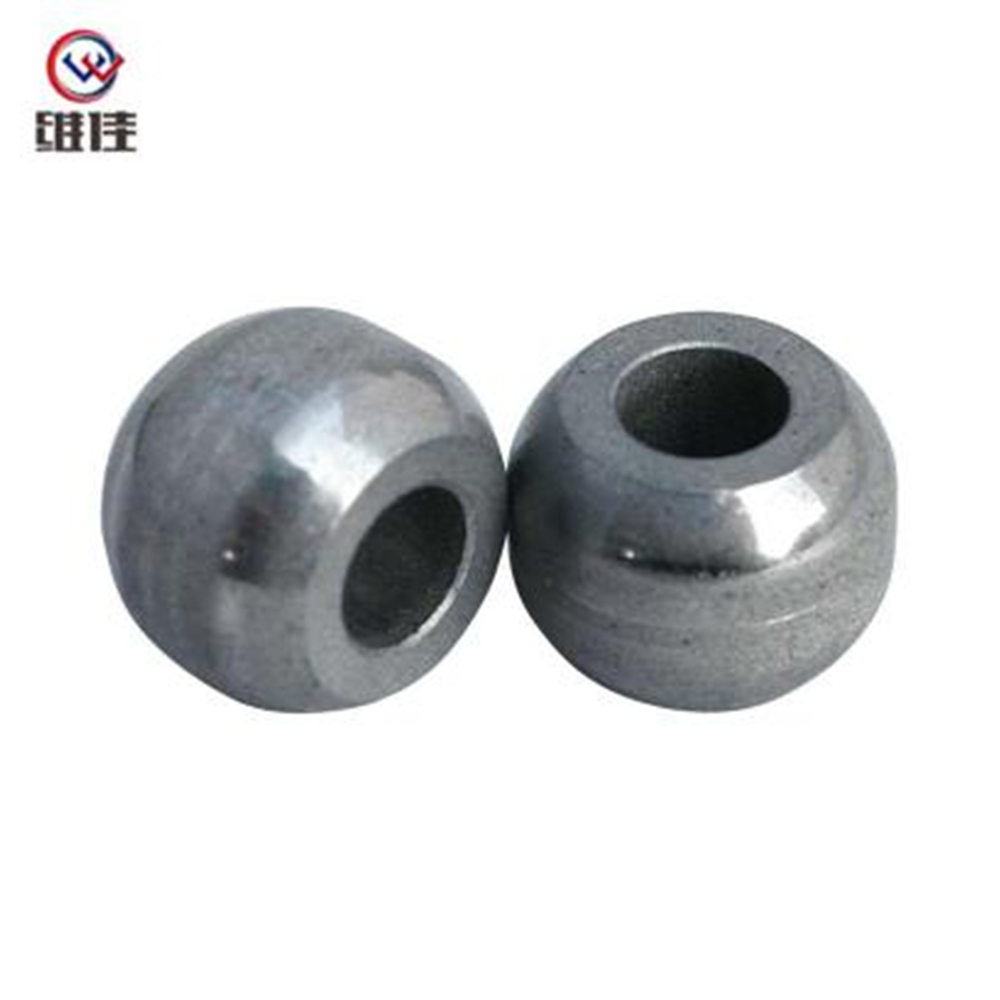
Product Description: High-precision powder metallurgy part (S14*7*10) made of iron material from Jiande Wefine, customized PM components with strict tolerance control.
See Details -
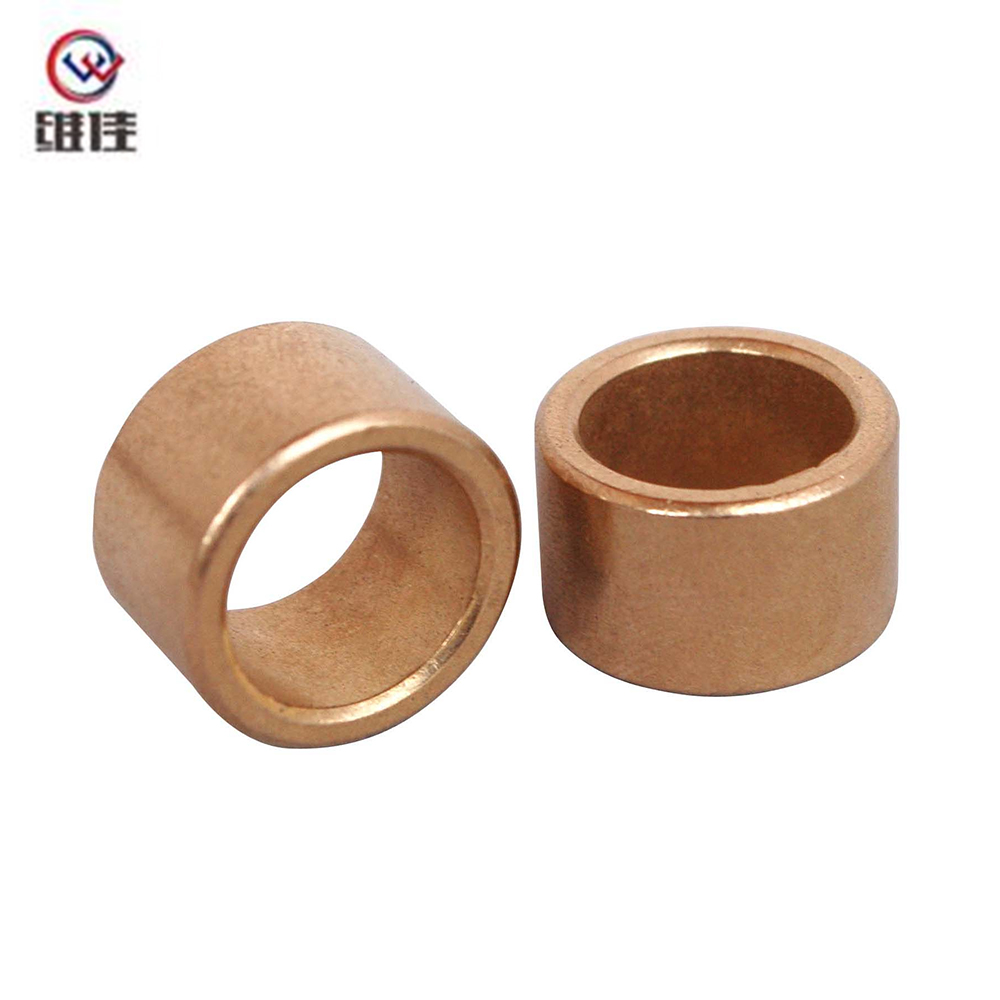
This copper-based powder metallurgy bushing is manufactured through an integrated process of compaction, sintering, sizing, and oil impregnation. It features excellent wear resistance and self-lubrica...
See Details -
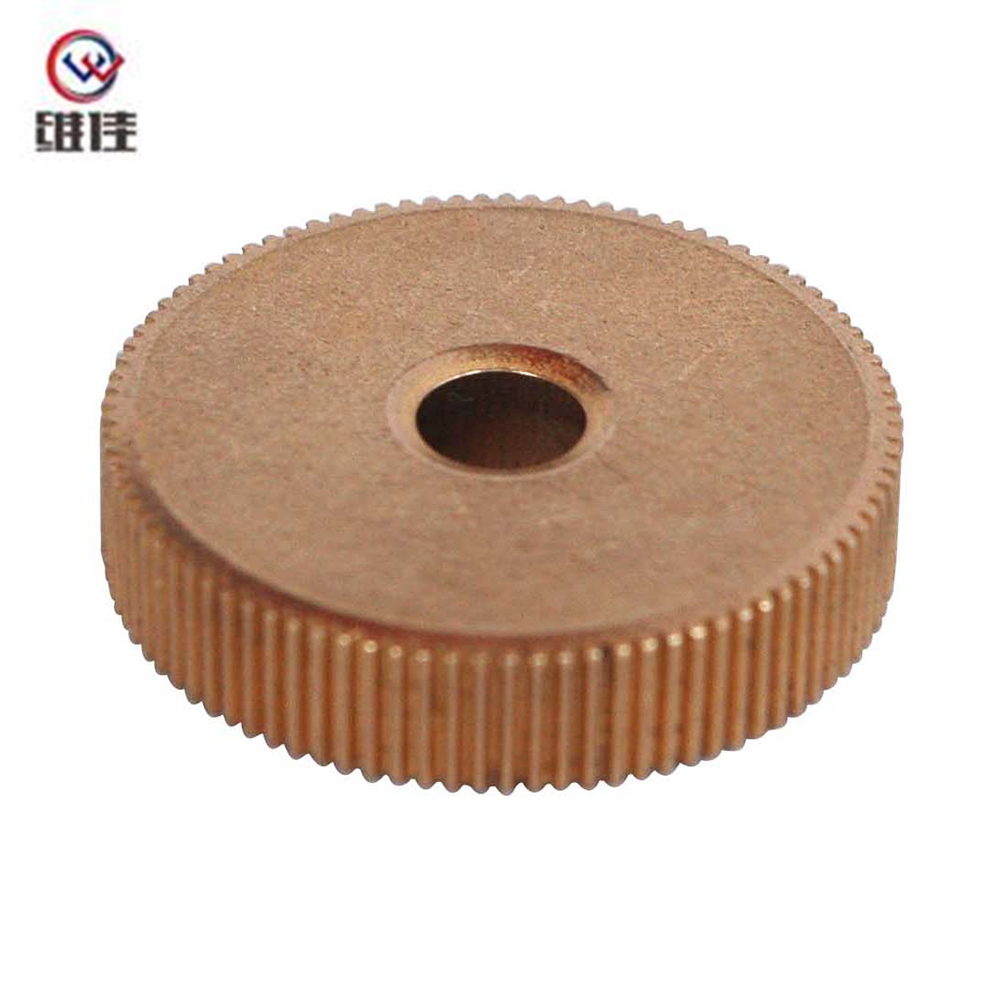
This 4×11.5×5.2mm powder metallurgy gear is manufactured through a precise press-sinter-through hole-oil impregnation process, with strict control of press density (6.7–6.8g/cm³) and sintering tempera...
See Details
Copyright © Jiande Welfine Technology Co., Ltd. All Rights Reserved. Custom Self-lubricating Sintered Bushing Manufacturers
