E-mail us: [email protected]
Tel: +86-15239857375
 English
 中文简体
中文简体

 Home / Author / Shen Yiruo — Senior After-Sales Service Manager / High Performance Sintered Self-Lubricating Bushings for Demanding Motion Systems
 High Performance Sintered Self-Lubricating Bushings for Demanding Motion Systems
 2026.06.08
 Shen Yiruo — Senior After-Sales Service Manager
Content
- 1 Product Overview
- 2 Why Self-Lubrication Matters in Engineering Design
- 3 Material Structure and Functional Mechanism
- 4 Key Product Advantages
- 5 Advantages Over Competing Bearing Solutions
- 6 Advanced Powder Metallurgy Manufacturing Process
- 7 Manufacturing Strengths Behind the Product
- 8 Performance in High-Load Applications
- 9 Performance in High-Speed and High-Frequency Motion
- 10 High-Temperature Reliability
- 11 Suitability for Dusty, Corrosive, and Special Environments
- 12 Application Areas
- 13 Design Considerations for Engineers
- 14 Customization and OEM/ODM Support
- 15 Quality Control and Certification Value
- 16 Economic Benefits and Total Cost of Ownership
- 17 Sustainability and Maintenance Reduction
- 18 Q&A Section
- 18.1 What is a sintered self-lubricating bushing?
- 18.2 What materials are used in these high performance bushings?
- 18.3 Why are graphite and molybdenum disulfide important?
- 18.4 Can these bushings operate without oil?
- 18.5 What are the main advantages compared with ordinary bronze bushings?
- 18.6 Are these bushings suitable for high-temperature applications?
- 18.7 Can they handle high loads?
- 18.8 What industries commonly use these bushings?
- 18.9 Can the bushings be customized?
- 18.10 Why does powder metallurgy improve manufacturing efficiency?
- 18.11 What quality certifications support product reliability?
- 19 Conclusion
- 20 References
- 21 Product: High Performance Sintered Self-lubricating Bushings
Modern machinery depends on motion components that can operate reliably under load, speed, heat, contamination, vibration, and limited maintenance access. Among these components, sintered self-lubricating bushings occupy a critical position because they provide stable sliding performance without the complexity, space requirements, or maintenance burden of conventional lubrication systems. High performance sintered self-lubricating bushings are engineered for applications where low friction, long service life, dimensional stability, and resistance to harsh operating conditions are essential.
These bushings are manufactured through advanced powder metallurgy technology, using carefully selected metal powders and solid lubricants to create a porous, wear-resistant, and mechanically strong bearing structure. The product is especially suitable for industrial machinery, automotive powertrain systems, high-temperature equipment, aerospace-related mechanisms, and high-load reciprocating, rotating, or oscillating assemblies. Its Fe-Cu sintered alloy matrix, combined with dry solid lubricants such as graphite and molybdenum disulfide, enables a low-shear transfer film to form during operation. This film reduces friction, protects the mating shaft, and extends bearing life.
Compared with many conventional bushings, these sintered self-lubricating bushings offer an important combination of advantages: oil-free or low-maintenance operation, excellent compressive strength, reliable performance under high static and dynamic loads, strong wear resistance, good shock resistance, and high thermal stability. They are also suitable for dusty, corrosive, radioactive, or otherwise difficult environments where ordinary lubricating oil may fail, evaporate, oxidize, attract contaminants, or be impossible to replenish.
High Performance Sintered Self-lubricating Bushings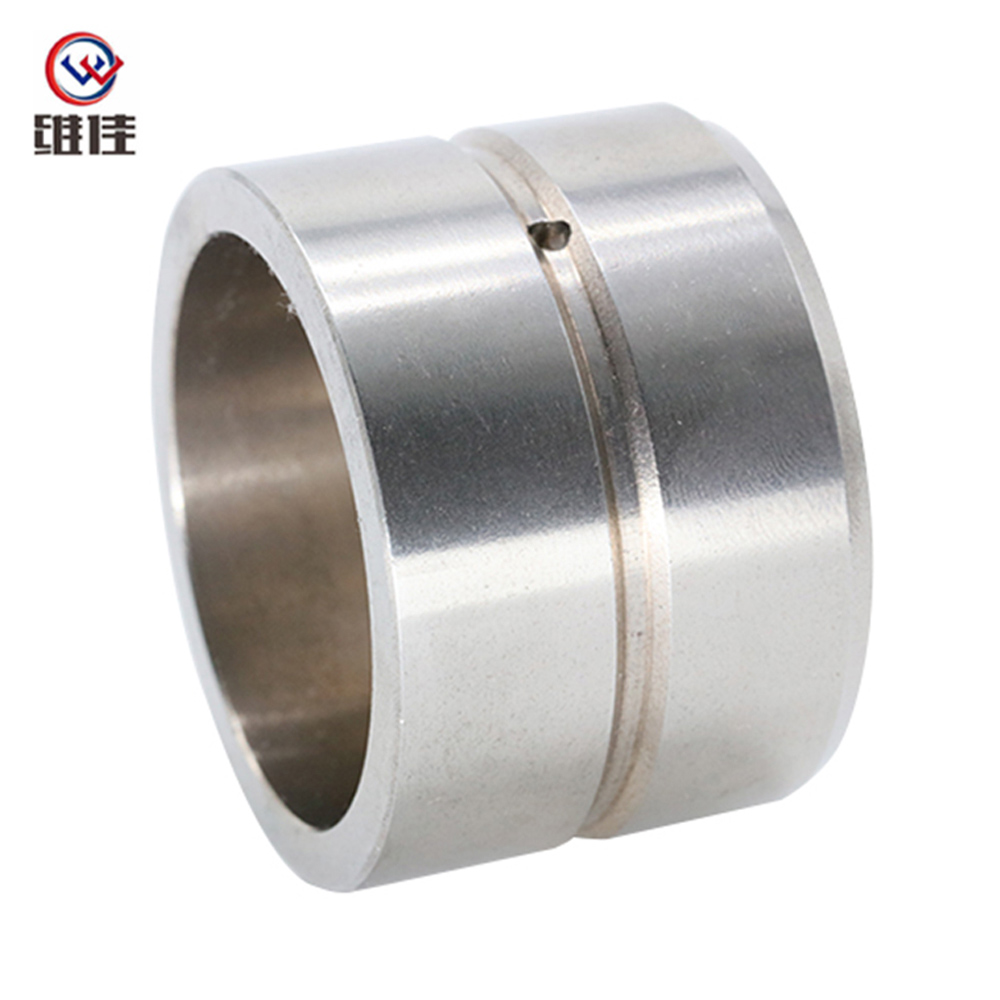
Product Overview
High performance sintered self-lubricating bushings are precision-engineered sleeve bearings produced by compacting metal powder into a near-net-shape form and then sintering it at elevated temperatures. The process bonds the powder particles without fully melting the material, creating a strong metallic structure with controlled porosity and stable geometry. The bearing may then be calibrated, machined, impregnated, or finished according to application requirements.
The product discussed here is based on a high-performance Fe-Cu sintered alloy system. Iron contributes strength, load capacity, fatigue resistance, and structural stability, while copper improves conformability, thermal conductivity, and running properties. Solid lubricants, typically graphite and molybdenum disulfide, are integrated into the bearing structure. During sliding contact, these lubricants gradually form a lubricating transfer layer on the bearing surface and the shaft surface. This layer has low shear strength, helping to reduce friction and wear even when external oil lubrication is unavailable.
The result is a self-lubricating bearing solution that works efficiently in high-load, high-speed, and high-temperature environments. It is designed for reciprocating, rotating, and oscillating motion, including applications where traditional rolling bearings may be unsuitable because of shock load, limited radial space, contamination, or intermittent movement. It also supports situations where liquid lubricant is undesirable, such as dusty equipment, clean mechanical assemblies, high-temperature systems, or mechanisms exposed to corrosion or radiation.
Unlike a plain metal sleeve that depends entirely on external grease or oil, a sintered self-lubricating bushing stores or generates lubrication at the sliding interface. Unlike some polymer bushings, it can provide stronger compressive strength and better dimensional stability under heat and load. Unlike many composite bearings, it can be customized through powder formulation, porosity control, density adjustment, and finishing operations, giving engineers a flexible platform for demanding design conditions.
Why Self-Lubrication Matters in Engineering Design
Lubrication is one of the most important factors in bearing performance. When a shaft slides inside a bushing, microscopic surface asperities come into contact. Without lubrication, the frictional heat and adhesive wear can quickly lead to scoring, noise, seizure, and dimensional failure. Conventional lubrication systems rely on oil reservoirs, grease fittings, pumps, channels, seals, maintenance schedules, and operator discipline. In many machines, however, lubrication is difficult to guarantee.
Self-lubricating bushings reduce this dependency. Because lubricating phases are incorporated into the bearing structure, the bushing can continue to operate with low friction even when external oil is absent, insufficient, or unsuitable. This is particularly valuable in remote industrial equipment, automotive mechanisms with sealed service life expectations, high-temperature assemblies where oil breaks down, dusty systems where grease attracts abrasive particles, and aerospace or special equipment where maintenance opportunities are limited.
In addition, self-lubricating designs help minimize the risk of stuck or seized components. The bearing surface continuously receives lubrication from the embedded solid lubricant system, reducing the likelihood of dry metal-to-metal contact. This is especially important in oscillating and reciprocating movements, where hydrodynamic oil films are difficult to establish because the motion direction changes frequently and speed may be low.
Self-lubrication also contributes to cleaner operation. In many production environments, excess grease or dripping oil can contaminate products, attract dust, or create housekeeping problems. A self-lubricating sintered bushing can provide dependable performance while reducing the need for frequent relubrication. This supports lower maintenance costs, improved machine uptime, and more predictable equipment operation.
Material Structure and Functional Mechanism
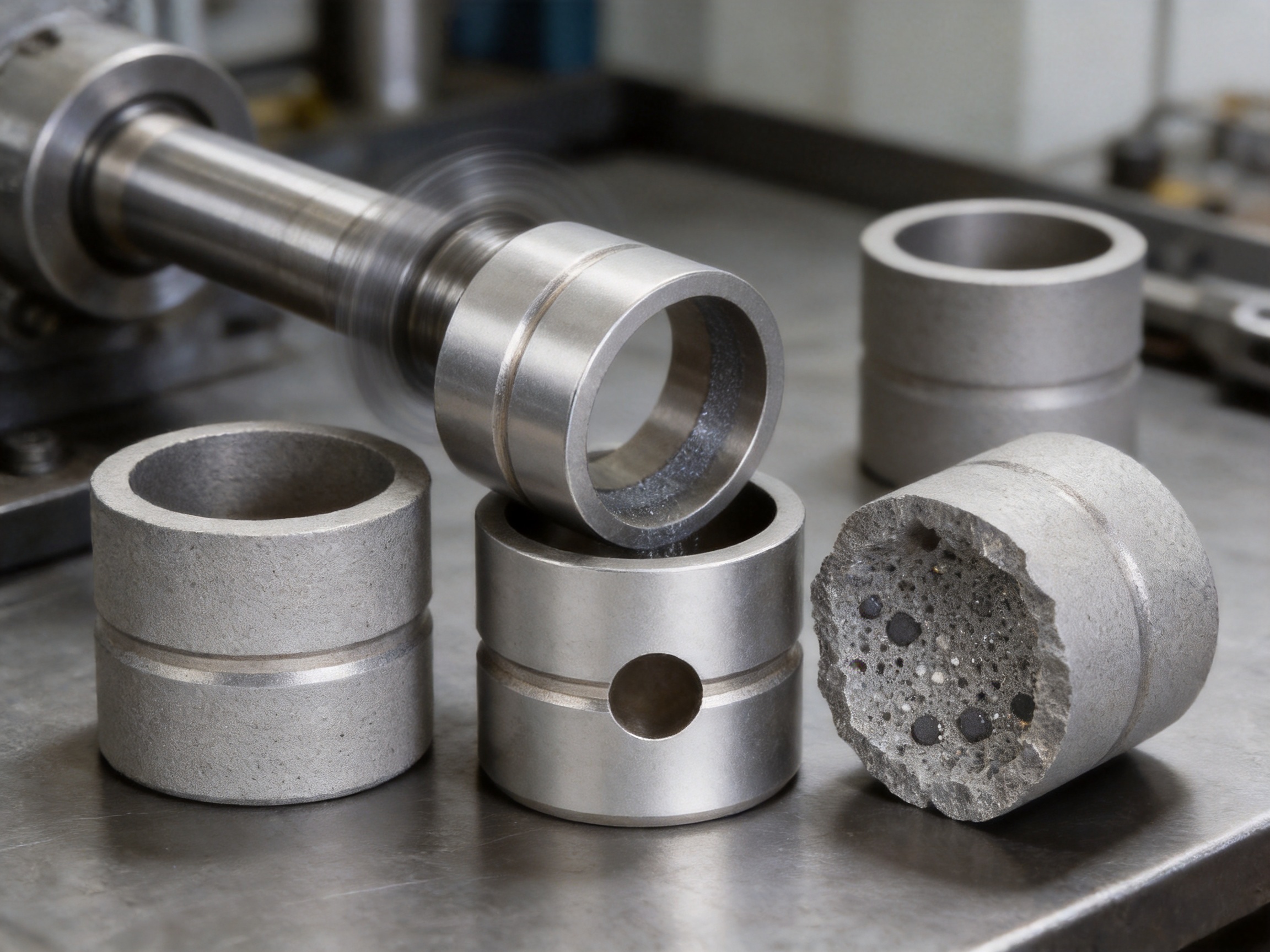
The core material structure of these bushings is a Fe-Cu sintered alloy matrix embedded with dry solid lubricants. The metallic skeleton provides mechanical strength and dimensional integrity. The pores and lubricant reservoirs provide controlled lubrication behavior. The final bearing structure is not simply a block of metal; it is a carefully engineered composite microstructure designed to combine load capacity, friction control, thermal stability, and wear resistance.
Iron-based powder metallurgy materials are valued for their strength and cost-effective mechanical performance. They can support high compressive loads and resist deformation when properly compacted and sintered. Copper additions improve running compatibility and heat transfer, helping dissipate frictional heat away from the contact zone. In sliding bearings, thermal conductivity matters because temperature rise can accelerate wear, change clearances, and degrade lubricants.
Graphite is one of the most widely used solid lubricants. It has a layered crystal structure that allows layers to shear easily under contact stress. This low-shear behavior reduces the coefficient of friction and helps form a protective transfer film. Molybdenum disulfide also has a lamellar structure and is known for strong lubricating performance under high loads and certain dry or boundary lubrication conditions. When used together in a sintered metallic matrix, graphite and molybdenum disulfide provide complementary lubrication performance across varied operating regimes.
During operation, the shaft and bushing surfaces interact under load. As sliding occurs, small amounts of solid lubricant migrate or smear onto the contact surfaces. This creates a thin transfer film that separates metallic asperities and reduces shear resistance. The film can renew itself during operation, so the bushing maintains friction control over a long service period. Because this mechanism does not depend solely on liquid oil, the bearing can function in environments where oil would evaporate, oxidize, wash away, or attract abrasive contaminants.
The sintered structure also allows design flexibility. By adjusting powder size distribution, alloy composition, compaction pressure, sintering temperature, lubricant content, and post-sintering calibration, the manufacturer can tune density, porosity, hardness, strength, and tribological behavior. This is a major advantage over many conventional bearing materials, which may offer less control over internal microstructure.
Key Product Advantages
The first major advantage is excellent compressive strength. High-load equipment often subjects bushings to radial pressure, impact load, and localized stress. A Fe-Cu sintered alloy matrix provides the mechanical backbone needed to resist crushing, distortion, and premature fatigue. This makes the bushing suitable for heavy-duty industrial machinery, automotive mechanisms, and equipment that experiences both static and dynamic loads.
The second advantage is strong wear resistance. Wear resistance is achieved through the combination of a durable metallic matrix and continuous solid lubrication. The matrix supports the load, while the solid lubricant reduces surface shear and adhesive wear. This dual mechanism helps extend service life, especially in oscillating or reciprocating motion where conventional oil films are unstable.
The third advantage is shock resistance. In real machines, loads are rarely perfectly smooth. Equipment start-up, braking, vibration, misalignment, impact, and intermittent operation can create sudden stress changes. Sintered metallic bushings with appropriate density and alloy design can absorb and distribute these forces more effectively than brittle materials or low-strength polymer alternatives.
The fourth advantage is oil-free operation. Although certain sintered bearings may also be oil-impregnated depending on application needs, this high-performance self-lubricating design can operate without additional lubricating oil because of its embedded dry lubricants. This minimizes the risk of seizure in applications where oil supply is unreliable and reduces the cost and complexity of lubrication maintenance.
The fifth advantage is high thermal stability. High-temperature applications challenge conventional lubricated bearings because oil viscosity changes, grease can oxidize, and polymeric materials may soften or creep. A sintered Fe-Cu alloy bearing with solid lubricants can remain dimensionally stable and functional at elevated temperatures, making it suitable for high-temperature equipment and demanding motion systems.
The sixth advantage is suitability for harsh environments. Dusty, corrosive, and radioactive conditions can make maintenance difficult and shorten the life of ordinary bearings. Liquid lubricants may capture abrasive particles, forming a grinding paste. Solid-lubricated sintered bushings reduce this problem and can be designed for more stable performance where contamination cannot be fully eliminated.
The seventh advantage is movement versatility. The bushing can be used for rotating shafts, oscillating joints, and reciprocating mechanisms. This broad motion compatibility helps engineers standardize bearing solutions across different assemblies while still meeting application-specific requirements through customization.
Advantages Over Competing Bearing Solutions
In many design projects, engineers compare sintered self-lubricating bushings with bronze bushings, polymer bushings, rolling bearings, composite wrapped bearings, and standard oil-impregnated sleeves. Each option has strengths, but high performance sintered self-lubricating bushings provide a balanced solution for applications requiring strength, low maintenance, and harsh-environment durability.
Compared with conventional bronze bushings, sintered Fe-Cu self-lubricating bushings can offer better lubrication autonomy. A solid bronze sleeve usually relies heavily on external grease or oil grooves. If lubrication is missed, friction and wear increase rapidly. The sintered self-lubricating structure carries its own lubricant system, reducing dependence on scheduled lubrication. Powder metallurgy also supports near-net-shape manufacturing, which can reduce material waste compared with machining bushings from solid bar stock.
Compared with polymer bushings, sintered metallic bushings generally provide higher compressive strength, better heat resistance, and improved dimensional stability under load. Polymer bearings can be excellent for light-duty, quiet, corrosion-resistant applications, but they may creep under sustained load, soften at elevated temperatures, or experience thermal expansion issues. A Fe-Cu sintered alloy bushing is better suited for heavy loads, high temperature, and applications where deformation must be minimized.
Compared with rolling bearings, self-lubricating bushings can be more tolerant of shock loads, contamination, and oscillating motion. Rolling bearings are efficient at continuous rotation but may suffer from brinelling, false brinelling, cage damage, and lubrication problems in small-angle oscillation. Bushings distribute load over a larger contact area and have simpler geometry, often making them more robust in dirty or impact-prone environments.
Compared with standard oil-impregnated porous bronze bearings, high performance Fe-Cu solid-lubricated bushings can provide enhanced strength and high-load capability. Oil-impregnated bronze bearings perform well in many moderate-load applications, but oil can be depleted, evaporate, or become contaminated. The addition of solid lubricants such as graphite and molybdenum disulfide helps maintain lubrication even when liquid oil is limited or unsuitable.
Compared with composite wrapped bearings, sintered bushings offer strong structural uniformity and broad customization potential through powder formulation and sintering parameters. Composite bearings often combine steel backing with porous bronze and polymer layers, delivering good performance in many cases. However, if the thin sliding layer is worn through, performance may decline sharply. A sintered bushing can provide a more integrated material structure throughout the bearing wall, depending on design.
| Bearing Type | Main Strength | Common Limitation | Advantage of High Performance Sintered Self-Lubricating Bushings |
|---|---|---|---|
| Machined bronze bushing | Good load capacity and machinability | Often depends on external lubrication | Integrated solid lubrication reduces maintenance dependence |
| Polymer bushing | Lightweight and corrosion resistant | May creep or soften under high load and temperature | Metallic matrix provides stronger thermal and mechanical stability |
| Rolling bearing | Low friction in continuous rotation | Sensitive to shock, contamination, and oscillation | Simple sliding structure tolerates impact and harsh conditions |
| Standard oil-impregnated bronze bearing | Good performance in moderate duty | Oil may deplete or degrade | Solid lubricants support dry or low-oil operation |
| Composite wrapped bearing | Compact and low friction | Sliding layer may be thin and application-specific | Powder metallurgy structure can be tuned for strength and wear resistance |
Advanced Powder Metallurgy Manufacturing Process
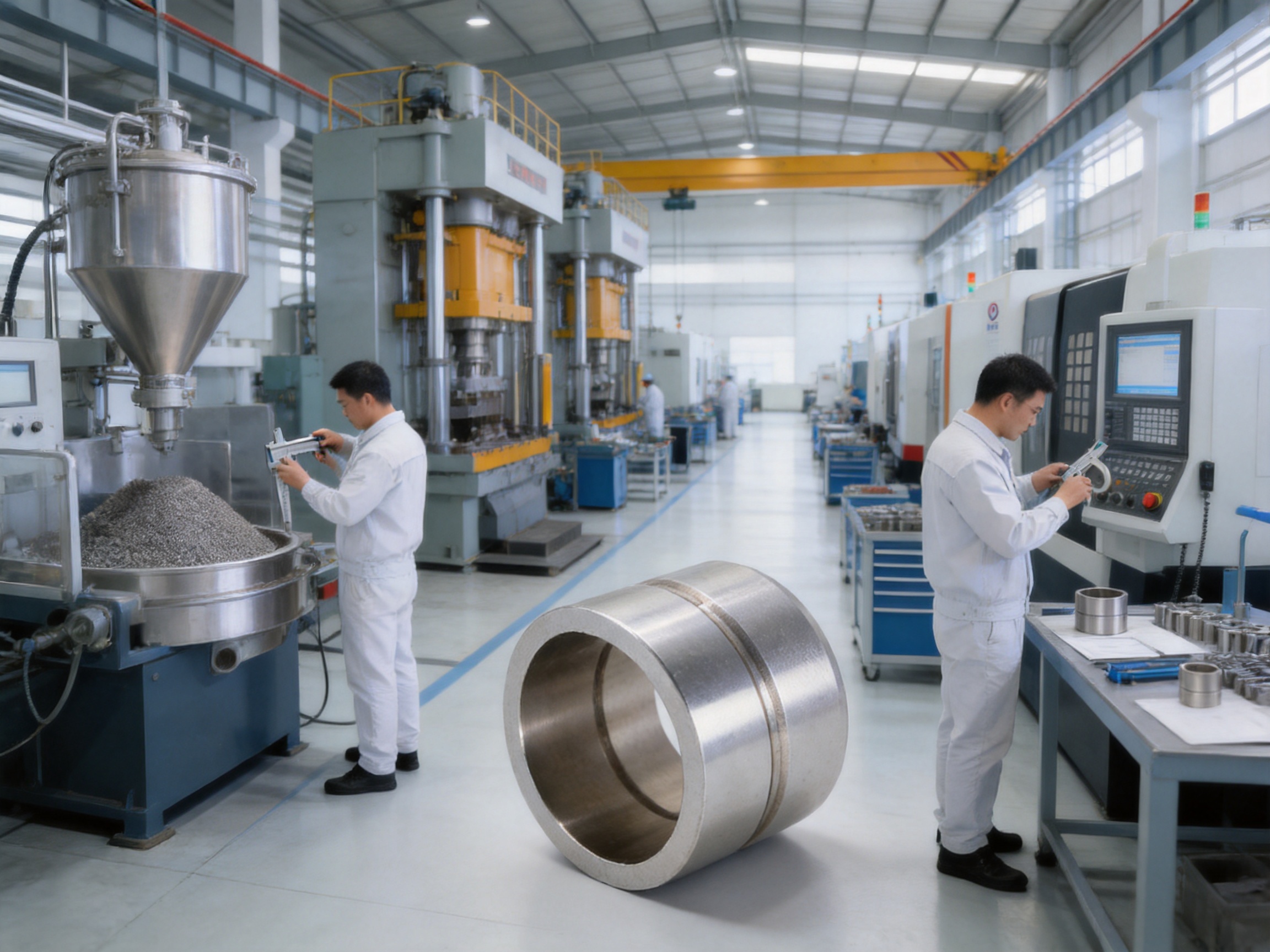
The performance of a sintered self-lubricating bushing depends not only on the material composition but also on the precision and consistency of the manufacturing process. Powder metallurgy is a highly controlled production route that transforms metal powders and lubricant additives into functional bearing components with repeatable properties. The process is especially suited for producing bushings because it can create cylindrical parts with accurate dimensions, controlled porosity, and efficient material usage.
The process begins with powder selection. Iron powder, copper powder, graphite, molybdenum disulfide, and other performance-enhancing additives must meet strict requirements for purity, particle size distribution, flowability, apparent density, and chemical consistency. Powder characteristics influence compaction behavior, sintering response, pore structure, and final mechanical strength. A strong manufacturing enterprise pays close attention to supplier qualification and incoming material inspection because stable powder quality is the foundation of stable product quality.
Next comes powder blending. The powders must be mixed uniformly so that the final bushing has consistent composition throughout its body. Inadequate mixing can cause local variations in strength, porosity, hardness, or lubrication behavior. Advanced blending equipment and controlled mixing procedures help ensure that metallic particles and solid lubricants are evenly distributed.
After blending, the powder mixture is compacted in a precision die using high-efficiency presses. Compaction pressure is carefully controlled to achieve the target green density and shape. The green compact must be strong enough for handling while retaining the designed pore network for later lubrication performance. Tooling precision is crucial because it determines the initial geometry, wall thickness, bore alignment, and dimensional repeatability of the bushing.
Sintering is the central stage of the powder metallurgy process. The compacted parts are heated in high-temperature sintering furnaces under controlled atmosphere conditions. At sintering temperature, powder particles bond through diffusion and metallurgical neck formation. The part gains strength, dimensional stability, and integrated microstructure. Furnace temperature uniformity, atmosphere composition, belt speed or cycle time, and cooling rate all influence final bearing properties.
For high-performance Fe-Cu self-lubricating bushings, sintering must create a strong alloyed matrix while preserving the functional lubricant system. Excessive temperature, insufficient temperature, poor atmosphere control, or inconsistent residence time can lead to dimensional instability, weak bonding, oxidation, or unpredictable wear behavior. Therefore, advanced sintering equipment and process control are essential.
After sintering, bushings may undergo sizing or calibration. In this step, the sintered part is pressed through precision tooling to improve dimensional accuracy, roundness, bore size, and surface finish. Calibration can also adjust density in selected zones and improve contact geometry. This is especially important for bushings, because shaft clearance directly affects friction, noise, lubrication film behavior, and service life.
Depending on customer requirements, additional machining may be performed. Precision forming machines, turning, chamfering, grooving, drilling, or special finishing operations can be used to meet drawings or samples. OEM and ODM customization is particularly important because bushing dimensions, tolerances, lubrication requirements, and installation conditions vary widely among industries.
Final inspection confirms that the finished bushings meet dimensional, mechanical, and performance specifications. Quality control may include measurement of inner diameter, outer diameter, length, wall thickness, roundness, density, hardness, radial crushing strength, oil content if applicable, surface roughness, and visual defects. Consistent inspection is essential for preventing assembly problems and ensuring reliable field performance.
Manufacturing Strengths Behind the Product
The producer of these high performance sintered self-lubricating bushings has more than two decades of experience in powder metallurgy sintering and precision machining. Established in 2001, the company has developed a strong technical foundation in powder metallurgy bushings, self-lubricating bushings, and precision sintered parts for many industrial fields. Long-term manufacturing experience matters because powder metallurgy quality depends on accumulated knowledge of materials, compaction behavior, furnace conditions, tooling design, and application feedback.
The production base covers 13,039 square meters and is equipped with advanced production and testing equipment. High-efficiency presses support stable compacting output and dimensional repeatability. High-temperature sintering furnaces provide the thermal processing capability required to create strong metallurgical bonding and consistent microstructure. Precision forming machines and machining equipment enable customized shapes and tight tolerances for customer-specific applications.
More than 150 skilled employees support production, engineering, inspection, and customer service. Skilled personnel are essential in powder metallurgy because small process deviations can influence final performance. Experienced technicians understand how to control powder feeding, pressing parameters, tooling wear, furnace operation, calibration, machining, and inspection procedures. This human expertise complements automated equipment and contributes to stable manufacturing.
The company provides OEM and ODM customized bushing solutions based on customer drawings or samples. This capability is important because high-performance bushings are rarely one-size-fits-all components. Engineers may need special inner and outer diameters, flange designs, grooves, chamfers, tolerance classes, material formulations, lubricant content, density levels, or application-specific testing. Customization allows the bushing to fit the mechanical system rather than forcing the system to adapt to a generic bearing.
Quality management is another strength. The manufacturer has passed ISO 9001:2015 and IATF 16949:2016 certifications. ISO 9001:2015 demonstrates a structured quality management system, including process control, documentation, corrective action, and continuous improvement. IATF 16949:2016 is especially important for automotive-related production because it emphasizes defect prevention, traceability, risk management, and consistent supply chain quality. These certifications help assure customers that the bushings are produced under disciplined quality systems.
The company philosophy emphasizes technology leadership, quality priority, stable manufacturing, continuous innovation, and long-term cooperation with global customers. For purchasing teams and design engineers, this means the supplier is not only a parts manufacturer but also a technical partner capable of supporting product development, performance optimization, and reliable supply.
Performance in High-Load Applications
High-load applications place severe demands on bushing materials. When radial load increases, the contact pressure between shaft and bushing rises. If the bushing material lacks compressive strength, it may deform, crack, wear rapidly, or lose clearance control. The Fe-Cu sintered alloy structure is designed to support both static and dynamic loads reliably.
Static load refers to a load that remains relatively constant or changes slowly. Examples include support pivots, hinge points, or machinery linkages holding a fixed position for long periods. Under static load, creep resistance and compressive strength are important. A metallic sintered matrix resists permanent deformation better than many polymers.
Dynamic load refers to load that changes during operation due to rotation, reciprocation, vibration, or impact. Dynamic loading can cause fatigue and progressive wear. The embedded solid lubricants reduce frictional heating and surface damage, while the metallic skeleton provides fatigue resistance. This combination helps the bushing survive repeated movement cycles.
Shock load is another important condition. Machinery may experience sudden impacts from start-stop operation, material handling, uneven torque, or external vibration. Rolling bearings can be damaged by brinelling when shock loads indent raceways. Sintered bushings distribute loads over a sliding contact area and can be more forgiving in rugged applications.
In high-load systems, proper shaft material and surface finish remain important. A hardened, ground, or properly finished shaft can improve bushing life by reducing abrasive wear and promoting stable transfer film formation. Correct clearance, alignment, and installation also help ensure that load is distributed evenly rather than concentrated at an edge.
Performance in High-Speed and High-Frequency Motion
Speed affects bearing performance through frictional heat generation. In sliding bearings, the product of pressure and velocity is often used to evaluate suitability. High speed can raise temperature, thin oil films, accelerate oxidation, and increase wear if lubrication is inadequate. High performance sintered self-lubricating bushings address this challenge through thermal conductivity, solid lubrication, and stable material design.
The copper component of the Fe-Cu alloy contributes to heat transfer, helping move heat away from the contact interface. The solid lubricant transfer film reduces friction and therefore lowers heat generation. The metallic matrix remains stable at temperatures that may challenge polymer materials. These characteristics make the bushing suitable for certain high-speed and high-frequency applications, provided that load, shaft finish, clearance, and environmental conditions are properly considered.
High-frequency reciprocating motion is especially challenging because the sliding direction changes repeatedly. Hydrodynamic lubrication may not fully develop, and boundary lubrication dominates. Graphite and molybdenum disulfide are valuable in boundary regimes because they can reduce shear without depending on a continuous oil wedge. This makes the product suitable for reciprocating mechanisms, actuators, linkages, textile machinery, packaging equipment, and other systems involving repeated directional changes.
Oscillating motion presents similar challenges. In small-angle oscillation, conventional rolling bearings may suffer from false brinelling because rolling elements vibrate over a small contact zone without full rotation. A self-lubricating bushing can be a practical alternative because sliding contact and transfer film formation are better suited to oscillation.
High-Temperature Reliability
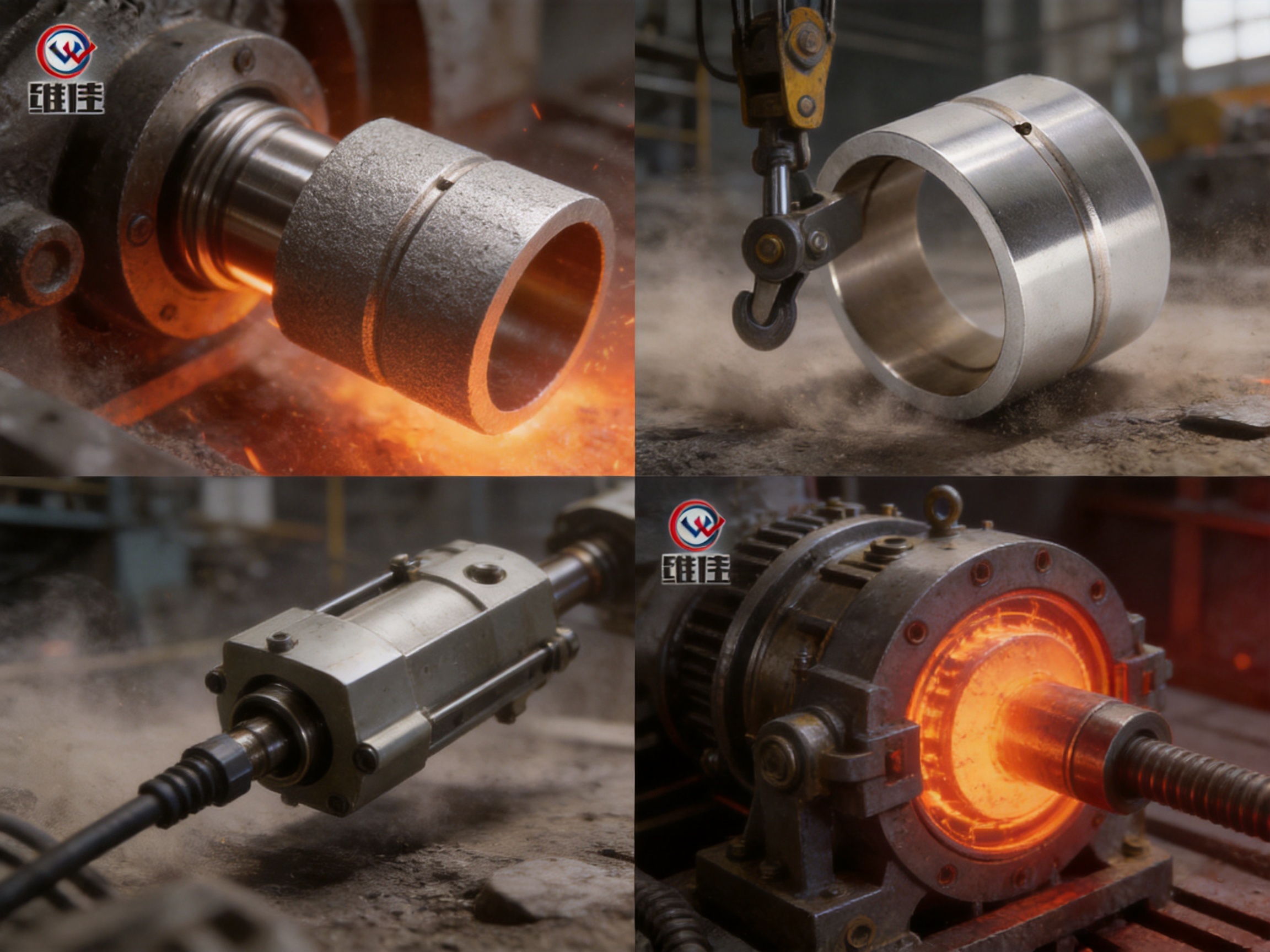
Temperature is one of the most significant factors affecting bearing life. High temperature can reduce lubricant viscosity, cause oil evaporation, oxidize grease, soften polymers, change clearances through thermal expansion, and accelerate chemical degradation. High performance sintered self-lubricating bushings are designed for stable operation in high-temperature environments where ordinary lubricated components may become unreliable.
The Fe-Cu metallic matrix provides structural stability under heat. Unlike some thermoplastic materials, it does not soften in typical high-temperature mechanical environments. Solid lubricants such as graphite and molybdenum disulfide can continue to provide lubricating action where liquid lubricants would degrade. This makes the bushing attractive for ovens, thermal processing equipment, high-temperature conveyors, engine-adjacent mechanisms, and aerospace-related assemblies.
High-temperature use still requires careful engineering. The designer should consider thermal expansion of both shaft and housing, oxidation resistance, atmosphere, load, speed, and possible lubricant behavior under specific temperature ranges. If the environment is extremely oxidizing or chemically aggressive, material selection and protective measures may need to be optimized. The value of working with an experienced powder metallurgy manufacturer is that material and process parameters can be adjusted to suit the application.
Suitability for Dusty, Corrosive, and Special Environments
Dusty environments are difficult for lubricated bearings because oil and grease can attract particles. Once trapped in the lubricant, dust can become abrasive and accelerate wear. A dry self-lubricating bushing reduces dependence on sticky external lubricants and can therefore improve reliability in agricultural equipment, construction machinery, material handling systems, woodworking equipment, cement equipment, and other dusty settings.
Corrosive environments introduce additional challenges. Corrosion can roughen bearing surfaces, increase friction, and contaminate the sliding interface. While material selection must match the specific chemical environment, powder metallurgy offers formulation flexibility. The manufacturer can evaluate whether additional alloying, impregnation, coating, or design modifications are appropriate for the operating conditions.
Radioactive or restricted-access environments increase the value of maintenance-free or low-maintenance components. In such settings, relubrication may be dangerous, costly, or impossible. A self-lubricating bushing that reduces the need for oiling can support safer and more reliable equipment operation. The simple sleeve geometry also supports compact, robust designs with fewer moving elements.
In dirty, hot, or inaccessible systems, a bearing should be judged not only by purchase cost but by total operating cost. If a low-cost component requires frequent lubrication, replacement, downtime, or labor, its true cost may be higher than a more durable self-lubricating solution. High performance sintered bushings are designed to reduce these hidden costs.
Application Areas
Industrial machinery is one of the most important application fields. Production equipment often includes shafts, pivots, rollers, linkages, conveyors, presses, pumps, valves, and actuators. Many of these components operate under load, vibration, dust, or limited maintenance conditions. Sintered self-lubricating bushings provide a practical solution for extending service intervals and improving uptime.
Automotive transmission and engine components are another important area. Vehicles require compact, durable, and consistent bearing solutions that can withstand vibration, heat, start-stop cycles, and long service life expectations. Powder metallurgy is widely used in automotive manufacturing because it supports repeatable mass production and cost-effective precision. IATF 16949 quality system certification further supports automotive customer requirements.
Aerospace high-temperature bearing applications require lightweight design discipline, reliability, and performance in demanding thermal conditions. While each aerospace application requires detailed qualification, the high-temperature capability and self-lubricating behavior of sintered metallic bushings make them relevant for mechanisms where external lubrication is limited.
High-load and high-frequency reciprocating or rotating parts are also suitable. Examples may include compressors, hydraulic equipment, textile machinery, packaging machines, automation systems, agricultural machinery, and power tools. In these applications, the ability to withstand repeated motion while maintaining low wear is essential.
Other possible uses include household appliances, office equipment, electric motors, fan systems, hinges, gear assemblies, medical equipment mechanisms, and precision mechanical devices. The exact material grade and geometry should be selected based on load, speed, temperature, shaft material, clearance, installation method, and service environment.
Design Considerations for Engineers
To achieve the best performance from high performance sintered self-lubricating bushings, engineers should evaluate the complete operating system. A bearing does not work in isolation; it interacts with the shaft, housing, load direction, speed profile, temperature, contamination, and assembly method.
Load analysis should include maximum radial load, average load, shock load, and duty cycle. If the application involves impact or vibration, safety factors should be selected accordingly. The bushing wall thickness and length should provide sufficient projected area to keep contact pressure within the recommended range.
Speed analysis should include continuous speed, peak speed, reciprocating frequency, oscillation angle, and start-stop behavior. High speed increases heat generation, so thermal dissipation and lubrication behavior must be considered. In reciprocating or oscillating applications, boundary lubrication performance becomes especially important.
Temperature analysis should include ambient temperature, frictional temperature rise, nearby heat sources, and possible thermal expansion. Bearing clearance must remain appropriate throughout the temperature range. If clearance becomes too small, seizure risk increases. If clearance becomes too large, noise, vibration, and uneven load distribution may occur.
Shaft finish is critical. A shaft that is too rough can abrade the bushing, while a shaft that is too smooth may not always support stable transfer film formation depending on materials and conditions. Appropriate hardness and surface roughness should be selected for the application. Alignment should also be controlled because misalignment concentrates load at the bushing edge.
Installation method matters. Press-fit bushings must be installed without damaging the bore or distorting the bearing. Housing bore tolerance, chamfer design, insertion tools, and lubrication during assembly may influence final bore size. After installation, the inner diameter should be checked if the application requires tight clearance control.
Environmental analysis should include dust, moisture, chemicals, radiation, cleaning agents, and exposure to abrasive particles. If corrosion or chemical attack is possible, the manufacturer should review material compatibility and recommend suitable modifications.
Customization and OEM/ODM Support
One of the strongest advantages of powder metallurgy bushing production is the ability to customize both material and geometry. Customers can provide drawings, samples, performance targets, or application descriptions. The engineering and manufacturing team can then recommend suitable dimensions, tolerances, density, lubricant content, and post-processing steps.
Custom geometry may include straight sleeve bushings, flanged bushings, stepped bushings, spherical or special profiles, lubrication grooves, holes, chamfers, or assembly features. Precision machining can be added when the required geometry cannot be achieved through pressing alone. Near-net-shape powder metallurgy reduces material waste, while secondary machining ensures critical features meet application requirements.
Custom material development may involve adjusting Fe-Cu ratios, adding solid lubricant content, changing porosity, improving strength, or optimizing wear behavior. This is useful when a standard bushing cannot meet special load, temperature, speed, or environmental requirements. The manufacturer’s experience in powder metallurgy and precision machining allows it to support such engineering adjustments.
Custom testing and quality documentation may also be provided for demanding customers. Depending on the project, inspection reports, material certificates, dimensional reports, process control documents, or performance testing may be required. Automotive and industrial customers often value traceability and documentation as much as the component itself.
Quality Control and Certification Value
Quality control is central to bushing reliability. A small dimensional error in a bushing can cause assembly difficulty, excessive clearance, high friction, noise, or premature wear. A material inconsistency can cause unpredictable life. Therefore, a disciplined quality system is essential for high-performance bearing products.
ISO 9001:2015 certification indicates that the manufacturer maintains a structured quality management system. This includes defined processes, document control, training, inspection procedures, corrective actions, internal audits, and continuous improvement. For customers, it reduces uncertainty and supports consistent supply.
IATF 16949:2016 certification is especially meaningful for automotive and other high-volume precision industries. It requires strong process control, risk-based thinking, defect prevention, traceability, and supplier management. A manufacturer operating under this system is better prepared to meet demanding customer expectations for consistency and reliability.
Testing equipment and inspection procedures help verify product conformance. Dimensional inspection ensures the bushing fits correctly in the housing and provides proper shaft clearance. Density measurement confirms compaction and sintering consistency. Hardness and strength tests help verify mechanical capability. Surface inspection identifies cracks, chips, deformation, or contamination. For self-lubricating products, lubrication-related properties may also be checked depending on specification.
Consistent quality control also supports long-term cooperation. When customers integrate a bushing into a machine, they need stable performance from batch to batch. Changes in material, density, or dimensions can affect assembly and field performance. A certified and experienced manufacturer is better positioned to maintain stable production over time.
Economic Benefits and Total Cost of Ownership
The value of high performance sintered self-lubricating bushings should be measured by total cost of ownership rather than unit price alone. A component that reduces downtime, maintenance labor, lubricant consumption, contamination risk, and replacement frequency can generate substantial long-term savings.
Oil-free or low-maintenance operation reduces lubrication labor. In large factories with many lubrication points, maintenance time can be significant. Missed lubrication can lead to sudden failures, while excessive lubrication can waste material and create contamination. Self-lubricating bushings simplify maintenance planning and reduce dependence on manual lubrication.
Long service life reduces replacement costs. Replacing a bushing may require machine shutdown, disassembly, realignment, and testing. The cost of downtime often exceeds the cost of the bearing itself. A bushing with low wear rate and strong load capacity helps protect production continuity.
Reduced seizure risk protects surrounding components. When a bushing seizes, it can damage the shaft, housing, motor, linkage, or drive system. Preventing seizure helps avoid secondary damage and emergency repairs. The embedded solid lubricants in high performance sintered bushings support safer operation under marginal lubrication conditions.
Near-net-shape manufacturing can also improve cost efficiency. Powder metallurgy produces parts close to final shape, reducing machining waste. For high-volume production, this can provide consistent quality and economical output. For customized production, tooling and process design can be optimized according to customer demand.
Sustainability and Maintenance Reduction
Self-lubricating bushings can support more sustainable machinery operation by reducing lubricant consumption and waste. Traditional bearing maintenance may involve grease cartridges, oil spills, cleaning solvents, contaminated rags, and disposal of used lubricants. Reducing the need for external lubrication can help lower environmental impact and simplify workplace cleanliness.
Powder metallurgy itself can be material-efficient because it forms parts close to final dimensions. Less machining means less metal scrap, lower cutting fluid use, and fewer processing steps. In many applications, the ability to produce a bushing directly from powder with only limited finishing is an important manufacturing advantage.
Longer service life also contributes to sustainability. Components that last longer reduce replacement frequency, transportation, inventory, and waste. Machines that require less maintenance may operate more efficiently and with fewer unplanned shutdowns.
Q&A Section
What is a sintered self-lubricating bushing?
A sintered self-lubricating bushing is a sleeve bearing made from compacted and sintered metal powders with integrated lubricating phases. Its structure can store or generate lubrication at the sliding surface, reducing friction and wear without relying entirely on external oil or grease.
What materials are used in these high performance bushings?
They are made from a high-performance Fe-Cu sintered alloy matrix embedded with dry solid lubricants such as graphite and molybdenum disulfide. The metal matrix provides strength and load capacity, while the solid lubricants reduce friction and support long service life.
Why are graphite and molybdenum disulfide important?
Graphite and molybdenum disulfide have layered structures that shear easily during sliding. This helps form a low-friction transfer film on the bearing and shaft surfaces, reducing wear and preventing direct metal-to-metal contact.
Can these bushings operate without oil?
Yes, they are designed for oil-free or low-maintenance operation because the solid lubricants are built into the bearing structure. In some applications, additional oil impregnation or lubrication may still be used, but the product is especially valuable where external lubrication is difficult or undesirable.
What are the main advantages compared with ordinary bronze bushings?
Ordinary bronze bushings often require regular external lubrication. High performance sintered self-lubricating bushings reduce that dependence, provide reliable solid lubrication, and can be manufactured with controlled porosity and customized material properties through powder metallurgy.
Are these bushings suitable for high-temperature applications?
Yes, the Fe-Cu metallic matrix and solid lubricant system provide good thermal stability. They are suitable for many high-temperature environments where oils, greases, or polymer bearings may degrade. Exact suitability should be confirmed based on the specific temperature, load, speed, and atmosphere.
Can they handle high loads?
Yes, the sintered Fe-Cu alloy structure provides strong compressive strength and supports both static and dynamic loads. They are designed for demanding applications involving heavy load, shock, reciprocating movement, rotating motion, or oscillation.
What industries commonly use these bushings?
Common applications include industrial machinery, automotive transmission and engine components, aerospace-related high-temperature mechanisms, high-load reciprocating systems, rotating equipment, oscillating joints, and machinery exposed to dust or limited maintenance access.
Can the bushings be customized?
Yes, OEM and ODM customization is available based on drawings, samples, or application requirements. Customization may include dimensions, tolerances, material formulation, lubricant content, density, grooves, holes, flanges, chamfers, and precision machining.
Why does powder metallurgy improve manufacturing efficiency?
Powder metallurgy forms parts close to final shape, reducing material waste and machining time. It also allows precise control of porosity, density, composition, and lubricant distribution, which are essential for self-lubricating bearing performance.
What quality certifications support product reliability?
The manufacturer operates under ISO 9001:2015 and IATF 16949:2016 quality management systems. These certifications support process control, traceability, defect prevention, and consistent production quality, especially for industrial and automotive customers.
Conclusion
High performance sintered self-lubricating bushings provide a powerful combination of strength, wear resistance, thermal stability, and low-maintenance operation. Their Fe-Cu sintered alloy matrix delivers mechanical reliability, while embedded graphite and molybdenum disulfide form a low-shear transfer film that reduces friction and extends service life. This makes them suitable for high-load, high-speed, high-temperature, dusty, corrosive, radioactive, and maintenance-restricted environments.
Compared with conventional bronze bushings, polymer bearings, rolling bearings, standard oil-impregnated sleeves, and some composite alternatives, these bushings offer a balanced solution for engineers who need durability, compactness, and lubrication reliability. Their ability to operate without frequent oiling reduces maintenance costs, lowers seizure risk, and supports cleaner equipment operation.
The manufacturing strength behind the product is equally important. Advanced powder metallurgy, high-efficiency pressing, controlled high-temperature sintering, precision forming, secondary machining, strict inspection, and certified quality management all contribute to consistent performance. With more than 20 years of experience, a 13,039-square-meter production base, advanced equipment, over 150 skilled employees, and OEM/ODM customization capabilities, the manufacturer is well positioned to support global customers with reliable bushing solutions.
For machinery designers, maintenance managers, and purchasing teams seeking longer service life, lower maintenance burden, and dependable operation in demanding environments, high performance sintered self-lubricating bushings represent a practical and technically advanced bearing choice.
References
1. German, R. M. Powder Metallurgy and Particulate Materials Processing. Metal Powder Industries Federation.
2. ASM International. ASM Handbook, Volume 7: Powder Metal Technologies and Applications.
3. Stachowiak, G. W., and Batchelor, A. W. Engineering Tribology. Butterworth-Heinemann.
4. Neale, M. J. The Tribology Handbook. Butterworth-Heinemann.
5. ISO 9001:2015. Quality Management Systems Requirements. International Organization for Standardization.
6. IATF 16949:2016. Quality Management System Requirements for Automotive Production and Relevant Service Parts Organizations.
7. Sliney, H. E. Solid Lubricants and Self-Lubricating Solids in Tribology. Technical literature on high-temperature sliding materials.
Product: High Performance Sintered Self-lubricating Bushings

Related products
-
-
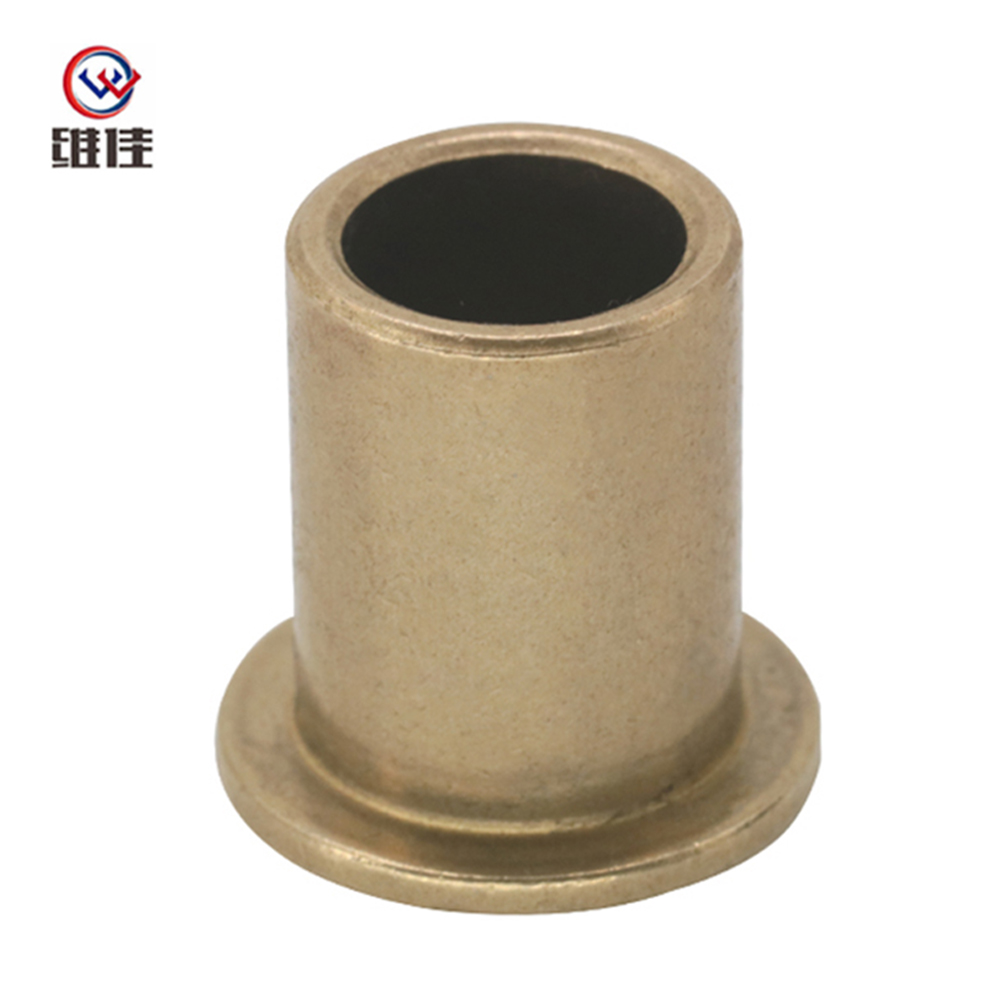
Our sintered bronze self-lubricating bearings are engineered for demanding industrial applications where traditional lubrication is impractical. Designed with advanced powder metallurgy technology, th...
See Details -
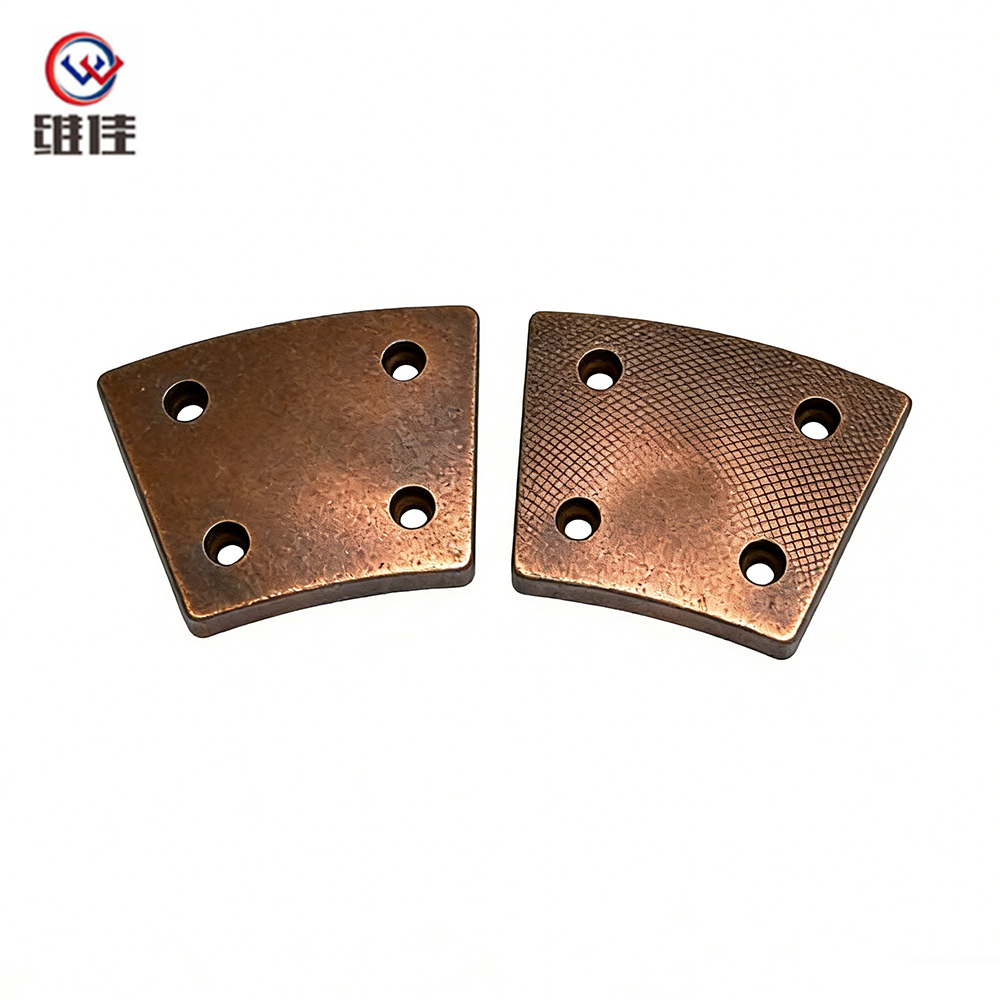
Description: 79.5×62×7.3mm copper-based brake pad with 4-hole design. Density 6.2g/cm³, weight 195g. Free from graphite segregation, cracks, and defects. Ideal for heavy-duty industrial braking system...
See Details
Copyright © Jiande Welfine Technology Co., Ltd. All Rights Reserved. Custom Self-lubricating Sintered Bushing Manufacturers
